How Water Filters Work: Complete Technology Guide
Understanding the science behind water filtration technologies—from activated carbon adsorption to reverse osmosis membranes
Water filters use distinct physical and chemical processes to remove specific contaminants. No single technology removes everything—understanding how each filtration method works helps you choose the right system for your water quality issues. This comprehensive guide breaks down the science behind carbon filters, reverse osmosis systems, UV purification, ion exchange, and mechanical filtration to help you make informed decisions about protecting your family's water supply.
Activated Carbon Filtration (Adsorption)
How Carbon Filters Work
Activated carbon is the most widely used filtration media in residential water treatment. The "activation" process creates millions of microscopic pores in carbon material (typically coconut shell, coal, or wood), increasing surface area to 500-1500 m²/gram—equivalent to 100 football fields of surface area in a single gram of carbon. This massive surface area enables adsorption: contaminant molecules chemically bond to carbon surfaces as water passes through.
What Carbon Removes Effectively (≥90%)
- • Chlorine and chloramines (taste/odor)
- • VOCs (volatile organic compounds) - benzene, toluene
- • Pesticides and herbicides
- • Trihalomethanes (THMs) - disinfection byproducts
- • Some industrial solvents and pharmaceuticals
- • Radon (gaseous form)
Carbon Block vs Granular Activated Carbon (GAC)
- • Higher density = better contaminant contact
- • Micron-rated for particle removal (0.5-5 microns)
- • Slower flow rate but superior performance
- • Under-sink and countertop systems
- • Faster water flow, more volume capacity
- • Less contact time = lower removal rates
- • Used in whole house systems
- • Better for high-flow applications
Carbon filters saturate over time as adsorption sites fill with trapped contaminants. Once saturated, contaminants pass through unfiltered or leach back into water. Replace on schedule (6-18 months) to maintain effectiveness. See our filter maintenance guide for detailed replacement schedules.
Best Uses for Carbon Filtration
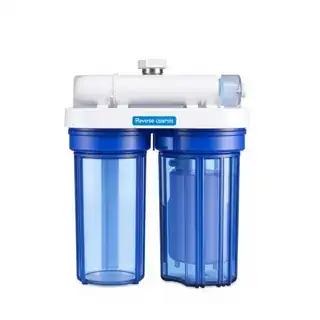
Reverse Osmosis (RO) - Membrane Filtration
The Science of Reverse Osmosis
Reverse osmosis is the most comprehensive filtration technology available for residential use. RO systems use household water pressure (40-80 PSI) to force water molecules through semi-permeable membranes with pore sizes of 0.0001 microns—approximately 1/1,000,000th the diameter of a human hair. This microscopic filtration physically blocks dissolved solids, heavy metals, microorganisms, and nearly all contaminants larger than water molecules themselves. The result: 95-99% removal of total dissolved solids (TDS) and virtually all health-threatening contaminants.
What RO Removes (95-99%)
- • Lead, arsenic, mercury, chromium-6
- • Fluoride (90-95% removal)
- • Nitrates and nitrites
- • TDS (total dissolved solids) - salts, minerals
- • Radium, uranium, barium
- • Pharmaceutical residues and hormones
- • Bacteria, viruses, parasites (with pre-filtration)
- • PFAS ("forever chemicals") 90-99%
Multi-Stage RO Process
Removes dirt, rust, sediment that would clog membrane
Removes chlorine that degrades RO membrane
Core filtration - blocks 95-99% of contaminants
Final polishing for taste and odor
Adds back healthy minerals for taste
RO Advantages
- • Most comprehensive contaminant removal available
- • Effective against dissolved solids carbon can't remove
- • Long membrane life (2-3 years with proper pre-filtration)
- • Removes virtually all known waterborne pathogens
RO Considerations
- • Slow filtration rate (50-75 gallons/day typical)
- • Water waste: 2-4 gallons rejected per 1 gallon produced
- • Removes beneficial minerals (remineralization option)
- • Requires storage tank due to slow production
- • Higher initial cost ($200-500 typical)
When You Need Reverse Osmosis
See our reverse osmosis systems comparison for certified product recommendations.
UV (Ultraviolet) Purification - Microorganism Destruction
How UV Sterilization Works
UV purification uses ultraviolet light at 254 nanometers wavelength—the germicidal spectrum that destroys DNA and RNA in microorganisms. As water flows past the UV bulb in a clear chamber, UV-C radiation penetrates bacterial cell walls and scrambles genetic material, preventing reproduction and causing immediate cell death. UV achieves 99.99% kill rates for bacteria, viruses, and parasites without chemicals, taste changes, or harmful byproducts.
What UV Destroys (99.99%)
- • E. coli and coliform bacteria
- • Salmonella, Shigella, Legionella
- • Cryptosporidium and Giardia cysts
- • Hepatitis, Norovirus, Rotavirus
- • All waterborne pathogens and parasites
UV Limitations
- • Does NOT remove: Chemicals, heavy metals, sediment, hardness
- • Requires pre-filtration for sediment (blocks UV light)
- • No residual protection after treatment
- • Annual bulb replacement required ($60-100)
- • Electricity required (runs continuously)
UV System Requirements
- • Pre-filtration mandatory: 5-micron sediment filter minimum to ensure water clarity
- • Iron/manganese removal: Levels >0.3 ppm block UV light penetration
- • Annual bulb replacement: UV intensity decreases over time (typical lifespan: 9,000 hours)
- • Hardness control: Mineral buildup on quartz sleeve reduces UV transmission
When UV Purification is Essential
UV is nearly always used in combination with well water treatment systems alongside sediment and carbon filters.
Ion Exchange & Water Softening
How Ion Exchange Works
Ion exchange uses resin beads charged with sodium or potassium ions. As hard water flows through the resin tank, hardness minerals (calcium and magnesium ions) are attracted to and captured by the resin, while sodium ions are released into the water—literally an "exchange" of ions. This process completely removes scale-causing minerals that damage appliances and plumbing.
What Ion Exchange Removes
- • Calcium and magnesium (hardness minerals)
- • Some heavy metals (barium, radium in limited amounts)
- • Iron and manganese (with proper pre-treatment)
- • Prevents scale buildup in pipes and appliances
Benefits of Softened Water
- • Extends appliance lifespan by 3-5 years
- • 30-50% energy savings on water heaters
- • Softer skin and hair (no mineral residue)
- • 50-75% less soap and detergent needed
- • No white spots on dishes or shower doors
- • Sodium addition: Each grain of hardness removed adds ~8 mg/L sodium. People on low-sodium diets should use potassium chloride instead.
- • Drinking water bypass: Many homeowners bypass kitchen tap from softener or use RO for drinking water
- • Regeneration required: Salt-based systems need periodic regeneration (typically every 3-7 days)
- • Salt deliveries: Budget $5-10/month for salt/potassium
When You Need a Water Softener
See our top water softener recommendations and complete hard water solutions guide.
Mechanical Filtration (Sediment Filters)
Physical Barrier Filtration
Mechanical filters are physical barriers that trap particles based solely on size. These filters use pleated fabric, spun polypropylene, or cellulose media with precise pore sizes measured in microns (1 micron = 0.001 millimeter). Water flows through the filter media, and particles larger than the micron rating are physically blocked. This is the simplest, most cost-effective filtration for removing visible sediment, rust, sand, and dirt.
Micron Ratings Explained
Removes visible particles: sand, silt, large sediment. Used as pre-filtration for well water and whole house systems.
Removes dirt, rust, debris. Most common pre-filter size for protecting RO membranes and carbon filters.
Removes cysts (Cryptosporidium, Giardia) and most bacteria. Often used in final stage mechanical filtration.
Removes smaller bacteria and cysts. Used in premium carbon block filters rated for health protection.
Common Applications
- • Well water pre-treatment (50-5 microns)
- • RO system pre-filters (5 microns standard)
- • Whole house sediment filters (5-20 microns)
- • Protecting appliances and fixtures
Maintenance
- • Replace every 6-12 months (varies by sediment load)
- • Reduced flow rate signals clogging
- • Cost: $5-30 per filter depending on size
- • Most affordable filter type to maintain
Choosing the Right Technology for Your Water
| Water Issue | Best Technology | Typical Cost | Effectiveness |
|---|---|---|---|
| Chlorine taste/odor | Activated carbon | $25-400 | 95-99% |
| Lead, heavy metals | RO or NSF 53 carbon | $200-500 | 95-99% |
| Bacteria, parasites | UV purification | $300-800 | 99.99% |
| Fluoride, TDS, arsenic | Reverse osmosis | $200-500 | 90-98% |
| Hardness minerals | Ion exchange softener | $400-2,000 | 100% |
| Sediment, rust, dirt | Mechanical filter | $30-200 | 99% |
| PFAS forever chemicals | RO or specialty carbon | $250-600 | 90-99% |
Most comprehensive systems combine multiple technologies. For example, well water systems typically use sediment + carbon + UV. See our complete filter selection guide for personalized recommendations.
One Pick for Each Technology
Exact products we link to, one per filtration method covered above. Check the current price before you buy.
Clearly Filtered Water Pitcher with Affinity Filter
Clearly Filtered Water Pitcher with Affinity Filter
Gravity-fed carbon and ion-exchange media in a pitcher. The simplest way to try filtration with no installation.
Aquasana AQ-5200 Claryum 2-Stage Under-Sink Filter
Aquasana AQ-5200 Claryum 2-Stage Under-Sink Filter
Pressurized carbon-block filtration under the sink, with longer contact time than a pitcher and a dedicated faucet.

iSpring RCC7AK 6-Stage RO System
iSpring RCC7AK 6-Stage RO System
A membrane system with carbon pre-filters and a remineralization stage for households that want dissolved contaminants reduced at the kitchen tap.
Compare sizing, treatment options and ongoing costs in our best reverse osmosis systems guide.