Fluoride levels explained
Four numbers come up again and again. They mean very different things, so it helps to see them side by side.
| Level | What it is | Status |
|---|---|---|
| 0.7 mg/L | U.S. Public Health Service recommendation for fluoridated water | Recommendation |
| 1.5 mg/L | World Health Organization guideline; NTP's level of concern for children's IQ | Guideline |
| 2.0 mg/L | EPA secondary standard to limit tooth staining (dental fluorosis) | Not enforceable |
| 4.0 mg/L | EPA maximum contaminant level to prevent skeletal fluorosis | Enforceable |
Utilities that go over the 2.0 mg/L secondary standard must send customers a special notice. See the EPA chemical contaminant rules for the full list of limits.
What the science says right now
- Teeth: fluoride at about 0.7 mg/L helps prevent tooth decay. Too much while teeth are forming can cause dental fluorosis, usually faint white spots.
- Bones: years of drinking water above 4 mg/L can cause skeletal fluorosis, which stiffens joints. This is the basis of the EPA limit.
- Children's IQ: the 2024 National Toxicology Program review found, with moderate confidence, that levels above 1.5 mg/L are linked to lower IQ in children. It could not say whether 0.7 mg/L has an effect. Most of the studies came from outside the U.S., at higher levels.
- Federal review: EPA began a fast-tracked review of fluoride's health risks in January 2026. The 4.0 mg/L limit stays in force until EPA changes it.
- State action: Utah and Florida banned adding fluoride to public water in 2025. Elsewhere, the choice is still made by states and local water systems.
For a deeper look at the debate, read fluoride controversy and science.
City water vs well water
City water: if your utility adds fluoride, the level is usually close to 0.7 mg/L, and it's listed in the annual water quality report. You can look up your area in our local water quality guide.
Private wells: fluoride dissolves naturally from some rocks, and certain wells exceed 2 or even 4 mg/L. Nobody tests a private well for you. The EPA private wells page explains how to find a certified lab.
If your well tests above 2 mg/L and young children drink the water, talk to your dentist or pediatrician and use treated or low-fluoride water for drinking and formula until you have a fix.
RO systems to compare for fluoride
Reverse osmosis is the most practical way to remove fluoride at home. Here are two under-sink systems we point readers to.
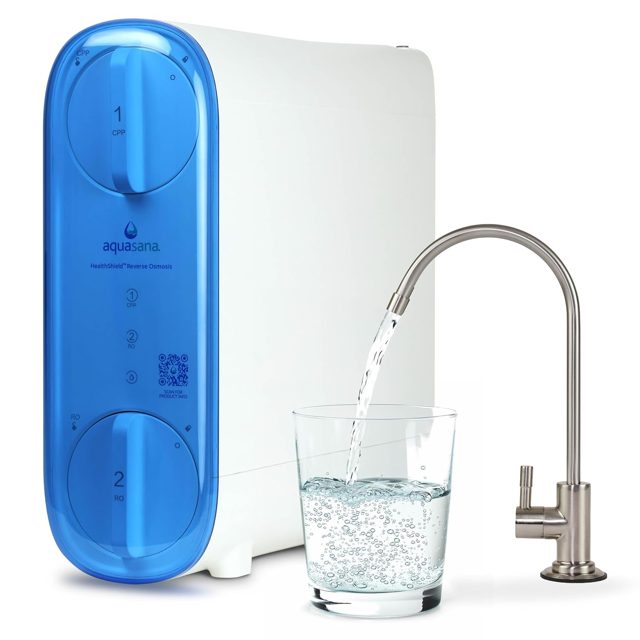
Aquasana Tankless Reverse Osmosis System (800 GPD)
Aquasana Tankless Reverse Osmosis System (800 GPD)
Best for: City or well water where you want fluoride, lead and arsenic reduced at the kitchen tap
Aquasana's performance data sheet for this tankless model (AQ-HSRO800) shows 95.72% fluoride reduction from an 8 mg/L test under NSF/ANSI 58, and the system is IAPMO certified for the claims on that sheet. It has no storage tank, but it needs a power outlet and at least 60 psi of water pressure.
iSpring RCC7AK 6-Stage RO System
iSpring RCC7AK 6-Stage RO System
A lower-cost 6-stage RO system with a remineralization stage. RO membranes usually reject most fluoride, but NSF's listing for this model names TDS reduction only, so lab-test the RO tap for fluoride after installing.
Compare sizing, treatment options and ongoing costs in our best reverse osmosis systems guide.
Prefer no plumbing? Countertop RO units and distillers are covered in our countertop filters guide and water distillers guide. See all picks in the best fluoride water filters.
Fluoride removal methods compared
| Method | Works on | Watch out for |
|---|---|---|
| Reverse osmosis | Usually removes most fluoride | Look for an NSF/ANSI 58 fluoride claim; some water goes to drain |
| Distillation | Removes nearly all fluoride | Slow, uses electricity, small batches |
| Activated alumina | Fluoride, plus some arsenic | Works best in slightly acidic water; media wears out |
| Bone char | Fluoride | Capacity drops over time; check the filter's test data |
| Carbon pitchers and fridge filters | Not designed for fluoride | Only trust a listing that names fluoride for the exact model |
| Boiling | Does not remove fluoride | Concentrates it slightly |
Learn more in does reverse osmosis remove fluoride, do water filters remove fluoride and our step-by-step guide to removing fluoride from water.
How to read a fluoride claim
- NSF/ANSI 58 fluoride reduction is the claim to look for on RO systems. The test starts at 8 mg/L and the system must bring it down to 1.5 mg/L or less.
- Check the certifier's listing from NSF, WQA, IAPMO or CSA for your exact model, not just the box.
- "Up to 99%" marketing without a listing or data sheet is weak proof. Ask the brand for its performance data sheet.
- Bottled water varies widely. See does bottled water have fluoride.
How to check your system is working
- Note your starting fluoride level from the water report or a lab test.
- Install the system and flush it as the manual says.
- Test water from the filtered tap with a lab or a fluoride-specific test kit.
- Retest every year and after you replace the membrane.
A TDS meter is a quick check that an RO membrane still works, but it can't measure fluoride. Compare test options in our water test kits guide.
Bottom line
Fluoridated city water sits far below the EPA limit, so filtering it is a personal choice. If you want less fluoride, or your well runs high, reverse osmosis at the kitchen tap is the most practical fix. Choose a system with a fluoride claim on its listing, then test the filtered water. Compare more systems in our best reverse osmosis systems guide, and see the other common water contaminants.