Where arsenic in water comes from
Arsenic is part of the earth's crust. As groundwater moves through certain rocks, it dissolves small amounts. Old arsenic pesticides, mining waste and coal ash can add more in some places.
- Private wells carry the most risk. A USGS and CDC study estimated about 2.1 million people in the lower 48 states may use wells with arsenic above 10 parts per billion.
- Higher-risk regions include parts of New England, the upper Midwest and much of the West.
- Public water must meet the EPA limit and report arsenic in its annual water quality report.
Well owners should read our full guide to arsenic in well water.
Health effects and the EPA limit
- EPA limit: 0.010 mg/L (10 parts per billion) for public water systems; the health goal is zero. See the EPA chemical contaminant rules.
- Stricter state limit: New Jersey enforces 5 parts per billion.
- Cancer: long-term exposure is linked to skin, bladder and lung cancer.
- Other effects: skin thickening and color changes, heart disease and diabetes.
Arsenic has no taste, smell or color. See warning signs in arsenic in drinking water symptoms.
How to test for arsenic
- Use a state-certified lab. Ask for total arsenic. On a well, add speciation to see how much is arsenic III and arsenic V.
- Add related tests. Iron, manganese, pH, sulfate and phosphate all affect which treatment will work.
- Retest over time. Well arsenic can change, so test every few years, and yearly once you treat.
- Test the treated tap after installing a system to confirm it works.
The EPA private wells page explains how to find a lab. Compare lab and home options in our water test kits guide.
Arsenic III vs arsenic V
Arsenic V (arsenate) carries a charge, so RO and most arsenic media remove it well. Chlorinated city water and oxygen-rich groundwater usually carry this form.
Arsenic III (arsenite) is uncharged and slips through RO much more easily. It's common in deep, low-oxygen wells, often alongside iron, manganese or a sulfur smell. It usually needs to be oxidized to arsenic V first, for example with chlorine or a manganese-dioxide filter.
Chlorine damages RO membranes. If you oxidize with chlorine, a carbon stage must remove the leftover chlorine before the membrane. See the full setup in does reverse osmosis remove arsenic.
RO systems to compare for arsenic
These drinking-water RO systems publish arsenic V results. On a well with arsenic III, add the oxidation step above.
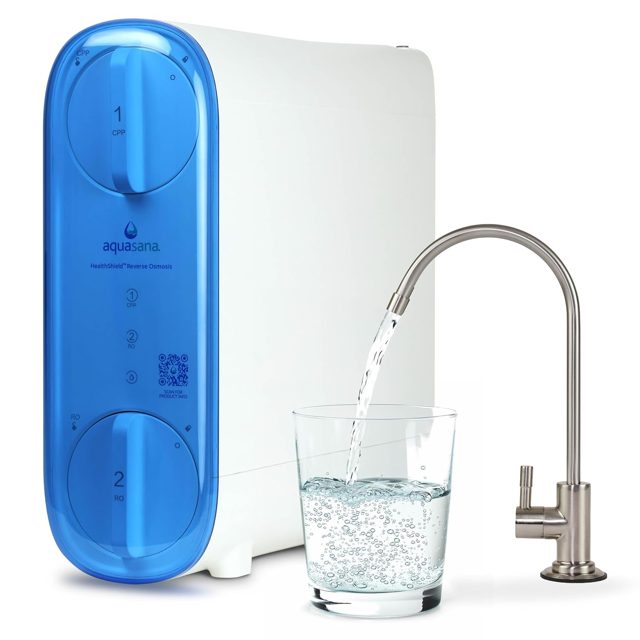
Aquasana Tankless Reverse Osmosis System (800 GPD)
Aquasana Tankless Reverse Osmosis System (800 GPD)
Best for: City water, or well water after arsenic III has been oxidized
Aquasana's performance data sheet for this tankless model (AQ-HSRO800) lists 96.42% pentavalent arsenic reduction from a 0.050 mg/L test under NSF/ANSI 58, plus lead and fluoride reduction. The sheet says it's for water with a free chlorine residual or arsenic already in the pentavalent form.
iSpring RCC7AK 6-Stage RO System
iSpring RCC7AK 6-Stage RO System
iSpring's manual reports 97.9% pentavalent arsenic reduction (50 ppb in, under 10 ppb out) in testing to NSF/ANSI 58. NSF's own listing for this model names TDS reduction, so confirm the arsenic claim for the exact version you buy, and lab-test the RO tap after installing.
Compare sizing, treatment options and ongoing costs in our best reverse osmosis systems guide.
See more options in the best arsenic filters and our best filter for arsenic guide.
Arsenic treatment options compared
| Method | Works on | Watch out for |
|---|---|---|
| Under-sink reverse osmosis | Arsenic V; arsenic III after oxidation | Treats one tap; needs filter and membrane changes |
| Iron-based adsorptive media | Mostly arsenic V; can be whole house | Phosphate, silica and pH reduce capacity |
| Activated alumina | Arsenic V and fluoride | Works best in slightly acidic water |
| Anion exchange | Arsenic V | Sulfate competes; an exhausted bed can release arsenic |
| Distillation | Both forms | Slow and uses electricity |
| Carbon pitchers and fridge filters | Not designed for arsenic | Only trust a listing that names arsenic |
| Boiling | Does not remove arsenic | Concentrates it slightly |
For a step-by-step plan, read how to remove arsenic from water. Whole-house arsenic systems should be designed from a full test; compare well water filters for options.
Bottom line
If you're on a well, test for arsenic: it's common, invisible and linked to cancer. Treat drinking water with an RO system that lists arsenic reduction, oxidize first if you have arsenic III, and prove the result with a lab test. Compare full rankings in our best reverse osmosis systems guide, and see the other common water contaminants.