Emergency filter types
Most households need two types: a home-base filter and a portable backup. See our emergency water treatment guide for boiling and disinfection steps.
Gravity filters (home base)
Pour water in the top chamber and gravity does the rest. No power, pressure or plumbing needed, and they fill containers for the whole household.
Straw and bottle filters (evacuation)
Light and cheap for a go-bag. Most target bacteria and protozoa; check whether a model is rated for viruses or chemicals.
Pump and squeeze filters (extended use)
Fill bottles and pots from streams or stored water. Some can be backflushed or cleaned in the field to restore flow.
Whole-house filters (pressure on)
Treat every tap day to day while pressure lasts. They do not work in a full outage and don't replace boil-water instructions.
Recommended picks
Check each manufacturer's current test data for the contaminants that matter to you.
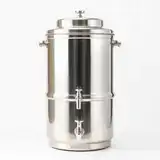
Berkey Big Berkey Gravity Filter
Berkey Big Berkey Gravity Filter
Works without power or water pressure and fills containers for the household during outages.
ProOne Big+ Stainless Gravity Filter
ProOne Big+ Stainless Gravity Filter
A stainless gravity system for households comparing filter elements and replacement costs.
Portable backups for each go-bag
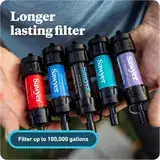
Sawyer Mini
Sawyer Mini
Small enough for every go-bag and can fill bottles, not just sip through. It targets bacteria and protozoa, not viruses or dissolved chemicals, so disinfect water from doubtful sources as well.
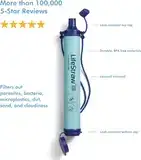
LifeStraw Personal
LifeStraw Personal
A no-setup straw filter for one person. You drink straight through it, so it can't fill containers for the family. It targets bacteria and protozoa, not viruses or chemicals.
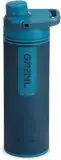
GRAYL UltraPress
GRAYL UltraPress
A bottle you press to purify, for travel or evacuation where viruses are a concern. Check the exact cartridge's rated limits and capacity; it doesn't desalinate or make floodwater or chemical spills safe.
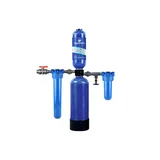
Aquasana Rhino Whole House Water Filter
Aquasana Rhino Whole House Water Filter
For everyday city water at every tap while pressure is on. Keep a gravity filter and stored water for full outages.
Compare sizing, treatment options and ongoing costs in our best whole house water filters guide.
How much water to store
Start from the CDC and Ready.gov baseline of one gallon per person per day, then add water for pets, hot weather, illness and infants. A filter stretches your supply; it doesn't replace it.
| Household | 3 days | 2 weeks |
|---|---|---|
| 1 person | 3 gallons | 14 gallons |
| 2 people | 6 gallons | 28 gallons |
| 4 people | 12 gallons | 56 gallons |
| 6 people | 18 gallons | 84 gallons |
See how long you can store water for containers and rotation, and how to disinfect a storage tank for larger supplies.
Three kit tiers
Starter
- Stored water for 3+ days
- A personal filter per person
- Water purification tablets
- Clean storage containers
Family
- Everything in Starter
- A gravity filter for home
- Spare filter elements
- Stackable water storage
Comprehensive
- Everything in Family
- Two-week stored water
- Rain collection with pre-filter
- Whole-house filter for daily use
What you can and cannot filter
| Source | Main risks | What to do | Verdict |
|---|---|---|---|
| Tap water under boil advisory | Bacteria, cysts, possibly viruses | Follow utility instructions; boil or use a rated purifier | Use with care |
| Rainwater | Bacteria, debris, roof contaminants | Pre-filter, filter, then disinfect | Use with care |
| Stream or lake | Parasites, bacteria, sediment | Settle, filter, then disinfect | Use with care |
| Pool water | Treatment chemicals | Use for flushing and cleaning only | Not for drinking |
| Floodwater | Sewage, fuel, chemicals | Do not drink; use stored water | Avoid |
| Seawater | Salt | Requires desalination | Not filterable |
| Chemical spill runoff | Industrial chemicals | Do not use | Avoid |
Emergency scenarios
Boil-water advisory
Follow your utility's instructions; boiling is the standard step. A filter tested for bacteria and cysts adds protection but doesn't override official guidance.
Hurricane, flood or earthquake
Rely on stored water first, then a gravity filter with disinfection for clean natural sources. Never drink floodwater.
Chemical contamination
Portable filters are not designed for chemical spills. Use stored or supplied water until officials say tap water is safe. See PFAS contamination for longer-term chemical concerns.
Extended power outage
Gravity and manual filters keep working. Well owners lose their pump without power, so stored water matters even more.
Storage and maintenance
- Test your gravity filter and portable filters at least once a year so you know how to use them.
- Dry used filters completely before storing; never seal them away wet.
- Keep spare elements and purification tablets, and check expiration dates.
- Rotate stored water following our water storage guide.
- Move stored water and filters out of freezing spaces in winter.
A filter that has failed or frozen can crack and pass untreated water. Follow the manufacturer's integrity test and replace damaged filters.