How to Choose a Water Filter: Complete Buying Guide
Start with what is in your water, not with a brand. This guide walks you through testing first, deciding between a drinking-water filter and whole-home treatment, and checking a model's certifications before you buy.
Turn your water results into a shortlist
Choose a treatment category before choosing a brand or deal.
- Identify your water source and verify the concern with appropriate testing.
- Decide between drinking-water treatment and coverage for every tap.
- Verify the exact model’s reduction claims, installation fit and replacement costs.
Not Sure Which Filter You Need?
Our interactive quiz asks about your water source, concerns, budget, and living situation to recommend the perfect filter in under 2 minutes.
Take the Filter QuizOn This Page
Test Your Water First
Before investing in any filter, you need to know what's in your water. Different contaminants require different filtration technologies. Without testing, you might buy an expensive system that doesn't address your specific problems.
Why Testing Matters
- • City water may contain lead from pipes, chlorine, and disinfection byproducts
- • Well water often has arsenic, bacteria, iron, and hardness minerals
- • Geographic location affects contaminants (e.g., Phoenix has high TDS)
- • Basic carbon filters won't remove heavy metals or fluoride
Testing Options
DIY Test Kits
Quick home testing for basic parameters
Cost: $20-50 | Time: 5-10 min
Best for: Initial screening
Lab Testing
Comprehensive analysis of 100+ contaminants
Cost: $200-400 | Time: 1-2 weeks
Best for: Accurate contaminant identification
Match Filter Type to Your Needs
Quick Links: Pitchers • Under-Sink • RO Systems • Whole-House • Softeners
Water Filter Pitchers
Best For
- ✓ Renters and apartments
- ✓ Improving taste and odor
- ✓ Small households (1-2 people)
- ✓ Budget-conscious buyers
Limitations
- ✗ Requires frequent refilling
- ✗ Slow filtration (minutes)
- ✗ Limited contaminant removal
- ✗ Higher long-term filter costs
What They Remove: Chlorine, some heavy metals (lead, mercury), taste/odor compounds. Advanced models like ZeroWater remove TDS and fluoride.
→ Compare Best Water PitchersFaucet Filters
Best For
- ✓ Instant filtered water on-demand
- ✓ Apartments (no drilling)
- ✓ Families of 3-4
- ✓ Quick installation
Limitations
- ✗ May not fit all faucets
- ✗ Visible on countertop
- ✗ Slower flow rate
- ✗ Moderate filter replacement costs
What They Remove: Chlorine, lead, cyst, VOCs, some pesticides. Similar to pitchers but with higher flow capacity.
→ Compare Best Faucet FiltersUnder-Sink Filters
Best For
- ✓ Homeowners
- ✓ High daily water usage
- ✓ Hidden installation
- ✓ Superior filtration
Limitations
- ✗ Requires under-sink space
- ✗ More complex installation
- ✗ Higher upfront cost
- ✗ One faucet only
What They Remove: Wide contaminant removal including heavy metals, chemicals, sediment, chlorine. Multi-stage filtration provides superior performance.
→ Compare Best Under-Sink FiltersReverse Osmosis Systems
Best For
- ✓ Maximum contaminant removal
- ✓ Well water with arsenic/nitrates
- ✓ High TDS water
- ✓ Long-term value
Limitations
- ✗ Water waste (3-4 gallons per 1 filtered)
- ✗ Removes beneficial minerals
- ✗ Slower filtration
- ✗ Requires storage tank
What They Remove: 99%+ of TDS, fluoride, arsenic, lead, nitrates, pharmaceuticals, bacteria, viruses. Most comprehensive filtration available.
→ Compare Best RO SystemsWhole-House Systems
Best For
- ✓ Filtering all household water
- ✓ Well water treatment
- ✓ Protecting appliances
- ✓ Shower/bath filtration
Limitations
- ✗ Highest upfront cost
- ✗ Professional installation often needed
- ✗ Larger filter replacements
- ✗ Homeowners only
What They Remove: Sediment, chlorine, heavy metals, iron, sulfur (depends on system type). Protects entire home including appliances.
→ Compare Best Whole-House SystemsRecommended Filters by Type
Once your test results point to a filter type, these are good places to start. Each is matched to one job; check its certification for the contaminants on your report, and open each deal for the current price.
Under-sink carbon: everyday drinking water
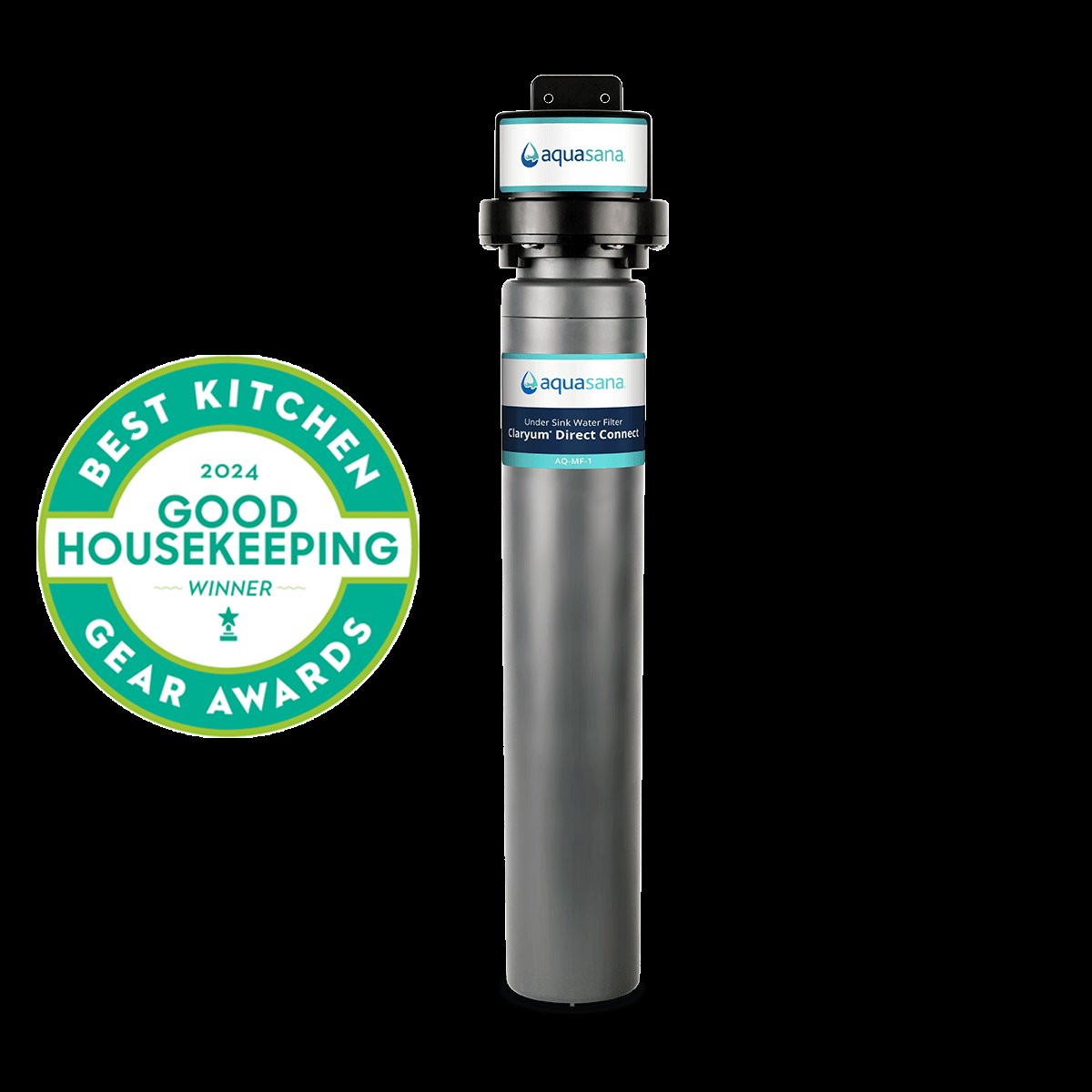
Aquasana Claryum Direct Connect (AQ-MF-1)
Aquasana Claryum Direct Connect (AQ-MF-1)
Connects to your cold-water line and uses your existing faucet, so there is no extra tap to drill. A good fit for city water when chlorine taste or lead is the concern; check Aquasana's performance data for the exact claims.
Compare sizing, treatment options and ongoing costs in our best under-sink water filters guide.
Reverse osmosis: dissolved contaminants

iSpring RCC7AK 6-Stage RO System
iSpring RCC7AK 6-Stage RO System
A six-stage under-sink RO system with a remineralization stage. Choose RO when your test shows nitrates, arsenic, fluoride, PFAS or high dissolved solids; it needs a drain connection and room for a tank.
Compare sizing, treatment options and ongoing costs in our best reverse osmosis systems guide.
Whole house: every tap on city water
Aquasana Rhino Whole House Water Filter
Aquasana Rhino Whole House Water Filter
A whole-house carbon system that reduces chlorine taste and smell at every tap, including showers and laundry. It is not a softener and is not designed for untreated well water.
Compare sizing, treatment options and ongoing costs in our best whole house water filters guide.
Pitcher or dispenser: renters and small budgets
Brita UltraMax Dispenser
Brita UltraMax Dispenser
A large countertop dispenser that needs no installation. Standard filters mainly improve chlorine taste; check which filter is included and its certification if you need lead reduction.
Complete Filter Type Comparison
Compare all filter types at a glance to find the best fit for your needs, budget, and living situation.
How to Read This Table:
Cost: Lower bar = less expensive over 5 years
Effectiveness: Higher bar = removes more contaminants
Installation: Higher bar = easier to install yourself
Maintenance: Higher bar = less frequent maintenance needed
Understand Filtration Technologies
Different filter media remove different contaminants. Many systems combine multiple technologies for comprehensive protection.
Activated Carbon
Removes: Chlorine, taste, odor, VOCs, some pesticides, herbicides
Doesn't Remove: Heavy metals, fluoride, TDS, minerals, bacteria
Found In: Pitchers, faucet filters, under-sink systems, whole-house systems
Reverse Osmosis (RO)
Removes: 95-99% of TDS, fluoride, arsenic, lead, nitrates, chromium-6, pharmaceuticals
Doesn't Remove: Some VOCs (needs carbon pre-filter)
Found In: Under-sink RO systems, countertop RO units
Ion Exchange
Removes: Heavy metals (lead, mercury), hardness minerals, some radioactive elements
Doesn't Remove: Chlorine, bacteria, sediment
Found In: Water softeners, specialty filters like ZeroWater
UV Sterilization
Removes: 99.99% of bacteria, viruses, protozoa
Doesn't Remove: Any chemical contaminants or sediment
Found In: Well water systems, specialty units
Sediment Filtration
Removes: Dirt, rust, sand, silt, particles
Doesn't Remove: Chemicals, dissolved contaminants, bacteria
Found In: Pre-filters in most multi-stage systems
Check Certifications
Third-party certifications prove a filter actually removes what it claims. Don't trust marketing claims without NSF, WQA, or IAPMO certification.
NSF/ANSI 42
Aesthetic effects: Chlorine, taste, odor reduction. Basic certification for most filters.
NSF/ANSI 53
Health effects: Lead, cysts, VOCs, PFAS removal. Critical for safety-focused filtration.
NSF/ANSI 58
Reverse osmosis systems: TDS, fluoride, arsenic, nitrate reduction certification.
NSF/ANSI 401
Emerging contaminants: PFAS, pharmaceuticals, herbicides, pesticides. Most advanced certification.
Red Flags
- • "Tested to NSF standards" (not the same as certified)
- • Vague claims like "removes 99% of contaminants" without specifics
- • No certification listings or test reports
- • "Laboratory tested" without independent third-party verification
Calculate Total Cost of Ownership
The cheapest upfront option often costs more over 3-5 years. Factor in filter replacements, water waste, and maintenance.
| Filter Type | Initial Cost | Filter Cost/Year | 5-Year Total |
|---|---|---|---|
| Pitcher | $20-60 | $80-200 | $420-1,060 |
| Faucet | $20-80 | $50-120 | $270-680 |
| Under-Sink | $150-400 | $60-150 | $450-1,150 |
| RO System | $200-600 | $60-120 | $500-1,200 |
| Whole-House | $500-3,000 | $100-300 | $1,000-4,500 |
Value Comparison
Best Budget Option: Faucet filters offer good filtration at lowest 5-year cost ($270-680)
Best Value Overall: Under-sink or RO systems provide superior filtration for comparable long-term cost
Avoid: Pitchers have highest 5-year cost despite low upfront price
Consider Your Living Situation
Renters & Apartments
Stick to portable, non-permanent solutions you can take with you:
- • Water filter pitchers (easiest, no installation)
- • Faucet-mount filters (clips on, no drilling)
- • Countertop filters (connects to faucet aerator)
- • Avoid: Permanent under-sink or whole-house systems
Homeowners
Invest in permanent systems for better long-term value:
- • Under-sink filters (kitchen drinking water)
- • RO systems (maximum contaminant removal)
- • Whole-house systems (protect entire home)
- • Consider: Point-of-use + whole-house combination
Well Water Users
Well water requires more comprehensive treatment:
- • Multi-stage well water systems (sediment + carbon + UV)
- • Test for bacteria, arsenic, iron, hardness annually
- • May need water softener + filtration
- • UV sterilization for bacterial protection
City Water Users
Focus on removing treatment chemicals and pipe contaminants:
- • Carbon filters for chlorine and taste (minimum)
- • NSF 53 certification for lead protection (if old pipes)
- • NSF 401 for PFAS in affected areas
- • Check city-specific guides for local issues
Match Contaminants to Filter Capabilities
Use your water test results to select a filter that targets your specific contaminants. Here's what removes what:
If You Have: Chlorine, Bad Taste/Odor
Solution: Any activated carbon filter
Options: Pitchers, faucet filters, under-sink
If You Have: Lead, Heavy Metals
Solution: NSF 53 certified carbon block OR reverse osmosis
Options: Lead-removing filters, RO systems
If You Have: Fluoride
Solution: Reverse osmosis or activated alumina
Options: RO systems, fluoride-specific filters
If You Have: Arsenic, Nitrates, Chromium-6
Solution: Reverse osmosis (99% removal)
Options: Under-sink RO, arsenic removal systems
If You Have: PFAS (Forever Chemicals)
Solution: NSF 401 certified carbon OR reverse osmosis
Options: PFAS-removing filters, RO systems
If You Have: Bacteria, Viruses (Well Water)
Solution: UV sterilization + sediment pre-filter
Options: Well water treatment systems
If You Have: Hard Water (Calcium/Magnesium)
Solution: Water softener (ion exchange)
Options: Water softener systems
If You Have: High TDS (Dissolved Solids)
Solution: Reverse osmosis or ion exchange
Options: RO systems, ZeroWater pitchers
Common Mistakes to Avoid
Not Testing Water First
Buying a filter without knowing what's in your water wastes money. A $30 test kit saves hundreds on the wrong filter.
Trusting Marketing Claims
"Removes 99% of contaminants" means nothing without NSF certification. Verify every claim with third-party certification.
Ignoring Filter Replacement Costs
A $25 pitcher with $15 monthly filters costs $205/year. A $400 under-sink system with $60/year filters is cheaper long-term.
Expecting One Filter to Do Everything
No single filter removes all contaminants. Carbon doesn't remove fluoride. RO doesn't remove chlorine without carbon. You may need multiple stages.
Forgetting to Replace Filters
Old filters don't just stop working—they can release trapped contaminants back into your water. Set calendar reminders.
Choosing Based on Price Alone
Cheapest upfront ≠ cheapest long-term. Factor in filter life, replacement cost, installation, and water waste (for RO).
Quick Decision Tree
You're a Renter
→ Start with water pitcher or faucet filter
You Have Lead/Heavy Metals
→ Get NSF 53 certified under-sink filter or RO system
You Have Well Water
→ Install multi-stage well water system with UV sterilization
You Want Maximum Protection
→ Install reverse osmosis system (99%+ contaminant removal)
You Just Want Better Taste
→ Any basic carbon filter pitcher will work
You Have Hard Water + Sediment
→ Install whole-house system + water softener
Contaminant Removal Effectiveness by Filter Type
| Contaminant | Carbon | RO | UV | Ion Exchange |
|---|---|---|---|---|
| Chlorine | ✓ Excellent | ✓ Excellent | ✗ None | ✗ None |
| Lead | ~ Moderate | ✓ Excellent | ✗ None | ✓ Good |
| PFAS | ~ Moderate | ✓ Excellent | ✗ None | ✗ None |
| Fluoride | ✗ None | ✓ Excellent | ✗ None | ~ Limited |
| Arsenic | ✗ None | ✓ Excellent | ✗ None | ~ Limited |
| Bacteria/Viruses | ✗ None | ~ Moderate | ✓ Excellent | ✗ None |
| Hard Water | ✗ None | ✓ Excellent | ✗ None | ✓ Excellent |
| VOCs | ✓ Excellent | ✓ Good | ✗ None | ✗ None |
| Sediment | ~ Moderate | ✓ Good | ✗ None | ✗ None |
✓ = 95%+ removal | ~ = 70-94% removal | ✗ = <70% removal or not applicable
Frequently Asked Questions
Related Guides & Resources
Filter Installation Guides
Final Recommendations
Best Overall for Most Homes
Under-Sink Multi-Stage Filter — Hidden installation, on-demand filtered water, NSF certified, reasonable 5-year cost
Best for Renters
Faucet-Mount Filter — No installation, portable, good filtration, lowest 5-year cost
Best for Maximum Protection
Reverse Osmosis System — 99%+ contaminant removal, NSF 58 certified, handles the toughest water issues
Best for Well Water
Multi-Stage Well System with UV — Sediment + carbon + UV sterilization protects against all well water threats
Best Whole-Home Solution
Whole-House Carbon Filter — Protects all fixtures, appliances, and drinking water throughout your home