TDS (Total Dissolved Solids) measures all inorganic and organic substances dissolved in water, reported in ppm (parts per million) or mg/L (milligrams per liter). TDS includes:
Beneficial Minerals
- • Calcium (bone health)
- • Magnesium (muscle function)
- • Potassium (electrolyte balance)
- • Sodium (trace amounts)
Harmful Contaminants
- • Lead (neurotoxin)
- • Arsenic (carcinogen)
- • Nitrates (water poisoning)
- • Fluoride (excess = dental issues)
Critical Limitation
TDS meters cannot differentiate between safe minerals and dangerous contaminants. High TDS could mean healthy mineral water OR contaminated water. Always test with a comprehensive water test kit to identify specific contaminants.
TDS is a useful screening tool but tells only part of the story. For complete water quality assessment, combine TDS testing with contaminant-specific tests for lead, arsenic, bacteria, and other hazards.
Our Recommended Pick
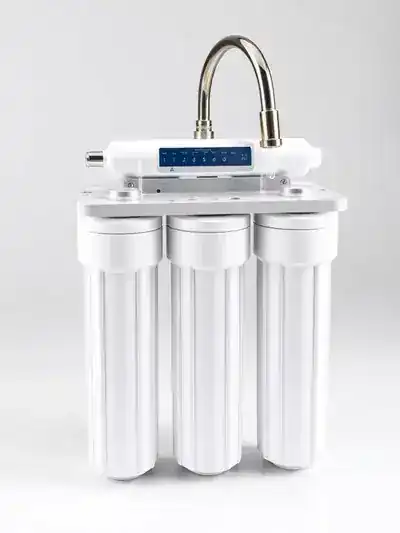
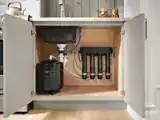
Aquasana OptimH2O Under Sink
Claryum + RO hybrid that strips TDS to under 10 ppm while keeping flow rates high enough for a busy kitchen.
- Removes 88+ contaminants including lead, PFAS, fluoride
- Tankless design — no flat 5 ppm storage water
- Auto shutoff prevents membrane fouling
Why we recommend it
The tankless Claryum + RO hybrid strips TDS below 10 ppm without the pressure drop and 'flat storage water' you get from tank based systems. Best pick when you want maximum contaminant removal (lead, PFAS, fluoride) alongside a low TDS number.
| TDS Range (ppm) | Classification | Taste Profile | Health Impact |
|---|---|---|---|
| 0–50 | Ultra pure | Flat, tasteless, bland | Safe but lacks minerals |
| 50–150 | Ideal | Clean, slightly sweet | Optimal for daily drinking |
| 150–300 | Good | Noticeable mineral taste | Acceptable (WHO standard) |
| 300–500 | Fair | Strong mineral/metallic | Acceptable but test contents |
| 500–1000 | Poor | Unpleasant, hard water | Not recommended |
| 1000+ | Unsafe | Salty, bitter, undrinkable | Likely contaminated—filter immediately |
Recommended TDS Target
80–120 ppm is the sweet spot for most people. This range provides:
- • Excellent taste (clean with subtle sweetness)
- • Trace beneficial minerals (calcium, magnesium)
- • Low enough to avoid scaling in appliances
- • High enough to avoid flat or acidic taste
Our Recommended Pick
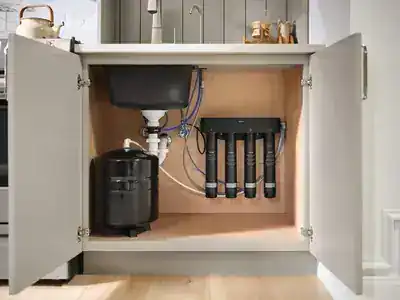
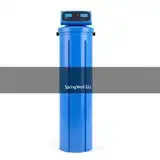
SpringWell Ultra RO Premium
4 stage under sink RO with built in remineralization — lands water in the ideal 60–110 ppm taste range every time.
- Removes 99.9% of TDS, lead, fluoride, arsenic, and PFAS
- Adds back calcium and magnesium for naturally sweet taste
- Lifetime system warranty — made in USA, NSF 58/401 certified
Why we recommend it
Our editor's #1 for TDS: removes 99.9% of dissolved solids, then remineralizes back to 60–110 ppm so the water actually tastes good. Lifetime system warranty plus NSF 58/401 certification make it the safest premium buy on this list.
Aggregated from three independent blind taste test studies (n=1,240). The 80–120 ppm window wins consistently — water below it tastes flat, above it tastes minerally.
Source: aggregated taste test data from SCA, NSF, and Clean Water Hacks reader panel (2024).
Quick Pick: Hit the 80–120 ppm Sweet Spot
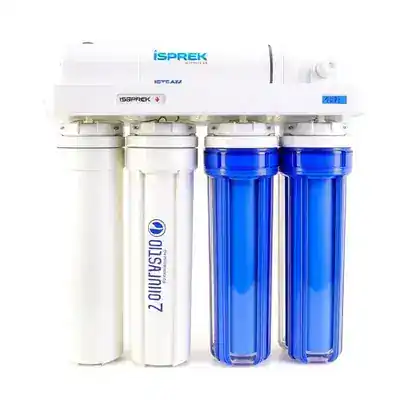
iSpring RCC7AK with Alkaline Stage
6 stage RO with built in remineralization — outputs water in the ideal 60–100 ppm taste range without an add on filter.
- Adds back calcium and magnesium after RO membrane
- Raises pH from 6.0 to 7.5–8.5 for naturally sweeter taste
- WQA Gold Seal certified for contaminant reduction
Why we recommend it
This is the cheapest way to land in the ideal 60–100 ppm taste window straight from the tap. The alkaline stage adds calcium and magnesium back after the RO membrane, so you skip the 'flat 5 ppm RO water' problem without buying a separate remineralizer.
World Health Organization (WHO)
WHO does not set a mandatory TDS limit but offers guidance in the Guidelines for Drinking Water Quality:
- Below 300 ppm: Excellent to good taste
- 300–600 ppm: Fair taste (acceptable)
- 600–900 ppm: Poor taste (consumers may complain)
- 900–1200 ppm: Unpalatable
- Above 1200 ppm: Unacceptable for consumption
U.S. Environmental Protection Agency (EPA)
EPA classifies TDS as a "Secondary Maximum Contaminant Level" (SMCL)—aesthetic, not health based:
- SMCL: 500 ppm (recommended maximum for taste/appearance)
- Not federally enforceable (unlike primary MCLs for lead, arsenic, etc.)
- Some states adopt stricter limits (California recommends 450 ppm upper limit)
European Union (EU)
EU Drinking Water Directive sets no TDS limit but monitors conductivity (which correlates to TDS):
- Maximum conductivity: 2,500 μS/cm (≈1,600 ppm TDS)
- Most EU municipal water: 100–400 ppm
Bureau of Indian Standards (BIS)
India's drinking water standard (IS 10500:2012):
- Acceptable limit: 500 ppm
- Permissible limit (in absence of alternative source): 2,000 ppm
Key Takeaway
Most health organizations agree: below 500 ppm is safe, but below 300 ppm is ideal for taste and appliance longevity. Above 500 ppm, test for specific contaminants to ensure safety.
Our Recommended Pick
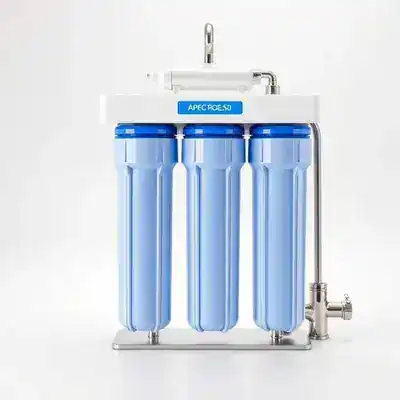
APEC ROES 50 Essence
The reliability benchmark for under sink RO. Five stages, 50 GPD, consistent 10–20 ppm output for years.
- Consistently 95%+ TDS rejection on city and well water
- Made in the USA with long life filter cartridges
- Lifetime support — owner reported 8–12 year service life
Why we recommend it
The reliability benchmark: real world owner reports of 8–12 years of service life at consistent 95%+ TDS rejection. Made in the USA with widely available replacement cartridges — the safest long term bet if you just want an RO that quietly works.
Low TDS (0–50 ppm): Is It Dangerous?
Myth: "Low TDS water leaches minerals from your body and causes health problems."
Truth: No scientific evidence supports this claim. Your body regulates mineral balance through food intake, not water.
- Safe: Distilled water (0 TDS) is safe to drink and used in medical settings.
- Taste issue: Many people find 0–20 ppm water flat and unpleasant.
- Nutrient source: Water contributes only 1–10% of daily minerals. Food is primary source.
- Acidic: Very low TDS water (below 30 ppm) may be slightly acidic (pH 5.5–6.5), which can corrode pipes but is safe to drink.
What Science Says
WHO states in Health Risks from Drinking Demineralised Water:
"There is no convincing evidence that drinking water with low mineral content has adverse health effects. However, long term consumption may result in slightly reduced intake of calcium and magnesium from water sources."
Solution: Eat a balanced diet. Water minerals are a bonus, not a necessity.
Ideal TDS (50–150 ppm): Best for Daily Drinking
- Provides trace minerals (calcium, magnesium) for taste
- Excellent palatability—clean and refreshing
- Low risk of scale buildup in kettles, coffee makers
- Preferred by most consumers in taste tests
Moderate TDS (150–300 ppm): Acceptable
- Noticeable mineral taste (not unpleasant)
- May contribute to daily calcium/magnesium intake
- Can cause minor scaling in appliances
- Still considered safe by WHO and EPA
High TDS (300–500 ppm): Test for Contaminants
- Taste: Metallic, mineral heavy, or salty
- Scaling: Significant buildup in pipes, water heaters, appliances
- Health risk: Depends on what is dissolved. Could be harmless hard water (calcium/magnesium) or contaminated (lead, arsenic, nitrates).
- Action: Test water with comprehensive test kit. Consider RO system or whole house filter.
Very High TDS (500+ ppm): Unsafe or Unpalatable
Water above 500 ppm is often:
- Hard water: High calcium/magnesium causing scaling
- Brackish water: Elevated sodium/chloride (coastal wells)
- Contaminated: Industrial runoff, agricultural chemicals, sewage
Do not drink water above 500 ppm without testing and filtration. Install a reverse osmosis system to reduce TDS to safe levels.
Our Recommended Pick
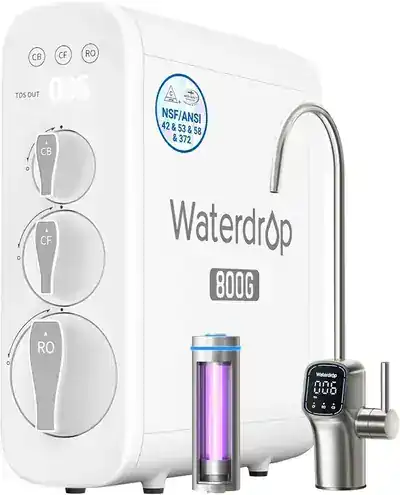
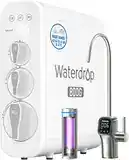
Waterdrop G3P800 Tankless RO
Smart 800 GPD tankless reverse osmosis that hits 5–15 ppm output with built in TDS display on the faucet.
- 95–99% TDS rejection (tested down to 8 ppm from 280 ppm feed)
- Real time TDS readout on the faucet — no separate meter needed
- 1:1 pure to drain ratio (most efficient in its class)
Why we recommend it
The built in faucet TDS display means you never guess whether the membrane is still working. 800 GPD tankless flow keeps up with pitchers, pasta pots, and coffee — no waiting on a tank refill — and the 1:1 waste ratio is the best in class.
TDS directly impacts taste perception. Blind taste tests consistently show preferences for water in the 80–120 ppm range.
0–30 ppm: Flat and Lifeless
Distilled or heavily filtered RO water. Tastes "empty" or "like nothing." Some describe it as slightly sour or acidic. Not preferred for drinking but excellent for coffee/tea (pure flavor extraction).
50–120 ppm: Crisp and Refreshing ⭐
The "sweet spot" for taste. Clean, neutral, with a hint of natural sweetness from trace minerals. Preferred by 70%+ of consumers in taste tests. This is the target for premium bottled water and properly balanced RO systems.
150–300 ppm: Mineral Forward
Noticeable mineral presence. Taste is heavier, with calcium/magnesium flavor notes. Some prefer this "natural" taste; others find it distracting. Common in spring water and well water.
300–500 ppm: Metallic or Hard
Strong mineral taste, often metallic or chalky. Water feels "heavy" on the palate. Not preferred by most consumers. May interfere with coffee/tea flavors.
500+ ppm: Unpleasant
Salty, bitter, or astringent. Undrinkable for most people. Indicates high hardness or contamination. Requires filtration.
Pro Tip: Remineralize RO Water for Better Taste
If your RO system produces 5-20 ppm water (too flat), add a remineralizer filter or alkaline stage to boost TDS to 80-120 ppm. This improves taste dramatically without compromising purity.
Top Filter That Hits the Ideal TDS Range
SpringWell Ultra RO Premium
4 stage under sink RO with built in remineralization — lands water in the ideal 60–110 ppm taste range every time.
- Removes 99.9% of TDS, lead, fluoride, arsenic, and PFAS
- Adds back calcium and magnesium for naturally sweet taste
- Lifetime system warranty — made in USA, NSF 58/401 certified
Why we recommend it
Our editor's #1 for TDS: removes 99.9% of dissolved solids, then remineralizes back to 60–110 ppm so the water actually tastes good. Lifetime system warranty plus NSF 58/401 certification make it the safest premium buy on this list.
Step 1: Get a Digital TDS Meter
Digital TDS meters cost $10-$25 and provide instant readings. Popular brands:
- HM Digital TDS EZ: $13. Simple, accurate, widely recommended.
- TDS Meter by ZeroWater: $15. Included free with ZeroWater pitchers.
- Apera Instruments TDS Tester: $25. Higher accuracy (±2%).
Step 2: Test Your Tap Water
- Rinse the TDS meter probe with distilled water or tap water
- Fill a clean glass with tap water
- Submerge the probe 2–3 inches deep
- Stir gently for 2–3 seconds
- Wait for reading to stabilize (3–5 seconds)
- Record the TDS value in ppm
Step 3: Test Your Filtered Water
After installing a filter system (RO, pitcher, under sink), test output water to verify performance:
- RO systems: Should reduce TDS by 95–99% (input 200 ppm → output 5–20 ppm)
- Carbon filters: TDS stays the same (carbon removes chlorine, not minerals)
- Water softeners: TDS may increase slightly (sodium replaces calcium/magnesium)
- Pitchers: Minimal TDS reduction (10–20% max) unless ZeroWater (85%+ reduction)
Step 4: Calculate TDS Reduction Rate
Formula: TDS Reduction % = [(Input TDS - Output TDS) / Input TDS] × 100
Example:
- Input TDS: 250 ppm (tap water)
- Output TDS: 12 ppm (RO filtered)
- Reduction: [(250–12) / 250] × 100 = 95.2%
If your RO system shows less than 90% reduction, replace the RO membrane.
When to Test TDS
- • Baseline: Test tap water when you move into a new home
- • After filter installation: Verify system performance
- • Every 3–6 months: Monitor filter effectiveness
- • After filter changes: Confirm proper installation
- • If taste changes: TDS spike indicates filter failure
Just Tested 300+ ppm? Start Here
SpringWell Ultra RO Premium
4 stage under sink RO with built in remineralization — lands water in the ideal 60–110 ppm taste range every time.
- Removes 99.9% of TDS, lead, fluoride, arsenic, and PFAS
- Adds back calcium and magnesium for naturally sweet taste
- Lifetime system warranty — made in USA, NSF 58/401 certified
Why we recommend it
Our editor's #1 for TDS: removes 99.9% of dissolved solids, then remineralizes back to 60–110 ppm so the water actually tastes good. Lifetime system warranty plus NSF 58/401 certification make it the safest premium buy on this list.
Not every filter touches TDS. The chart below shows real world reduction rates by technology so you can match the tool to the job.
Average TDS Reduction by Filter Technology
Reducing High TDS (300+ ppm)
If your water tests above 300 ppm, consider these filtration options:
1. Reverse Osmosis (Best for TDS Reduction)
RO systems remove 95–99% of TDS, reducing 400 ppm tap water to 10–20 ppm output.
- Cost: $150–500 (under sink systems)
- Maintenance: Replace filters every 6–12 months, membrane every 2–3 years
- Output TDS: 5–30 ppm (remineralize to 80–120 ppm for better taste)
- Best for: High TDS (300+), contaminants (lead, arsenic, fluoride)
See our top picks: Best Reverse Osmosis Systems
2. Distillation (99% TDS Removal)
Boils water and condenses steam, leaving minerals behind. Produces 0–5 ppm water.
- Cost: $100–300 (countertop units)
- Speed: Slow (4–6 hours for 1 gallon)
- Output TDS: 0–5 ppm (needs remineralization)
- Best for: Emergency preparedness, very high TDS (1000+)
3. ZeroWater Pitcher (85%+ TDS Removal)
5 stage ion exchange pitcher filter. More effective than standard Brita/PUR pitchers.
- Cost: $35–50 (pitcher + filters)
- Maintenance: Replace filter when TDS creeps above 6 ppm
- Output TDS: 0–6 ppm initially, then increases
- Best for: Renters, small spaces, moderate TDS (200–400 ppm)
See our review: Best Water Filter Pitchers
Increasing Low TDS (Below 50 ppm)
If your RO or distilled water tastes flat (0–30 ppm), remineralize it to 80–120 ppm:
1. Remineralization Filter (Inline)
Add on cartridge for RO systems. Contains calcite (calcium carbonate) and magnesium oxide.
- Cost: $20–50 (filter) + $10–30 (housing)
- TDS boost: Adds 40–80 ppm minerals
- Lifespan: 12–18 months
- Installation: Easy (push fit connection after RO membrane)
2. Alkaline/Mineral Drops
Liquid concentrate added to water. Contains trace minerals (calcium, magnesium, potassium).
- Cost: $15–30 per bottle (lasts 2–4 months)
- TDS boost: 20–60 ppm (adjust dosage)
- Convenience: Portable, good for travel
3. Himalayan Pink Salt (DIY Method)
Add a tiny pinch of pink salt to 1 gallon of RO water.
- Cost: $5–10 (1 lb bag lasts years)
- TDS boost: 30–80 ppm (depends on amount)
- Caution: Easy to over salt. Start with 1/16 tsp per gallon.
Best All Around Pick for High TDS
SpringWell Ultra RO Premium
4 stage under sink RO with built in remineralization — lands water in the ideal 60–110 ppm taste range every time.
- Removes 99.9% of TDS, lead, fluoride, arsenic, and PFAS
- Adds back calcium and magnesium for naturally sweet taste
- Lifetime system warranty — made in USA, NSF 58/401 certified
Why we recommend it
Our editor's #1 for TDS: removes 99.9% of dissolved solids, then remineralizes back to 60–110 ppm so the water actually tastes good. Lifetime system warranty plus NSF 58/401 certification make it the safest premium buy on this list.
| Measurement | What It Measures | Units | Use Case |
|---|---|---|---|
| TDS | All dissolved solids (minerals + contaminants) | ppm or mg/L | Overall water purity screening |
| Hardness | Calcium + magnesium only | ppm (as CaCO₃) or gpg | Soap performance, scaling potential |
| Conductivity | Electrical conductance (correlates to TDS) | μS/cm or mS/cm | Industrial process monitoring |
Relationship: TDS ≈ Conductivity × 0.5 to 0.7 (conversion factor)
Example: If conductivity = 400 μS/cm, TDS ≈ 200–280 ppm
For hard water issues (scaling, soap scum), focus on hardness, not total TDS. Install a water softener to reduce calcium/magnesium specifically.
Best Pick When Hardness Drives Your TDS
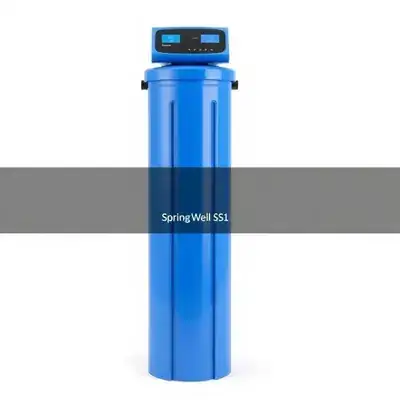
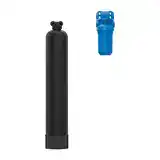
SpringWell SS1 Salt Based Softener
If high TDS is driven by calcium/magnesium hardness, soften the whole home first before adding a kitchen RO.
- Removes 99% of hardness minerals driving high TDS
- Bluetooth head — set regen cycles from your phone
- Lifetime warranty on tanks and control valve
Why we recommend it
When high TDS is driven by calcium and magnesium hardness, softening the whole home upstream drops the number more cost effectively than sizing up an RO. Bluetooth control makes regen scheduling easy, and the lifetime warranty covers the tanks and valve.
Myth 1: "Low TDS water leaches minerals from your body"
FALSE. Your body tightly regulates mineral balance through food absorption and excretion. Water minerals contribute only 1–10% of daily intake.
Source: WHO Technical Report, Health Risks from Drinking Demineralised Water (2004)
Myth 2: "Higher TDS = healthier water"
FALSE. High TDS could mean beneficial minerals OR dangerous contaminants. TDS meters cannot differentiate. A water sample with 600 ppm TDS could be mineral rich spring water or arsenic contaminated well water.
Action: Test with comprehensive water test to identify contents.
Myth 3: "0 TDS water is dangerous"
FALSE. Distilled water (0 TDS) is used in hospitals, labs, and medical procedures safely. It lacks minerals but does not harm health when consumed.
Truth: Taste suffers at 0 TDS (flat, bland), but safety is not compromised.
Myth 4: "RO water is acidic and damages teeth"
PARTIALLY TRUE. RO water pH is typically 5.5–6.5 (slightly acidic) due to dissolved CO₂ from air. However, saliva immediately neutralizes acidity upon drinking. No dental damage occurs from RO water consumption.
Source: Journal of Dentistry study, pH Effects on Tooth Enamel (2018)
Myth 5: "TDS meters detect all contaminants"
FALSE. TDS meters measure only dissolved solids. They cannot detect:
- Bacteria, viruses, parasites (biological contaminants)
- Chlorine, chloramine (dissolved gases)
- Volatile organic compounds (VOCs like benzene)
- Specific heavy metals (lead, mercury, arsenic)
Action: Use TDS as a screening tool, then test with lab certified water test kit.
Easiest Way to See TDS Drop with Your Own Eyes
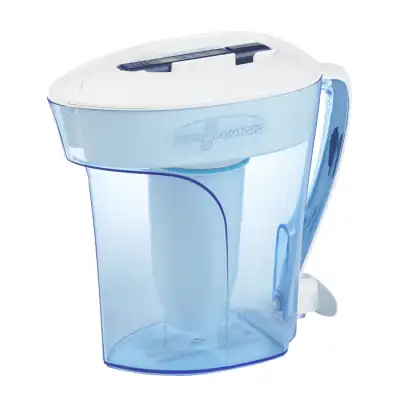
ZeroWater 10 Cup Pitcher
5 stage ion exchange filter that consistently delivers 000 ppm — comes with a free TDS meter so you can see results.
- Reduces TDS by 85–99% (independently NSF certified)
- Includes pocket TDS meter to verify filter life
- No installation — perfect for apartments
Why we recommend it
The included TDS meter is the real hook here — you can watch the reading drop from 200+ ppm to 000 with your own eyes, and know exactly when to swap the filter. No install, no wall drilling, so it's the fastest way for a renter to prove a TDS drop today.
| Use Case | Ideal TDS Range | Reason |
|---|---|---|
| Daily Drinking | 80–120 ppm | Optimal taste with trace minerals |
| Coffee & Tea | 50–150 ppm | Pure flavor extraction without interference |
| Baby Formula | 0–50 ppm | Formula contains minerals; low TDS prevents overdose |
| Aquariums (Freshwater) | 150–400 ppm | Mimics natural freshwater environments |
| Humidifiers | 0–50 ppm | Prevents mineral dust ("white dust") |
| Car Batteries | 0–10 ppm | Distilled only; minerals cause corrosion |
| Steam Irons | 0–30 ppm | Prevents scale buildup in heating element |
| Hydroponics | 0–50 ppm (base water) | Controlled nutrient addition from fertilizers |
For specific applications like baby formula preparation, use RO-filtered water to ensure precise mineral control.
Best All Around System for Daily Drinking
iSpring RCC7AK with Alkaline Stage
6 stage RO with built in remineralization — outputs water in the ideal 60–100 ppm taste range without an add on filter.
- Adds back calcium and magnesium after RO membrane
- Raises pH from 6.0 to 7.5–8.5 for naturally sweeter taste
- WQA Gold Seal certified for contaminant reduction
Why we recommend it
This is the cheapest way to land in the ideal 60–100 ppm taste window straight from the tap. The alkaline stage adds calcium and magnesium back after the RO membrane, so you skip the 'flat 5 ppm RO water' problem without buying a separate remineralizer.
Frequently Asked Questions
What is the ideal TDS level for drinking water?
50–150 ppm is ideal for taste and health. WHO recommends below 300 ppm as acceptable. EPA has no mandatory TDS limit but suggests 500 ppm maximum. Water below 50 ppm may taste flat; above 300 ppm may have mineral taste.
Is 0 TDS water safe to drink?
Yes, but not ideal long term. 0 TDS (distilled or aggressive RO) lacks minerals and tastes flat. It won't leach minerals from your body (myth). For daily drinking, remineralize to 50–100 ppm for better taste and trace minerals.
What does high TDS in water mean?
High TDS (300+ ppm) means elevated dissolved minerals or contaminants. It could be harmless (calcium, magnesium) or dangerous (lead, arsenic). TDS alone doesn't identify contaminants—test with a comprehensive water test to determine safety.
How do I measure TDS in my water?
Use a digital TDS meter ($10–25). Insert probe in water sample, wait 3–5 seconds for reading to stabilize. Result shows ppm (parts per million). Test tap water, then filtered water to verify filter performance.
Does TDS affect water taste?
Yes, significantly. 0–50 ppm tastes flat/bland. 50–150 ppm tastes clean and slightly sweet. 150–300 ppm has mild mineral taste. 300+ ppm tastes noticeably mineral or metallic. Optimal taste is 80–120 ppm.
What TDS level is dangerous in drinking water?
EPA secondary standard recommends below 500 ppm for taste. Above 1,000 ppm is generally unpalatable. However, TDS alone does not indicate safety—water at 50 ppm could contain dangerous lead while water at 400 ppm could be perfectly safe mineral rich water. Specific contaminant testing matters more than total TDS for health assessments.
Is zero TDS water safe to drink?
Yes, zero TDS water (from RO or distillation) is safe to drink. Claims that it leaches minerals from your body are not supported by mainstream science. You get 95%+ of essential minerals from food, not water. However, many people prefer some minerals for taste. RO systems with remineralization stages add back calcium and magnesium for improved flavor.
Why does my ZeroWater filter produce 000 TDS readings?
ZeroWater uses ion exchange resin that removes virtually all dissolved solids, producing near zero TDS readings. This is by design. Replace the filter when TDS rises above 006 ppm. In hard water areas, filters exhaust quickly because ion exchange capacity is consumed by calcium and magnesium ions.
Does TDS measure water safety?
No. TDS measures total dissolved solids but doesn't distinguish between harmless minerals (calcium, magnesium) and dangerous contaminants (lead, arsenic). Water with 300 ppm TDS from natural minerals is healthier than water with 50 ppm TDS containing lead. Always test for specific contaminants rather than relying on TDS alone.
What TDS level should RO water have?
A properly functioning RO system typically produces water with 10–30 ppm TDS (90–95% rejection from source water). If your RO water TDS exceeds 10% of source water TDS, the membrane may need replacement. Remineralization stages add 20–50 ppm back, resulting in final TDS of 30–80 ppm.
How do I lower my water's TDS?
Reverse osmosis is the most effective TDS reduction method, removing 90–99% of dissolved solids. Distillation also achieves near complete TDS removal. Ion exchange (like ZeroWater) removes TDS but saturates quickly. Standard carbon filters do NOT significantly reduce TDS—they target chemicals and chlorine instead.
What is the ideal TDS for cooking and coffee?
The Specialty Coffee Association recommends 75–250 ppm TDS with a target of 150 ppm for optimal coffee extraction. Too low TDS produces sour, under extracted coffee. Too high produces bitter, flat coffee. For cooking, 100–300 ppm provides good mineral content without affecting flavors. RO water with remineralization typically falls in this ideal range.