Best UV Water Purifiers 2026
UV water purification kills 99.99% of bacteria, viruses, and parasites without chemicals. Essential for well water, and increasingly popular as supplemental protection for city water. Our expert guide covers the science, top products, and how to choose the right system.
How UV Water Purification Works
UV water purifiers use ultraviolet light at a specific wavelength (253.7 nanometers, known as UV-C) to destroy the DNA and RNA of microorganisms. When UV-C photons penetrate a cell's nucleus, they create thymine dimers—molecular bonds that prevent the organism from reproducing. Without the ability to replicate, the pathogen is effectively "killed" and cannot cause infection, even if still physically present in the water.
The effectiveness of UV treatment depends on three critical factors: UV dose (measured in mJ/cm², the product of intensity × exposure time), water clarity (UV transmittance or UVT), and flow rate (which determines contact time in the chamber). The international standard for primary disinfection is 40 mJ/cm²—sufficient to achieve 4-log (99.99%) reduction of even resistant organisms like Cryptosporidium and Giardia.
What UV Removes (99.99%)
- Bacteria: E. coli, Salmonella, Legionella, Cholera, Campylobacter, Shigella
- Viruses: Hepatitis A, Norovirus, Rotavirus, Adenovirus (at higher dose)
- Protozoa: Giardia lamblia, Cryptosporidium parvum (chlorine-resistant)
- Other: Coliform bacteria, iron bacteria, sulfur-reducing bacteria
What UV Does NOT Remove
- Chemicals: Chlorine, pesticides, herbicides, VOCs, pharmaceuticals
- Heavy metals: Lead, arsenic, mercury, chromium-6
- Minerals: Iron, manganese, calcium, magnesium (hardness)
- Other: Sediment, turbidity, taste, odor, color, PFAS, nitrates
UV is a disinfection technology only. Combine with carbon, sediment, or RO filters for comprehensive treatment.
UV vs. Other Disinfection Methods
| Method | Effectiveness | Chemicals Added | Taste Impact | Annual Cost | Kills Crypto |
|---|---|---|---|---|---|
| UV Sterilization | 99.99% | None | None | $105-295 | ✓ Yes |
| Chlorination | 99.9% | Chlorine | Significant | $200-500 | ✗ No |
| Ozonation | 99.99% | Ozone (dissipates) | Minimal | $300-600 | ✓ Yes |
| Boiling | 99.9% | None | Concentrates minerals | $200+ (energy) | ✓ Yes |
Top UV Water Purifier Systems 2026
Viqua D4 Premium
NSF 55 Class A certified, 12 GPM flow
The Viqua D4 Premium is the gold standard for residential UV disinfection. It delivers a validated 40 mJ/cm² dose at 12 GPM flow rate—enough for 4-5 bathroom homes running multiple fixtures simultaneously. The built-in UV intensity sensor continuously monitors germicidal output and alerts you when the lamp needs replacement, eliminating guesswork about bulb effectiveness.
The controller displays remaining lamp life in days, tracks total operating hours, and provides audible alarms for lamp failure or low UV output. The stainless steel chamber resists corrosion from acidic well water (pH 6.5-8.5 range), and the single-end design allows bulb replacement without disconnecting plumbing. As the only NSF 55 Class A certified unit in this price range, it's our top recommendation for primary disinfection of well water.
View on AmazonHQUA-OWS-12
High flow rate at an unbeatable price
At roughly one-third the cost of the Viqua D4, the HQUA-OWS-12 delivers surprisingly strong performance. The 55-watt lamp provides adequate UV-C output for the rated 12 GPM flow rate, and the stainless steel chamber construction matches premium units. Check the manufacturer's UV-dose and UV-transmittance requirements before relying on its rated flow.
The trade-off for the lower price is the absence of NSF 55 certification (no third-party validated dose), no built-in UV intensity monitor (you're relying on the 12-month replacement schedule), and a less sophisticated controller (basic on/off with lamp indicator). For wells that test clean for bacteria but want insurance protection, this represents excellent value. For wells with confirmed bacterial contamination, we recommend the NSF-certified Viqua D4 for the additional safety margin.
View on AmazonAquasana Rhino Well Water UV Bundle
Complete multi-stage system with UV sterilization
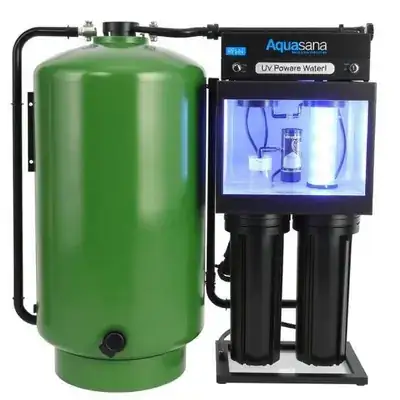
The Aquasana Rhino Well Water UV bundle eliminates the need to piece together a multi-stage system. It combines 20-inch sediment pre-filter, copper-zinc/activated carbon media (removes chemicals, heavy metals, VOCs), sub-micron post-filter, and a Sterilight UV chamber in a single integrated package. This is the most convenient approach for well owners who want comprehensive treatment without the complexity of selecting and sequencing individual components.
The triple NSF certification (42 for aesthetic, 53 for health, 55 for UV) provides independent verification of performance claims—something few competitors can match. The 500,000-gallon main tank capacity means the carbon/KDF media lasts approximately 5 years for a family of four. Pre-filters need changing every 3 months ($30 each) and the UV bulb annually ($80). The Rhino system is rated at 15 GPM. Size the UV stage to your peak demand and follow its manufacturer-rated disinfection flow limit.
Check Price at AquasanaUV System Comparison at a Glance
| Model | Type | Flow Rate | NSF 55 | UV Monitor | Price |
|---|---|---|---|---|---|
| Viqua D4 Premium | Whole-house | 12 GPM | Class A ✓ | Yes ✓ | $450-500 |
| HQUA-OWS-12 | Whole-house | 12 GPM | No | No | $150-200 |
| Aquasana Rhino UV | Whole-house + filter | 15 GPM | Class A ✓ | Yes ✓ | $1,899 |
| Viqua VH200 | Point-of-entry | 6 GPM | Class A ✓ | No | $300-350 |
| iSpring CU-A4 | Under-sink | 0.75 GPM | No | No | $140-160 |
| SteriPEN Ultra | Portable | 1L/90 sec | No | No | $90-110 |
Critical: UV Pre-Filtration Requirements
UV light cannot penetrate cloudy, colored, or particle-laden water. Without proper pre-filtration, microorganisms can "hide" behind particles and pass through the UV chamber alive. This is the most common reason for UV system failure—not the technology itself, but inadequate water preparation.
Water Quality Minimums for UV Effectiveness
- UV Transmittance (UVT): Must be ≥75% (ideally ≥85%)
- Turbidity: Must be below 1 NTU (nephelometric turbidity units)
- Iron: Must be below 0.3 ppm (iron absorbs UV light)
- Manganese: Must be below 0.05 ppm (coats quartz sleeve)
- Hardness: If above 7 GPG, consider softener to prevent sleeve scaling
- Tannins: Must be below 0.1 ppm (absorbs UV-C wavelength)
Minimum Pre-Filtration Setup
5-Micron Sediment Filter
Removes particles that block UV light. Change every 3-6 months.
Activated Carbon Filter
Removes organic matter that absorbs UV. Also improves taste.
UV Sterilizer (LAST stage)
After all filtration, when water is clear and particle-free.
Complete Well Water Setup
Spin-Down Sediment Filter
First defense against heavy sediment loads.
Iron/Manganese Filter
Removes minerals that coat the quartz sleeve and absorb UV light.
Water Softener (if hard water)
Prevents calcium scaling on quartz sleeve.
Carbon Filter
Final polishing for organics and taste.
UV Sterilizer
Final stage after all pre-treatment.
Maintenance & Operating Costs
UV systems are remarkably low-maintenance compared to chemical treatment alternatives. However, consistent maintenance is critical for continued effectiveness. A UV system that's neglected is worse than no system at all, because it creates a false sense of security.
| Task | Frequency | Cost | Difficulty |
|---|---|---|---|
| UV Bulb Replacement | Every 12 months | $50-150 | Easy (5 min) |
| Quartz Sleeve Cleaning | Every 6-12 months | $0 (vinegar soak) | Easy (15 min) |
| Quartz Sleeve Replacement | Every 2-3 years | $20-50 | Easy (10 min) |
| Pre-filter Cartridge Change | Every 3-6 months | $15-40 | Easy (5 min) |
| Electricity | Continuous (24/7) | $5-15/year | N/A |
Total Annual Cost: $105-295/year — making UV one of the most affordable disinfection technologies available.
Who Needs a UV Water Purifier?
Essential (Must Have)
- Well water users: Private wells have no treatment—UV provides primary disinfection
- Positive bacteria tests: Any coliform or E. coli detection requires immediate treatment
- Surface water sources: Springs, lakes, and cisterns are inherently contaminated
- Immunocompromised households: Cancer patients, transplant recipients, HIV/AIDS patients need extra protection
- Homes with infants: Developing immune systems are more vulnerable to waterborne pathogens
Recommended (Nice to Have)
- Areas with boil advisories: UV provides continuous protection during main breaks
- Aging city infrastructure: Old distribution pipes can harbor Legionella
- Travelers: Portable UV (SteriPEN) for international travel
- RV/boat owners: Water sources vary in quality
- Emergency preparedness: UV works when chemical supplies run out
5-Year Total Cost of Ownership
| System | Initial Cost | Annual Maintenance | 5-Year TCO |
|---|---|---|---|
| Viqua D4 + Pre-filters | $600-700 | $150-200 | $1,350-1,700 |
| HQUA + Pre-filters | $300-400 | $100-150 | $800-1,150 |
| Aquasana Rhino UV Bundle | $1,899 | $200-280 | $2,899-3,299 |
| Chlorination System | $1,500-2,500 | $300-500 | $3,000-5,000 |
Explore Our Top Picks
Related Resources
Frequently Asked Questions
Related Articles
How SpringWell WS4 compares to Aquasana Rhino Well Pro
Large home well water comparison
Aquasana Rhino Pro Grade: full review and verdict
UV + carbon + softener combo for borderline wells
Buying guide: Well Water Filters
Complete well water filtration buyer's guide
See the best Well Water Whole House Systems
Multi stage whole house treatment for wells
Deep dive — Well Water Bacteria Treatment
UV, chlorination, and disinfection methods
More on Well Water Rust Removal
Iron and manganese treatment solutions
Understanding Water Quality Science
Water quality is determined by a complex interplay of dissolved minerals, organic compounds, and potential contaminants that vary significantly by geographic region and water source. Municipal water treatment facilities use multi-stage processes including coagulation, sedimentation, sand filtration, and chemical disinfection to meet EPA Safe Drinking Water Act standards. However, these treatment processes can introduce disinfection byproducts such as trihalomethanes and haloacetic acids, which form when chlorine reacts with naturally occurring organic matter in the source water.
Private well water faces different challenges, as it bypasses municipal treatment entirely and may contain naturally occurring contaminants like arsenic, radon, and heavy metals that leach from surrounding geological formations. The Environmental Protection Agency recommends annual testing for coliform bacteria, nitrates, total dissolved solids, and pH levels for all private wells. Additional testing for volatile organic compounds, pesticides, and heavy metals should be conducted if you live near agricultural areas, industrial sites, or old mining operations. Understanding your specific water chemistry is the critical first step in selecting the most effective filtration system for your household needs.
Total dissolved solids (TDS) measurements provide a general indicator of water purity but should not be the sole basis for filtration decisions. Water with high TDS from beneficial minerals like calcium and magnesium may actually be healthier than ultra-purified water. The World Health Organization has noted that demineralized water may have adverse health effects due to the absence of essential minerals. This is why many advanced filtration systems, particularly reverse osmosis units, now include remineralization stages that add back beneficial minerals after removing contaminants. The ideal approach balances contaminant removal with mineral retention, targeting specific harmful substances identified through comprehensive water testing while preserving the natural mineral content that contributes to both taste and health benefits.