Winter Water Filter Maintenance Guide
Protect your water filtration investment from freeze damage. Complete winterization procedures, prevention methods, spring restart checklists, and repair cost estimates.
Temperature Risk Zones for Water Filters
Understanding temperature thresholds helps you plan winterization timing. Don't wait for a hard freeze—damage begins before water fully freezes as ice crystals form and expand inside filter media and housings.
Safe Zone: Above 50°F
No action needed. Normal operation is safe for all filter types.
- • All systems operate normally
- • No insulation required
- • Standard maintenance schedule
Caution Zone: 33-50°F
Monitor closely. Take preventive measures for exposed systems.
- • Insulate exposed pipes and housings
- • Check insulation integrity weekly
- • Plan winterization if temps dropping
- • Keep water flowing during cold snaps
Danger Zone: Below 33°F
Immediate action required for any unheated filter location.
- • Drain all unprotected systems NOW
- • Activate heat tape or space heaters
- • Remove and store portable filters indoors
- • Monitor hourly during extreme cold
Winterization Procedures by Filter Type
Different filter systems require different winterization approaches. Follow the specific procedures for your equipment to prevent costly freeze damage.
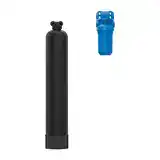
Whole House Filters
Highest risk — large water volume in tanks and housings
If in Unheated Space (Garage, Basement, Outdoor):
- Turn off water supply at the main shut-off valve before the filter
- Release pressure by opening a downstream faucet until flow stops
- Open drain valve or remove filter housings to drain all standing water
- Remove filter cartridges/media and store indoors in sealed bags
- Leave housings open or use compressed air (15-20 PSI) to remove remaining water
- Apply non-toxic antifreeze (RV-safe propylene glycol) if any water remains in low points
- Insulate all exposed pipes leading to and from the filter location
- Label the system with winterization date and spring restart instructions
Critical: Whole house tanks can hold 10-30+ gallons. Ensure ALL water is drained. A partially drained tank will still freeze and crack.
RO Systems (Under-Sink)
Moderate risk — membrane is most vulnerable component
If in Unheated or Garage Location:
- Turn off water supply valve to the RO system
- Close the storage tank valve
- Open the RO faucet to release all pressure and drain the line
- Remove pre-filters, post-filters, and RO membrane
- Disconnect and drain the storage tank completely (invert to empty)
- Blow out all tubing with low-pressure compressed air
- Store membrane and filters indoors in sealed plastic bags
RO membrane note: A single freeze cycle can crack the membrane housing and destroy the $50-150 membrane. If your RO is in a heated kitchen, no action is needed unless your heating fails.
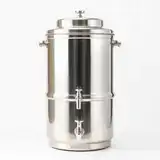
Gravity & Portable Filters
Berkey, LifeStraw Family, camping filters
- Drain both upper and lower chambers completely
- Remove filter elements and air-dry thoroughly (24-48 hours)
- Store elements in sealed bags in a climate-controlled area (40-80°F)
- Never let primed ceramic or Black Berkey elements freeze—internal cracking ruins filtration
- In spring: re-prime elements per manufacturer instructions before first use
Water Softeners
Lower risk — salt brine has lower freezing point
Water softeners are somewhat freeze-resistant because salt water has a lower freezing point than fresh water. However, the resin tank, valve head, and bypass lines contain fresh water that can freeze.
- Set regeneration to run more frequently (moving water resists freezing)
- Insulate the resin tank and all connecting pipes
- Maintain brine tank salt level (salt water has a lower freeze point)
- Consider a tank heating blanket for extreme cold regions (below 0°F)
RV & Outdoor Filters
Highest risk — fully exposed to outdoor temperatures
- Remove and drain after each use in cold weather—do not leave connected
- Store indoors when temperatures drop below 40°F
- Blow out all lines and hoses with compressed air
- Replace filters in spring even if no visible freeze damage—internal media may be compromised
- For hollow fiber filters (LifeStraw, Sawyer): a single freeze destroys the filter permanently
Freeze Prevention Methods
If draining your system is impractical (e.g., you need filtered water year-round), these prevention methods keep systems operational through freezing temperatures.
Insulation Solutions
Pipe insulation foam ($0.50-2/ft): Wrap all exposed pipes and filter housings. Use minimum R-4 rating for moderate climates, R-8 for severe cold.
Insulated enclosures ($100-500): Build or buy insulated boxes for outdoor filters. Use rigid foam board (R-6 to R-13) with weatherproof exterior.
Fiberglass batting ($20-50): Wrap around filter housings in unheated basements and garages. Cover with plastic to prevent moisture damage.
Reflective radiant barrier ($30-80): Reflects heat back toward the filter. Most effective when combined with an air gap and insulation.
Active Heating Solutions
Heat tape/cable ($20-60): Self-regulating heat cable wraps around pipes and housings. Thermostat-controlled versions activate only when needed—most energy-efficient option.
Space heater ($30-100): Small ceramic heater with built-in thermostat in filter enclosure. Set to maintain 45°F minimum. Ensure adequate ventilation and use a GFCI outlet.
Heat lamp ($10-20): A 60-100W incandescent bulb in an insulated enclosure generates enough heat for mild freezes. Not sufficient for extended sub-zero temperatures.
Circulating pump ($50-150): Keep water moving through the system at low flow—moving water resists freezing. Most effective for whole house systems with bypass loops.
Freeze Damage Repair Costs
Understanding potential repair costs makes the case for prevention compelling. Prevention typically costs $20-200 while freeze damage can reach tens of thousands when water damage is included.
| Damage Type | Repair Cost | Prevention Cost |
|---|---|---|
| Cracked filter housing | $30-150 | $5-20 insulation |
| O-ring/fitting replacement | $10-30 | $5 insulation |
| RO membrane replacement | $50-150 | $20 heat tape |
| Complete system replacement | $200-2,000+ | $50-100 enclosure |
| Softener valve head repair | $150-400 | $30-60 insulation + heat |
| Water damage to home | $5,000-50,000+ | $20-200 prevention |
Spring Restart Checklist
After winter, follow this systematic restart procedure to ensure your system is functioning safely. Rushing the restart process can cause leaks, contamination, or equipment damage.
- Inspect all housings and connections visually
Look for hairline cracks, warped housings, loose fittings, and corrosion. Use a flashlight to examine the interior of transparent housings.
- Replace ALL O-rings and rubber gaskets
Cold temperatures harden and degrade rubber seals even without freezing. Fresh O-rings are cheap insurance ($5-15 per set).
- Install fresh filter cartridges
Replace any filters stored through winter—even if they appear undamaged. Internal filter media can be compromised by temperature cycling.
- Slowly open water supply valve (quarter turns)
Watch for leaks at every joint and housing as pressure builds. Stop immediately if leaking occurs.
- Flush the system thoroughly
Run water for 10-15 minutes to clear antifreeze residue, air pockets, and any debris. Discard this water.
- Test water quality
Use a TDS meter or water test kit to verify filtration is working properly. Compare results to pre-winter baseline.
Common Winter Problems & Solutions
Slow Flow / No Flow After Cold Snap
Cause: Partially frozen filter media, ice blockage in lines, or constricted O-rings
Solution: Warm the area gently using a space heater—never apply direct heat (hair dryer, torch) to plastic housings. Once thawed, run water slowly and check for leaks. If flow doesn't restore, the filter media may be damaged and needs replacement.
Leaking After Thawing
Cause: Cracked housing or damaged O-rings from ice expansion
Solution: Turn off water supply immediately. Replace damaged housing ($30-150). Inspect and replace all O-rings in the affected area. Test under pressure for 30 minutes before leaving unattended. Check for pressure irregularities that may indicate hidden damage.
Strange Taste or Discoloration After Winter
Cause: Stagnant water in system, degraded filter media, antifreeze residue, or bacterial growth in warm areas of stored filters
Solution: Replace ALL filters, flush the entire system with 15+ gallons of water, and sanitize housings with food-grade hydrogen peroxide or bleach solution. Test water quality before resuming use for drinking.
Pressure Spikes After Pipe Thawing
Cause: Rapid thawing of frozen pipes upstream creates pressure surges that can damage filter housings and membranes
Solution: Install a pressure regulator ($30-50) before your filter system. After any pipe freeze event, inspect all filter connections and housings before restoring normal water use. Consider a full system inspection.
Explore Our Top Picks
Related Resources
Understanding Water Quality Science
Water quality is determined by a complex interplay of dissolved minerals, organic compounds, and potential contaminants that vary significantly by geographic region and water source. Municipal water treatment facilities use multi-stage processes including coagulation, sedimentation, sand filtration, and chemical disinfection to meet EPA Safe Drinking Water Act standards. However, these treatment processes can introduce disinfection byproducts such as trihalomethanes and haloacetic acids, which form when chlorine reacts with naturally occurring organic matter in the source water.
Private well water faces different challenges, as it bypasses municipal treatment entirely and may contain naturally occurring contaminants like arsenic, radon, and heavy metals that leach from surrounding geological formations. The Environmental Protection Agency recommends annual testing for coliform bacteria, nitrates, total dissolved solids, and pH levels for all private wells. Additional testing for volatile organic compounds, pesticides, and heavy metals should be conducted if you live near agricultural areas, industrial sites, or old mining operations. Understanding your specific water chemistry is the critical first step in selecting the most effective filtration system for your household needs.
Total dissolved solids (TDS) measurements provide a general indicator of water purity but should not be the sole basis for filtration decisions. Water with high TDS from beneficial minerals like calcium and magnesium may actually be healthier than ultra-purified water. The World Health Organization has noted that demineralized water may have adverse health effects due to the absence of essential minerals. This is why many advanced filtration systems, particularly reverse osmosis units, now include remineralization stages that add back beneficial minerals after removing contaminants. The ideal approach balances contaminant removal with mineral retention, targeting specific harmful substances identified through comprehensive water testing while preserving the natural mineral content that contributes to both taste and health benefits.
Filtration Technology Comparison
Modern water filtration leverages several distinct technologies, each with unique strengths for addressing specific water quality challenges. Activated carbon filtration, the most common residential method, uses adsorption to capture chlorine, volatile organic compounds, and taste-affecting chemicals. Granular activated carbon (GAC) filters provide good flow rates but may allow channeling, while carbon block filters compress carbon particles for more consistent contact time and finer filtration down to 0.5 microns. Catalytic carbon represents the latest advancement, specifically engineered to break down chloramines through a catalytic reaction rather than simple adsorption.
Reverse osmosis systems force water through a semipermeable membrane with pore sizes as small as 0.0001 microns, effectively removing dissolved solids, heavy metals, and most microorganisms. Modern RO systems achieve 95-99 percent rejection rates for contaminants like lead, arsenic, fluoride, and PFAS compounds. The primary considerations for RO systems include water waste ratios (typically 3:1 to 4:1 for standard systems, improved to 1:1 in premium tankless models), storage tank requirements, and the need for pre-filtration to protect the delicate membrane from sediment and chlorine damage.
Ion exchange technology, used in both water softeners and specialized contaminant removal systems, swaps problematic ions in the water with benign alternatives. Water softeners exchange calcium and magnesium ions for sodium ions, preventing scale buildup in plumbing and appliances. Specialized ion exchange resins can target specific contaminants like lead, nitrates, or perchlorate. Ultraviolet purification provides chemical-free disinfection by disrupting the DNA of bacteria, viruses, and protozoa at wavelengths around 254 nanometers. UV systems are particularly valuable for well water and as a final treatment stage in multi-barrier systems, though they do not remove chemical contaminants or improve taste.
Our Top Recommendations
Based on our extensive testing and analysis, these are the systems we recommend most highly for this category:
Best overall water filter with 800 GPD RO and smart features
Check Price: SpringWell CF1Top-rated whole house carbon filter with lifetime warranty
Frequently Asked Questions
Related Articles
Best Whole House Water Filters
Top-rated systems that need winter protection
Water Filter Maintenance Schedule
Year-round maintenance calendar for all filter types
Our picks for Water Softeners
Softener systems and their winter care requirements
Read: RO System Maintenance Guide
Complete RO system care including winterization
Buying guide: Reverse Osmosis Systems
RO systems and cold-weather protection tips
More on Well Water Filtration Guide
Protecting well water systems from winter damage