ZeroWater Filter Complete Guide 2026
The only pitcher filter that matches reverse osmosis: 5-stage ion exchange filtration, TDS removal to 000, filter lifespan realities, cost analysis, and whether ZeroWater is actually worth the premium over Brita and PUR.
Quick Verdict
ZeroWater is the only pitcher filter that delivers RO-level TDS removal without installation. Its proprietary 5-stage ion exchange filtration achieves 000 TDS readings—removing 99.6% of lead, 93–99% of fluoride, and 94%+ of PFAS. The catch? Filters last only 15–40 gallons depending on your water's TDS level, making ZeroWater the most expensive pitcher to operate ($120–300/year). It's the ideal choice for renters who need maximum purification without permanent installation.
How ZeroWater's 'total purification' approach differs from Brita and PUR.
ZeroWater, founded in 2003, occupies a unique position in the water pitcher market. While Brita and PUR focus on removing specific harmful contaminants while leaving beneficial minerals in water, ZeroWater takes the opposite approach: remove everything. This "total purification" philosophy produces water with 000 TDS (total dissolved solids)—the same purity level as reverse osmosis systems costing $200–500+.
The brand's signature innovation is including a free TDS meter with every pitcher, letting users verify filtration performance in real-time. This transparency is unique in the industry—no other pitcher brand gives consumers a way to objectively measure filter effectiveness. When a fresh ZeroWater filter reads 000 and a Brita reads 180, the visual impact is powerful (though the comparison is somewhat misleading, as not all dissolved solids are harmful).
ZeroWater holds NSF/ANSI certifications under Standards 42 (chlorine taste and odor) and 53 (health effects including lead and chromium). The brand offers pitchers in various sizes from 6-cup to 40-cup dispensers, all using the same universal filter cartridge. Unlike PUR and Brita, ZeroWater does not produce faucet-mount or under-sink systems—the pitcher/dispenser format is the entire product line.
A breakdown of each filter stage and why it achieves 000 TDS.
ZeroWater's filter cartridge packs five distinct filtration stages into a single replaceable unit. This multi-stage approach is what enables the 000 TDS performance that no other pitcher achieves. Understanding each stage helps explain both the filter's exceptional purification and its shorter-than-average lifespan.
Coarse Filtration Screen
A woven mesh screen captures large sediment particles, rust flakes, and debris. This pre-filtration layer protects the finer media below from premature clogging, especially important for well water or older pipe systems with visible particulates.
Foam Distributor
A multi-layer foam disc evenly distributes water across the full diameter of the filter cartridge. Without this distribution layer, water would channel through the path of least resistance, leaving portions of the carbon and ion exchange media unused and reducing overall filter life.
Multi-Layer Activated Carbon
Granular and compressed activated carbon removes chlorine taste, odor, organic chemicals (pesticides, herbicides, VOCs), and some pharmaceutical residues. This stage handles the same contaminants that Brita Standard filters target exclusively, but in ZeroWater it's just one component of the broader system.
Ion Exchange Resin (Key Stage)
The defining technology: dual-bed ion exchange resin swaps dissolved minerals, metals, and salts for hydrogen and hydroxyl ions. This is what reduces TDS to 000 and removes lead (99.6%), chromium (99.9%), mercury (98%), and fluoride (93–99%). This stage does the heavy lifting but also saturates fastest—it's why ZeroWater filters have shorter lifespans.
Ultra-Fine Screen & Non-Woven Membrane
A final ultra-fine mesh catches any remaining particles or media fragments, ensuring nothing from the filter itself enters your water. This polishing stage is why ZeroWater produces crystal-clear water with zero visible particulates.
Why 5 Stages Matter
Brita uses 1 stage (activated carbon). PUR uses 2 combined (carbon + partial ion exchange via MAXION). ZeroWater's 5-stage approach dedicates separate stages to pre-filtration, distribution, carbon treatment, full ion exchange, and final polishing. The result is the purest water any pitcher can produce—but the trade-off is filter cost and lifespan. Understanding this trade-off is essential for deciding whether ZeroWater suits your needs and budget.
Complete contaminant analysis: heavy metals, chemicals, and what it can't remove.
ZeroWater's ion exchange technology provides exceptionally broad contaminant removal for a pitcher filter. While the brand advertises "23 NSF-certified contaminants," the 5-stage process actually reduces far more substances that aren't individually tested or certified. Below is a comprehensive breakdown based on NSF certifications and independent lab testing.
Heavy Metals (NSF 53 Certified)
- Lead: 99.6% removal
- Chromium: 99.9% removal (including Cr-6)
- Mercury: 98% removal
- Cadmium: 96% removal
- Copper: 95% removal
- Zinc: 93% removal
Chemicals & Inorganics
- Fluoride: 93–99% removal (rare for pitchers)
- Chlorine: 97% taste/odor — NSF 42
- PFAS: 94%+ (PFOA/PFOS) — NSF P473
- Nitrates: Partial reduction via ion exchange
- Total Dissolved Solids: 99.6% (to 000 TDS)
- Arsenic: Significant reduction via ion exchange
Organic Compounds
- Pesticides: Atrazine, lindane via carbon stage
- VOCs: Benzene, toluene, xylene
- Pharmaceuticals: Partial reduction via carbon
- Microplastics: Removed by mechanical filtration
What ZeroWater Does NOT Remove
- Bacteria: No pitcher removes bacteria reliably
- Viruses: Requires UV or chemical treatment
- Chloramine: Partially reduced, not certified
- Large-volume contaminants: Iron/manganese will destroy filter in days
TDS readings, classifications, and when to replace your ZeroWater filter.
ZeroWater's included TDS meter is both a marketing tool and a genuinely useful diagnostic device. Total Dissolved Solids (TDS) measures the concentration of dissolved minerals, salts, and metals in water, expressed in parts per million (ppm). However, it's critical to understand that TDS is not a direct measure of water safety—high TDS doesn't necessarily mean unsafe water, and low TDS doesn't guarantee safety.
| TDS Reading | Classification | What It Means |
|---|---|---|
| 000–050 ppm | Excellent | Very pure water. ZeroWater achieves 000 when fresh. RO systems typically produce 005–020. |
| 050–150 ppm | Good | Typical Brita/PUR output. Contains beneficial minerals. WHO considers this ideal. |
| 150–300 ppm | Acceptable | Common municipal water. May have mineral taste. Indicates moderate hardness. |
| 300–500 ppm | Poor | Hard water. Noticeable mineral taste. ZeroWater filters may last only 15–20 gallons at this level. |
| 500+ ppm | Unacceptable | EPA secondary limit. Consider water softener + RO instead of pitcher for this TDS range. |
ZeroWater Filter Replacement Guide by TDS
Replace your ZeroWater filter when the output TDS reading reaches 006 ppm or higher. At this point, the ion exchange resin is nearing saturation and contaminant removal efficiency drops rapidly. If water develops a fishy or acidic taste before reaching 006, replace immediately—the taste change means the filter is releasing trapped contaminants back into the water. Use your included TDS meter weekly to track filter degradation and optimize replacement timing.
The honest advantages and limitations of choosing ZeroWater.
Advantages
- RO-level purification in a pitcher — 000 TDS output, unmatched by any competitor
- Removes fluoride — one of the few pitchers that does (93–99%)
- 99.6% lead removal — highest of any pitcher brand
- Free TDS meter included — verify performance objectively
- No installation required — perfect for renters
- 94%+ PFAS reduction — strong protection against forever chemicals
Limitations
- Shortest filter life of any pitcher — 15–40 gal vs Brita's 120
- Highest annual filter cost — $120–300/year vs Brita's $20–70
- Flat/acidic taste — demineralized water lacks the mineral taste most prefer
- Slow filtration — 15–25 min per fill (slower than Brita/PUR)
- Fishy taste when filter exhausted — releases trapped contaminants if overused
- Not economical for high-TDS water — 400+ TDS can require filters every 2 weeks
How ZeroWater stacks up against Brita, PUR, Clearly Filtered, and RO.
| Feature | ZeroWater | Brita Elite | PUR PLUS | Clearly Filtered |
|---|---|---|---|---|
| TDS Removal | 99.6% (000) | Minimal | Minimal | Moderate |
| Lead Removal | 99.6% | 99% | 99% | 99.5% |
| Fluoride Removal | 93–99% | ❌ | ❌ | 90%+ |
| PFAS Removal | 94% | Partial | Partial | 99.7% |
| Filter Life | 15–40 gal | 120 gal | 30 gal | 100 gal |
| Annual Cost | $120–300 | $30–50 | $48–54 | $130–170 |
| TDS Meter Included | ✅ | ❌ | ❌ | ❌ |
| Retains Minerals | ❌ | ✅ | ✅ | ✅ |
ZeroWater vs Brita
ZeroWater wins on purification depth (000 TDS vs ~180 TDS), fluoride removal, and objective verification (TDS meter). Brita wins on cost (3–5× cheaper), filter life (3–8× longer), and taste (minerals retained). Full comparison →
ZeroWater vs PUR
ZeroWater removes fluoride and TDS that PUR can't. PUR costs 40–60% less annually and provides more natural-tasting water with minerals. PUR is better for lead-focused protection; ZeroWater for total purification. PUR guide →
ZeroWater vs Clearly Filtered
Clearly Filtered removes 365+ contaminants (including 99.7% PFAS) while retaining minerals. ZeroWater achieves lower TDS but costs more annually in high-TDS areas. Clearly Filtered has better PFAS protection; ZeroWater has better fluoride removal. CF review →
ZeroWater vs Reverse Osmosis
Both achieve 000 TDS. RO costs 80% less per gallon ($0.03–0.06 vs $0.30–0.45) and removes more contaminant types. ZeroWater wins for portability, no installation, and lower upfront cost. Best RO systems →
The real price of 000 TDS by water hardness, plus cost vs Brita, PUR, and RO.
ZeroWater's cost is uniquely variable because filter lifespan depends directly on your water's TDS level. A user in Portland (TDS ~30) might replace filters every 3 months. A user in Phoenix (TDS ~500) might replace them every 2 weeks. This analysis covers three realistic scenarios.
| Scenario | TDS Level | Filter Life | Filters/Year | Annual Cost | 5-Year TCO |
|---|---|---|---|---|---|
| Low TDS Water | 50–100 ppm | 35–40 gal | 4–6 | $60–90 | $330–485 |
| Moderate TDS | 150–250 ppm | 20–30 gal | 8–12 | $120–180 | $630–935 |
| High TDS Water | 350–500 ppm | 15–20 gal | 15–20 | $225–300 | $1,160–1,540 |
ZeroWater vs Alternatives: Annual Cost Comparison
| Filtration Method | Year 1 Cost | Cost/Gallon |
|---|---|---|
| ZeroWater (moderate TDS) | $155–215 | $0.30–0.45 |
| PUR PLUS Pitcher | $80–90 | $0.20–0.30 |
| Brita Elite Pitcher | $50–65 | $0.08–0.15 |
| Under-Sink RO System | $250–350 | $0.03–0.06 |
| Bottled Water | $730–1,460 | $1.00–2.50 |
The Break-Even Point: When RO Beats ZeroWater
If your water TDS exceeds 200 ppm, a reverse osmosis system typically pays for itself within 12–18 months compared to ZeroWater. An under-sink RO ($200–350 upfront) produces the same 000 TDS water at $0.03–0.06 per gallon with annual filter costs of just $40–80. The only barrier is installation—making ZeroWater the clear choice for renters or anyone unable to modify their plumbing.
A quick check of who ZeroWater fits — and who should choose an alternative.
Perfect For
- • Renters who need RO-level water — no installation, take it when you move
- • Fluoride-concerned households — one of the only pitcher options for fluoride removal
- • High-TDS city water — cities like Phoenix, Las Vegas, San Antonio
- • Data-driven users — TDS meter lets you objectively track performance
- • Parents with infants — removes lead, chromium, and contaminants harmful to babies
- • College students and dorm dwellers — 6-cup model fits anywhere
Consider Alternatives If
- • Budget is a concern — Brita Elite costs 60–80% less per year
- • Your TDS exceeds 300 ppm — an under-sink RO will save money within a year
- • You prefer mineral-rich water — ZeroWater's 000 TDS tastes flat to most people
- • Maximum PFAS protection — Clearly Filtered removes 99.7% vs ZeroWater's 94%
- • You have well water — iron and manganese will destroy filters in days
- • You want convenience — ZeroWater's slow filtration and frequent replacements add friction
Every model uses the same universal filter — differences are size and format.
All ZeroWater products use the same universal replacement filter (ZR-017), so performance is identical across models. The only differences are capacity, form factor, and features like pour spouts and reservoirs. Every unit ships with a free TDS meter.
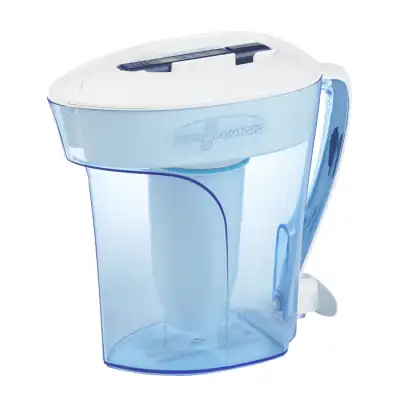
ZeroWater 10-Cup Ready-Pour Pitcher
Convenient ready-pour spout lets you fill a glass while the reservoir is still filtering. Includes free TDS meter.
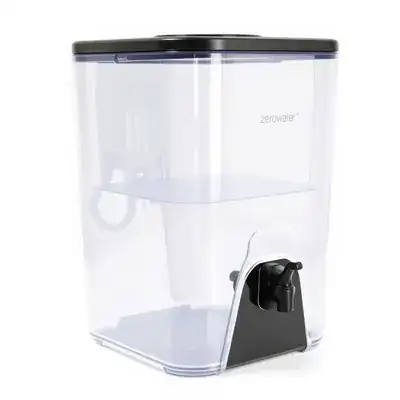
ZeroWater 23-Cup Dispenser
High-capacity countertop dispenser with push-button spigot. Fewer refills for large households.
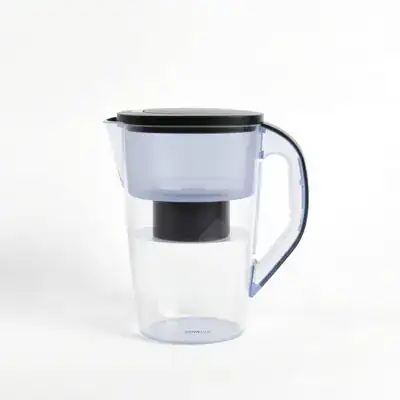
ZeroWater 6-Cup Pitcher
Smallest ZeroWater model. Same 5-stage filter and 000 TDS performance in a fridge-door-friendly footprint.
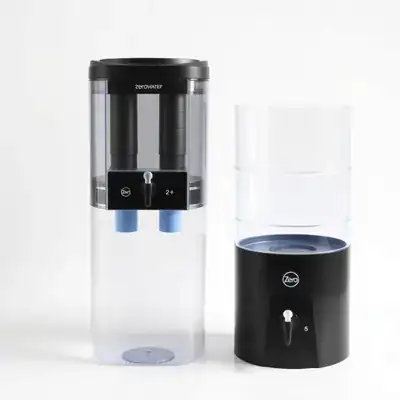
ZeroWater 40-Cup / 2.5 Gal Dispenser
Largest ZeroWater unit; uses two filters simultaneously for faster throughput and fewer refills.
Pre-filter tricks, TDS monitoring, and when to replace immediately.
Maximizing Filter Life
Pre-Filter High-TDS Water
Run water through an inexpensive Brita Standard filter first, then through ZeroWater. The Brita removes sediment and organic compounds that would otherwise clog the ZeroWater's ion exchange resin. This "dual-pitcher" approach extends ZeroWater filter life by 30–50% and costs only $3–5/month in Brita filters.
Weekly TDS Monitoring
Test filtered water weekly with the included TDS meter. Track readings in a simple spreadsheet or phone note. When output exceeds 006 TDS, replace the filter. This data-driven approach prevents both premature replacement (wasting money) and late replacement (reduced safety).
Proper Storage
Store the pitcher in the refrigerator at all times. Cold temperatures inhibit bacterial growth on the filter media and in the reservoir. Never leave filtered water sitting at room temperature for more than 24 hours—without chlorine protection, the purified water is more susceptible to bacterial contamination than tap water.
When to Replace Immediately
Replace the filter immediately if: (1) Water tastes fishy, acidic, or "off" — this means the resin is releasing trapped contaminants. (2) TDS reads 006+ ppm. (3) Filtration takes over 30 minutes per fill. (4) You notice discoloration in filtered water. Never attempt to clean or rinse ZeroWater filters—they cannot be regenerated.
Top Water Pitcher Picks
Not sold on ZeroWater? These are the other pitchers we recommend for different needs and budgets.
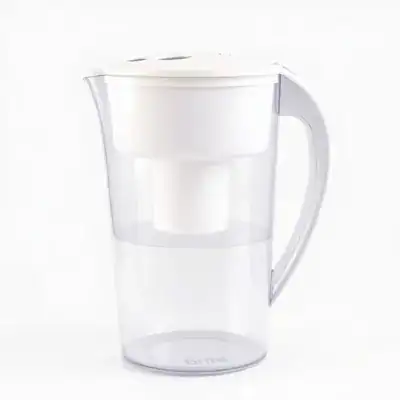
Brita Classic 10-Cup Pitcher
The cheapest, simplest way to improve tap water taste. Great for city water without heavy metal concerns.
ZeroWater 10-Cup Ready-Pour
The only pitcher that hits 000 TDS. Includes a free TDS meter so you can verify performance.
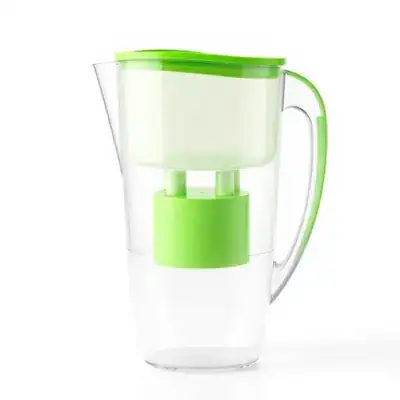
Clearly Filtered Pitcher
Premium pitcher tested to reduce 365+ contaminants including 99.7% PFAS and 99.5% lead — retains healthy minerals.
Common ZeroWater questions on lifespan, taste, safety, and comparisons.