RO Sizing Guide: Pick the Right GPD for Your Home
Stop guessing. Use real demand math, temperature correction, and pressure analysis to choose a system that actually meets your needs.
Choosing the wrong size reverse osmosis system is the most common—and most expensive—mistake homeowners make. Undersize it and you wait 30 minutes for the tank to refill after dinner. Oversize it and you waste money on a commercial-grade unit. The "75 GPD" sticker on every popular system is misleading: real-world output is 50-70% of that rating once you account for cold water, household pressure, and rising feed TDS.
This guide walks you through the actual math: calculating household demand, applying temperature correction factors, evaluating tank vs tankless trade-offs, and matching the right capacity to your contaminant removal goals. By the end, you will know exactly what GPD rating, tank size, and pressure setup your household needs.
Sizing also affects membrane lifespan and water waste. An undersized membrane runs at maximum flux constantly, fouling faster and producing more wastewater. The right size membrane operates at 60-80% capacity, lasts 3+ years, and minimizes drain water.
Step 1: Calculate Your Daily RO Water Demand
Start with a real demand audit. Most households underestimate by 40-60% because they forget about ice makers, coffee bars, pet water, and the gradual habit shift of drinking more water once filtered water is convenient. Use the table below to add up your demand:
| Use Case | Daily Gallons | Notes |
|---|---|---|
| Drinking water (per person) | 1.0-1.5 | Increases by 30-50% once RO is installed |
| Cooking (rice, pasta, soup, baby formula) | 0.5-1.0 | Higher with home cooking |
| Coffee maker / espresso machine | 0.3-0.8 | Specialty coffee drinkers use more |
| Ice maker (refrigerator) | 1.0-2.0 | Higher in summer / entertaining |
| Pet water bowls (per dog) | 0.2-0.5 | Cats use less |
| Aquarium top-off / changes | 2.0-10.0 | Reef tanks need DI water |
| Houseplants / indoor garden | 0.5-2.0 | Sensitive plants benefit from RO |
| Humidifier (winter) | 0.5-1.5 | Prevents mineral dust |
Worked Example: Family of 4
4 people drinking (1.2 x 4 = 4.8) + cooking (1.0) + coffee (0.5) + ice maker (1.5) + dog (0.3) = 8.1 gallons per day. Then multiply by 2.5x to account for derating and peak demand: target a system producing 20 gallons per day in real conditions. That maps to a 75 GPD tank-based system (real output ~38-53 gpd) or a 400 GPD tankless (real output ~200-280 gpd, with instant fill).
Step 2: Apply Temperature and Pressure Correction
The "75 GPD" rating on every membrane assumes lab conditions: 77 degrees F water, 60 PSI inlet pressure, and 500 ppm feed TDS. Most homes do not match these conditions. Cold winter water can cut production by half. Low pressure cuts it further. Use this two-step derating process:
Temperature Correction Factor (TCF)
| Water Temp | Multiplier | Typical Source |
|---|---|---|
| 77°F (25°C) | 1.00 (rated) | Summer slab plumbing |
| 67°F (19°C) | 0.82 | Spring/fall city water |
| 57°F (14°C) | 0.65 | Cool basement plumbing |
| 50°F (10°C) | 0.55 | Well water (year-round) |
| 45°F (7°C) | 0.45 | Winter well water (north) |
| 40°F (4°C) | 0.38 | Deep well, deep winter |
Pressure Correction Factor (PCF)
Test your home's pressure with a $10 hose bib gauge before sizing. Common ranges:
| Inlet PSI | Multiplier | Recommendation |
|---|---|---|
| 80 PSI | 1.10 | Add pressure regulator (high) |
| 60 PSI (rated) | 1.00 | Optimal—no action |
| 50 PSI | 0.85 | Acceptable |
| 40 PSI | 0.65 | Consider booster pump |
| 30 PSI | 0.45 | Booster pump required |
Real Output Formula: Rated GPD × TCF × PCF = Real GPD. Example: 75 GPD × 0.55 (50°F well water) × 0.85 (50 PSI) = 35 real gallons per day. If your demand is 8 gpd and you need 2.5x cushion (20 gpd), this 75 GPD system is sufficient. If you needed 30 gpd, you would need to upgrade to 100 GPD or add a booster pump.
Step 3: Tank vs Tankless Decision Matrix
Once you know your real GPD target, choose between tank-based (slower fill, lower upfront cost) and tankless (instant fill, higher cost, lower waste). Use this decision matrix:
| Factor | Tank-Based (50-100 GPD) | Tankless (400-1000 GPD) |
|---|---|---|
| Upfront cost | $150-400 | $400-1,200 |
| Fill speed at faucet | 0.5 gpm (slows as tank empties) | 0.5-1.0 gpm constant |
| Waste ratio | 3:1 to 4:1 | 1:1 to 2:1 |
| Under-sink space | Large (tank takes 12" x 16") | Compact (no tank) |
| TDS monitoring | Optional add-on | Built-in |
| Membrane life | 2-3 years | 2-3 years |
| Booster pump | Optional | Built-in |
| Best for | Budget, low demand, big space | Family of 4+, instant fill, eco |
Sizing Recommendations by Household Type
1-2 People
Demand: 2-4 gpd
Recommended: 50-75 GPD tank-based with 3.2 gallon tank
Budget pick: APEC ROES-50. Premium: Aquasana OptimH2O. Tank size is fine since refill happens between meals.
3-4 People
Demand: 5-10 gpd
Recommended: 75-100 GPD tank-based OR 400 GPD tankless
Most popular sweet spot. iSpring RCC7AK or Waterdrop G3 hit this perfectly. Step up to tankless if instant fill matters.
5-6 People
Demand: 10-15 gpd
Recommended: 600-800 GPD tankless
Tank systems struggle with peak morning/dinner demand. Waterdrop G3P800 or Frizzlife PD800 deliver instant fill.
7+ People / Multi-faucet
Demand: 15-25 gpd
Recommended: 1000+ GPD prosumer tankless
Waterdrop X16 or commercial-residential hybrids. Often paired with separate ice maker line.
Well Water Households
Demand: Standard + 30% derating
Recommended: 100 GPD tank or 600+ GPD tankless
Cold water year-round. Add iron/sediment pre-filtration. See best RO for well water.
Aquarium / Reef Hobbyist
Demand: 5-15 gpd dedicated
Recommended: Dedicated 100-200 GPD RO/DI
Use a separate system to keep DI from affecting drinking water taste. See our RO for aquariums guide.
Top RO System Recommendations by Size Category
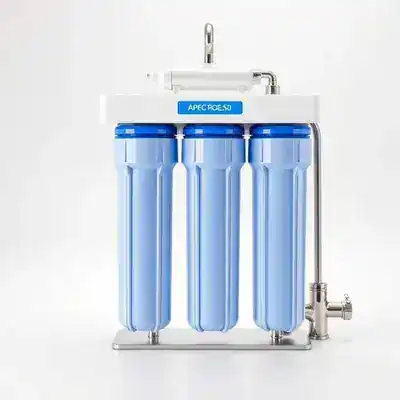
APEC ROES-50
- • 50 GPD TFC membrane
- • 5-stage filtration
- • 3.2 gallon tank
- • Made in USA
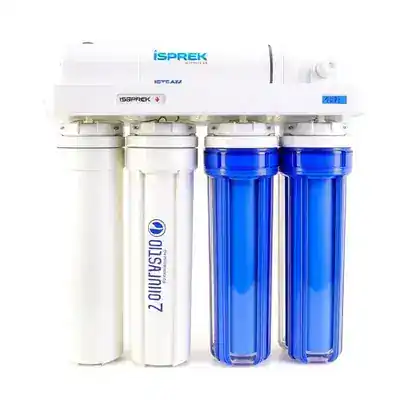
iSpring RCC7AK
- • 75 GPD Dow Filmtec membrane
- • 6-stage with remineralization
- • 3.2 gallon pressurized tank
- • NSF/ANSI 58 certified
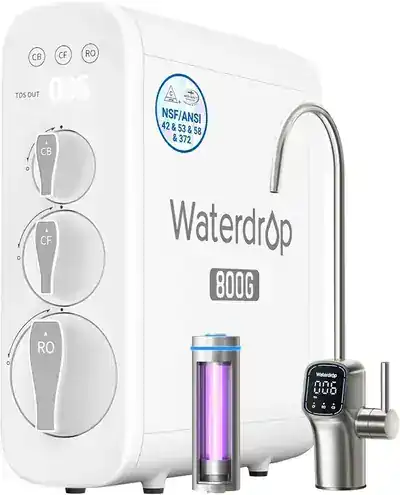
Waterdrop G3P800
- • 800 GPD composite TFC
- • Built-in TDS display
- • 3:1 waste ratio
- • UV sterilization stage
Common Sizing Mistakes to Avoid
Mistake 1: Using Rated GPD as Real GPD
A "75 GPD" membrane rarely produces 75 gallons in a real home. Cold water and average pressure typically deliver 38-53 actual gallons. Always derate by 0.5-0.7 multiplier when planning.
Mistake 2: Forgetting About Habit Shifts
Households drink 30-50% more water once RO is installed because it tastes better and is convenient. Ice maker usage also increases. Size for future habits, not current ones.
Mistake 3: Ignoring Inlet Pressure
Below 50 PSI, even a 100 GPD system performs like a 50 GPD system. Test pressure first—a $10 gauge can save you from buying the wrong unit. Add a booster pump or upgrade to tankless if pressure is low.
Mistake 4: Choosing Tank Size Last
A 100 GPD membrane with a 3.2 gallon tank still empties in 5 minutes during a dinner-prep rush. Match tank capacity to peak demand windows, not just daily totals.
Mistake 5: Skipping Pre-filter Sizing
Larger membranes need higher-flow sediment and carbon pre-filters. Mismatched pre-filters create back-pressure that derates the membrane and damages it over time. See our membrane guide.
Sizing for Specific Contaminant Removal Goals
If you are sizing primarily for contaminant removal—not just convenience—membrane selection matters more than capacity. High-rejection contaminants require fresh membranes operating at 60-80% of rated capacity for best removal rates:
- Lead removal: 99%+ requires fresh TFC membrane at 60-70% capacity. Oversize by one tier.
- Fluoride removal: 94-96% requires modern TFC—older CTA membranes only achieve 82-90%.
- PFAS removal: 95-97% requires NSF/ANSI 58 + 53 certified TFC. Verify certification.
- Arsenic removal: 97-99% (As V) requires fresh TFC. As III requires pre-oxidation.
- Nitrate removal: 85-95% with TFC, lower with CTA. Important for well water near agriculture.
Related RO Resources
RO Membrane Types: TFC vs CTA
Pick the right membrane chemistry for your water
RO Pressure Requirements
When you need a booster pump
RO Wastewater Reduction
Cut your waste ratio from 4:1 to 1:1
RO Remineralization
Add minerals back after filtration
Best RO for Well Water
Iron and sediment pre-treatment guide
Best Reverse Osmosis Systems
2026 rankings across all size categories
Frequently Asked Questions
Related Articles
Best Reverse Osmosis Systems
Top-rated RO water filters
Best Water Softeners
Top water softening systems
Our picks for Whole House Water Filters
Complete whole-house filtration
Top-rated Well Water Filters
Specialized well water treatment
Read: Water Filter Buying Guide
Avoid common buying mistakes
State Water Quality Guide
Water quality by state