Best Reverse Osmosis Systems for Well Water 2026
Lab tested RO systems built to survive well water conditions like iron, hardness, and pressure swings, while still delivering 95%+ removal of nitrates, arsenic, lead, and PFAS.
Quick Comparison: Top Well-Water RO Systems
Flow, certification, and price at a glance

| Product | Score | Type | GPD | Booster | Price | Actions |
|---|---|---|---|---|---|---|
4.6 / 5.0 | Tanked Under-Sink RO | 75 GPD | — | $199 – $239 | ||
4.5 / 5.0 | Tanked RO + Claryum | 35 GPD (rated) | — | $449 – $549 | ||
4.4 / 5.0 | Tankless SmartFlow RO | Continuous | ✓ | $399 – $499 |
Detailed Reviews
In-depth testing notes for every system in our shortlist
RCC7AK 6-Stage RO + Alkaline
iSpring
Best For:
Iron-bearing wells (>0.3 ppm) needing both pre-treatment and drinking-water RO in one ecosystem.
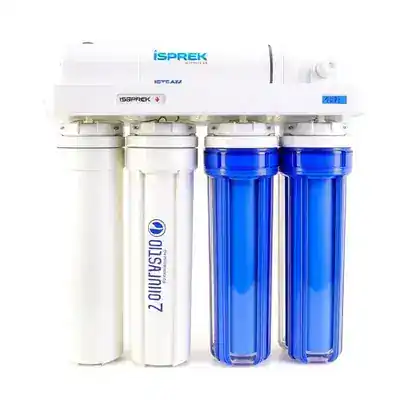
The budget workhorse for well-water RO. Pair the RCC7AK with a $50–$80 aftermarket booster pump and a whole-house sediment/iron filter and you get NSF-tested drinking water for under $400 total. Alkaline 6th stage rebalances minerals after the membrane.
Tanked Under-Sink RO
0.5 GPM tap
75 GPD
Membrane 2 yrs, pre-filters 6 mo
Pros
- Lowest cost-per-stage on the market
- Alkaline remineralization 6th stage
- Replacement filters cheap and everywhere
Cons
- Needs aftermarket booster pump for well pressure
- Tank reduces under-sink storage
- 1-year warranty
Price
OptimH2O Reverse Osmosis + Claryum
Aquasana
Best For:
Well households with existing pre-treatment that want premium SpringWell build quality and a built-in booster pump.
The only under-sink RO that's NSF certified for PFAS removal — critical if your well is downgradient of farmland, an airport, or fire-training sites. Adds Aquasana's Claryum carbon post-filter so water doesn't taste flat.
Tanked RO + Claryum
0.8 GPM tap
35 GPD (rated)
Carbon 6 mo, RO 1 yr
Pros
- NSF/ANSI 401 + P473 certified for PFAS
- Claryum carbon prevents 'flat' RO taste
- Designer brushed-nickel faucet
Cons
- No built-in booster pump
- Cartridge filters proprietary
- Tanked — needs cabinet space
Price
Claryum SmartFlow Reverse Osmosis
Aquasana
Best For:
Wells with variable pressure or cold-water temps where a booster pump and 800 GPD throughput matter most.
SmartFlow tech doubles efficient throughput (~1.4 GPM at the tap) without a holding tank, freeing under-sink space. Best when well water already has good pressure (≥50 PSI) and basic pre-filtration in place.
Tankless SmartFlow RO
1.4 GPM tap
Continuous
12 months
Pros
- 1.4 GPM peak — fastest non-tankless RO
- No bulky storage tank
- Claryum stage keeps minerals
Cons
- Needs steady ≥50 PSI well pressure
- No PFAS certification (use OptimH2O)
- Proprietary filters
Price
Well-Water RO Buying Guide
Well water destroys RO membranes that aren't protected. Here's the pre-treatment chain, sizing rules, and budget framework that keeps a system running for 5+ years.
The Well-Water RO Treatment Stack
RO is always the last drinking-water stage. Everything upstream protects the membrane.
Step Zero: Test Your Well First
Before sizing any stage above, run a $100–200 comprehensive panel. It tells you whether you need an iron filter, softener, or just RO — and skipping it is the #1 reason well water RO setups fail early.
Sediment (20 µ)
Spin-down catches sand, grit, rust at point-of-entry.
Iron / Sulfur
Air-injection (AIO) for iron >0.3 ppm or rotten-egg odor.
Softener
Add if hardness >10 GPG to stop membrane scaling.
5 µ + Carbon
RO's built-in pre-stages catch fines and chlorinated taste.
RO Membrane
Removes nitrates, arsenic, lead, PFAS, bacteria.
What RO Handles (and What It Doesn't)
Damages the Membrane
- Iron >0.3 ppm — irreversible fouling, replace
- Manganese >0.05 ppm — same oxidative damage
- Hardness >10 GPG — calcium scaling
- Chlorine on TFC membrane — pre-carbon required
Sizing & Cost of Ownership
Cold well water (50–55°F) cuts rated GPD by 25–35%. Always size up.
Sizing by Household
- 1–2 people50–75 GPD
- 3–4 people75–100 GPD
- 5+ people400+ GPD tankless
- Cold well water+50% size
Tankless w/ booster is the safe default for wells.
Annual Cost
- Sediment pre-filter$20–40
- Carbon pre/post$40–80
- RO membrane (2 yrs)$40–80/yr
- Iron filter media (5 yrs)$20–50/yr
Total operating cost: $120–250/year.
Common Mistakes When Purchasing
The five errors that turn a $400 RO system into a $400 paperweight within a year.
Skipping a water test
Buying before you know your iron, hardness, and nitrate levels almost always leads to the wrong system or no pre-treatment.
Ignoring iron and manganese
Anything above 0.3 ppm iron will foul the membrane in months. An iron filter upstream is non-negotiable for most wells.
Undersizing for cold water
Rated GPD assumes 77°F. At 50°F well temps you lose 25–35% of capacity. Size up at least one tier.
No booster pump
Well pressure swings between 30 and 50 PSI. Without a booster, rejection rates and production tank both drop hard.
Forgetting maintenance budget
Filters cost $120–250 per year. A cheap system with expensive proprietary cartridges costs more long term.
Buying NSF 42 only
For well water you want NSF 58 (TDS, arsenic, lead) and ideally 53 (cysts, VOCs). NSF 42 is just taste and odor.
Hire a Pro or DIY?
An under-sink RO is the most DIY-friendly stage. The pre-treatment side is where most homeowners should call a plumber.
You Can DIY If
- • Installing an under-sink RO with a standard cold water valve
- • Swapping pre-filters, post-filters, or the membrane
- • Adding a refrigerator line or a second faucet
- • You're comfortable with John Guest push fittings and a drill
- • Sanitizing the system annually
Plan on 2–3 hours for a first-time install.
Hire a Pro For
- • Whole-house iron, sulfur, or AIO systems at the well tank
- • Softener install with brine line and drain plumbing
- • UV sterilizer wiring near the pressure tank
- • Bypass loops, sweat-soldered copper, or PEX manifolds
- • Wells with bacterial contamination or arsenic above EPA limits
Expect $300–800 for a whole-house pre-treatment install.
Frequently Asked Questions
Related Articles
See the best Reverse Osmosis Systems
Top-rated RO systems with detailed comparisons
APEC or iSpring RO Comparison? Full breakdown
Head-to-head comparison of leading RO brands
How Waterdrop compares to iSpring RO Systems
Compare tankless vs tank RO systems
RO Installation Guide
Step-by-step RO system installation
Keep it running: RO Maintenance & Troubleshooting
Filter replacement schedules and common fixes
Our picks for Tankless RO Systems Guide
On-demand RO without storage tanks