RO for Aquariums: Complete Setup Guide for Hobbyists
Why reef and shrimp keepers use RO/DI water, how to size your system, remineralization recipes, and the best dedicated aquarium RO units of 2026.
Tap water is the silent killer of advanced aquarium hobbies. Chloramines stress fish, copper kills shrimp at 0.1 ppm, phosphates fuel algae, and unpredictable mineral content makes parameter management nearly impossible. Serious freshwater and saltwater hobbyists use RO water—or more often, RO/DI water—to control every variable in their tank.
This guide covers everything you need to set up a dedicated aquarium RO system: choosing between standard RO and RO/DI, sizing for your tank and water change schedule, remineralization recipes for different species, storage best practices, and the top 2026 systems built specifically for the hobby.
Whether you keep a 30-gallon community tank, a 200-gallon reef system, or a sensitive Caridina shrimp colony, the principle is identical: start with pure water (0-15 ppm TDS), then add exactly the minerals your livestock needs. This control is impossible with tap water—and it is why RO/DI is considered standard equipment in advanced aquarium keeping.
Why Tap Water Fails in Advanced Aquariums
| Tap Water Contaminant | Aquarium Impact | RO Removal |
|---|---|---|
| Chlorine (1-4 ppm) | Damages gills, kills fish | 99% (carbon) |
| Chloramine (0.5-3 ppm) | More toxic than chlorine | 95% (catalytic carbon) |
| Copper (0.1-1 ppm) | Kills invertebrates <0.1 ppm | 99%+ (RO) |
| Phosphate (0.5-3 ppm) | Fuels algae blooms | 95-99% (RO/DI) |
| Silicate (1-30 ppm) | Causes diatom blooms | 90-99% (RO/DI) |
| Nitrate (0-10 ppm) | Algae fuel, harms sensitive fish | 85-95% (RO) |
| Heavy metals (lead, zinc) | Accumulate in fish tissue | 99%+ (RO) |
| Pesticides (seasonal) | Lethal at low concentrations | 95-99% (carbon + RO) |
| Variable hardness/pH | Stress, breeding failure | Reset to baseline |
RO vs RO/DI: Which Do You Need?
The DI (Deionization) stage is a mixed-bed ion exchange resin that removes the final 2-5% of dissolved solids that RO membranes leave behind. This brings TDS from 5-15 ppm down to 0-1 ppm. For freshwater fish, this extra purity is optional. For sensitive species and reef tanks, it is essential.
Standard RO (5-15 ppm) Works For
- • Community freshwater tanks
- • Goldfish ponds
- • Tetras, barbs, danios, livebearers
- • Most cichlid tanks
- • Planted tanks (low-tech)
- • Quarantine and hospital tanks
RO/DI (0-1 ppm) Required For
- • Reef tanks (corals, anemones)
- • Saltwater fish-only with invertebrates
- • Caridina shrimp (CRS, taiwan bee)
- • Discus and rays
- • Breeding altum angelfish, soft water tetras
- • Wild-caught soft water species
- • High-tech CO2 planted tanks
Sizing Your Aquarium RO System
Match GPD output to your weekly water change volume + daily evaporation top-off + buffer for emergency changes:
| Tank Size | Weekly Change | Daily Top-off | Recommended GPD |
|---|---|---|---|
| 10-30 gal freshwater | 3-7 gal | 0.1-0.3 gal | 50 GPD RO |
| 30-75 gal freshwater | 8-15 gal | 0.3-0.7 gal | 75 GPD RO |
| 75-150 gal freshwater | 15-30 gal | 0.7-1.5 gal | 100 GPD RO/DI |
| 30-75 gal reef | 8-15 gal | 1-3 gal | 75-100 GPD RO/DI |
| 75-200 gal reef | 15-40 gal | 3-8 gal | 150 GPD RO/DI |
| 200+ gal reef | 40-80 gal | 5-15 gal | 200+ GPD RO/DI + booster |
| Shrimp tanks (any size) | 2-5 gal | 0.1-0.3 gal | 50-75 GPD RO/DI |
Pro Tip: Skip the Storage Tank
For dedicated aquarium use, skip the pressurized storage tank that comes with most RO systems. Instead, plumb the RO output directly to a 30-50 gallon HDPE mixing barrel with a heater and powerhead. This setup produces water faster (no tank back-pressure), allows you to pre-mix and age saltwater for 24+ hours, and accommodates emergency large water changes. Total cost: $50-100 for the barrel and pump.
Remineralization Recipes by Species
Pure RO/DI water has 0 TDS, 0 GH, 0 KH, and unstable pH (5.5-7.0). You must add minerals before adding to a tank or topping off:
Community Freshwater (Tetras, Corys, Livebearers)
Target: 6-8 GH, 4-6 KH, 7.0-7.5 pH, 200-300 TDS
Recipe: SeaChem Equilibrium (1.5 tsp per 5 gal RO) + Alkaline Buffer (1/4 tsp per 5 gal). Test and adjust to target.
African Cichlids (Mbuna, Peacocks)
Target: 12-18 GH, 10-15 KH, 7.8-8.5 pH, 400-600 TDS
Recipe: Brightwell NeoBuffer per directions, or DIY: 1 tbsp baking soda + 1 tsp Epsom salt + 1 tbsp aragonite per 10 gal RO. Test and adjust.
Discus / Soft Water Species
Target: 2-4 GH, 1-3 KH, 6.0-6.8 pH, 80-150 TDS
Recipe: Salty Shrimp GH+ at 1/8 strength. For pH lowering, use Indian almond leaves or peat in filter—avoid acid buffers in low-KH water.
Caridina Shrimp (CRS, Taiwan Bee)
Target: 4-6 GH, 0-1 KH, 5.5-6.5 pH, 100-150 TDS
Recipe: Salty Shrimp GH+ only (no KH+). Use active substrate (Brightwell ShrimpSubstrate, ADA Amazonia) to maintain low pH.
Reef Tank (Saltwater)
Target: 35 ppt salinity (1.025 SG), 8-12 dKH, 420-450 ppm Ca, 1300-1400 ppm Mg, 8.1-8.4 pH
Recipe: Reef salt mix (Red Sea Coral Pro, Tropic Marin Pro Reef) per directions. Heat to 78°F, mix with powerhead 24+ hours, test all parameters before adding to tank.
Top RO Systems for Aquariums
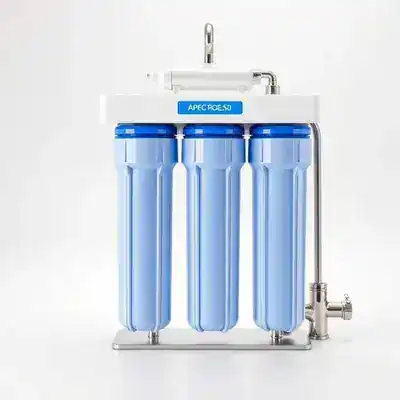
APEC ROES-50
- • 50 GPD output
- • Affordable filter replacements
- • Easy DI add-on
- • Great for tanks under 75 gal
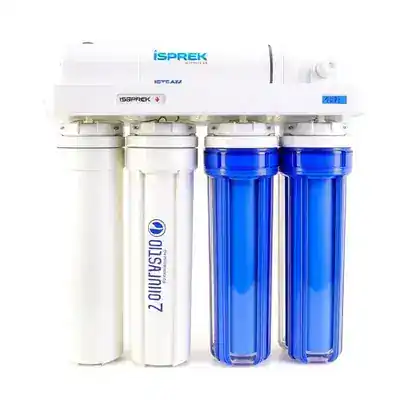
iSpring RCC7AK
- • 75 GPD with high rejection
- • Optional DI cartridge add-on
- • 6-stage filtration
- • Quick-connect fittings
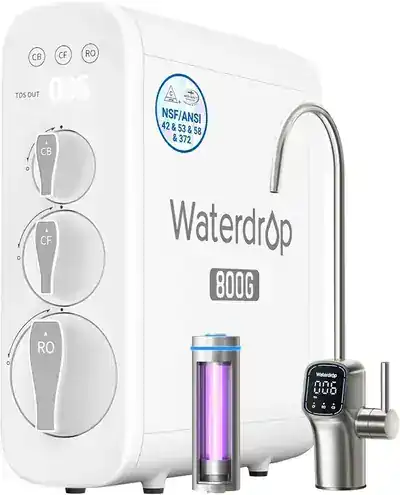
Waterdrop G3P800
- • 800 GPD for fast water changes
- • Built-in TDS monitoring
- • 1:1 efficient waste ratio
- • Dedicate to aquarium use
Common Aquarium RO Mistakes
Adding Pure RO Directly to Tank
Pure RO/DI water has zero buffering capacity. Adding it directly causes pH crashes, osmotic shock, and livestock death. Always remineralize and temperature-match before adding.
Skipping DI Resin Replacement
DI resin exhausts much faster than the RO membrane. For reef tanks, replace every 1-3 months when TDS reads above 1 ppm. Color-changing resin makes this easy to monitor.
Storing Mixed Saltwater Too Long
Mixed saltwater begins precipitating calcium and alkalinity after 7-14 days without circulation. Always keep mixed saltwater moving and heated, and use within 30 days.
Using RO Drinking Water Output for Reefs
Standard RO output (5-15 ppm) contains traces of phosphate and silicate that fuel algae. For reef tanks, always use RO/DI (0-1 ppm). Worth the small extra DI cost.
Forgetting to Test the Output
A failing RO membrane can produce 50+ ppm output that ruins reef tanks. Test RO/DI output TDS weekly with an inline or handheld meter. Take action when readings rise above target.
Related Resources
RO Sizing Guide
Match GPD to your aquarium needs
RO vs Distilled Water
Why hobbyists choose RO/DI
RO Membrane Types
Pick the right membrane for aquarium use
Filter Replacement Schedule
Including DI resin replacement
Copper in Water
Why copper kills aquarium invertebrates
Best Reverse Osmosis Systems
Full 2026 RO system rankings
Frequently Asked Questions
Related Articles
Top-rated Reverse Osmosis Systems
Top-rated RO water filters
Top-rated Water Softeners
Top water softening systems
Top-rated Whole House Water Filters
Complete whole-house filtration
Our picks for Well Water Filters
Specialized well water treatment
Water Filter Buying Guide
Avoid common buying mistakes
Read: State Water Quality Guide
Water quality by state