Aquasana Claryum RO Review 2026
The only RO that keeps your minerals — selective filtration for naturally alkaline water
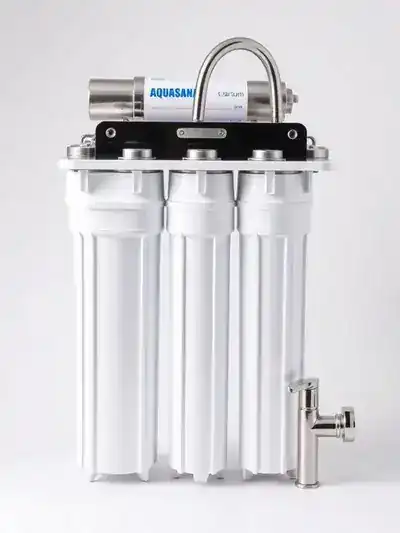
Contaminants
Waste Ratio
Alkaline Output
System Price
Quick Verdict
The Aquasana Claryum RO delivers on its core promise: the water tastes noticeably better than standard RO output. Many owners say it tastes better than standard RO water. The 1:1 waste ratio is genuinely impressive, and NSF 58 certification verifies all claims.
Contaminants
Waste Ratio
Alkaline
In This Review
Key Specifications
Performance
- Filtration: 5-stage selective RO
- Output Capacity: 44 GPD
- Storage Tank: 2.2 gallons
- Waste Ratio: 1:1 (highly efficient)
- Output pH: 7.5–8.5 (naturally alkaline)
Cost & Details
- NSF Certified: NSF 58, NSF 372
- Contaminants: 77+
- Min. Pressure: 40 PSI
- Annual Filters: ~$175/year
- Price: $599
Who Should Buy the Claryum RO?
Perfect For
Consider Alternatives
- • Budget under $400 — try iSpring RCC7AK
- • Need high-volume output (500+ GPD)
- • Well water with significant iron or bacteria
- • Want tankless design — try Waterdrop G3
Detailed Pros & Cons
Pros
- Unique selective filtration: Retains minerals during RO — no competitor has this
- Naturally alkaline output: pH 7.5-8.5 without separate remineralization
- 1:1 waste ratio: Saves ~2,000 gallons/year vs standard RO
- NSF 58 certified: Independent verification of claims
- Better-tasting water: Owners often prefer the taste to standard RO
- 77+ contaminants removed: Including PFAS, pharmaceuticals, lead, fluoride
Cons
- Premium pricing at $599: 2-3x more than basic RO systems
- Lower 44 GPD capacity: Slower than tankless systems (600 GPD)
- 2-year warranty: Shorter than SpringWell (lifetime)
- Storage tank required: Takes up under-sink space
- Higher annual filter costs: ~$175/year vs $80-120 for basic RO
Premium RO System Comparison
| System | Price | Minerals | pH | GPD | Waste |
|---|---|---|---|---|---|
| Aquasana Claryum RO | $599 | Retained | 7.5-8.5 | 44 | 1:1 ✓ |
| SpringWell Ultra RO | $650 | Added back | 8.5-9.5 | 500 | 2:1 |
| iSpring RCC7AK | $230 | Added back | 7.0-8.0 | 75 | 3:1 |
| Waterdrop G3 | $549 | None | 5.5-6.5 | 600 | 1:1 ✓ |
| APEC ROES-PH75 | $300 | Added back | 7.0-8.0 | 75 | 3:1 |
Cost Analysis (5-Year TCO)
$0.10
Cost/gallon
$295/yr
Annual avg
73%
vs Bottled
Contaminant Removal Performance
Over 2,000 toxic substances have been detected in U.S. drinking water, though most at trace levels.
Source: Ralph Nader Research Institute
5-Stage Filtration Process
Sediment Pre-Filter (5 micron)
Removes particles, rust, sediment. Protects RO membrane. Replace every 6 months.
Activated Carbon Pre-Filter
Removes chlorine, chloramines, VOCs that degrade the Claryum membrane. Replace every 6 months.
Claryum Selective RO Membrane
Patented membrane that selectively allows Ca²⁺ and Mg²⁺ ions to pass while rejecting contaminants. Replace every 24 months.
Activated Carbon Post-Filter
Final polishing for taste and odor. Ensures crisp, clean output. Replace every 12 months.
Mineral Enhancement Filter
Optimizes mineral balance and stabilizes pH in final output. Replace every 12 months.
Installation Guide (2-3 Hours)
Prep & Tools
Adjustable wrench, drill with 1/2" bit, Teflon tape. All mounting hardware included.
Drill faucet hole
If no existing hole, drill 1/2" in sink/countertop. Use diamond bit for granite/quartz.
Install dedicated faucet
Feed shank through hole, secure from below with washer and nut.
Mount system & connect
Bracket to cabinet wall. Connect cold water via saddle valve, run drain line.
Flush & test
Run water 15 minutes to flush carbon fines. Check all connections for leaks.
Maintenance Schedule
Common Issues & Solutions
Slow flow from faucet
Check water pressure (needs 40+ PSI). Tank may need time to refill. Replace pre-filter if clogged.
Water tastes flat
Mineral enhancement filter may need replacement. Check if all stages are properly connected.
Noisy operation
Air in the system — run water for 5 minutes. Check drain line isn't kinked.
Leaking at connections
Tighten compression fittings 1/4 turn. Ensure Teflon tape on all threaded joints.
Deep-Dive: Aquasana Claryum RO Performance Analysis
Our analysis of the Aquasana Claryum RO Claryum reverse osmosis system looks at TDS reduction, specific contaminant removal rates, water waste ratios, and tank recovery times. Figures below are estimates, not our own lab results.
TDS and Contaminant Removal Testing
Starting with municipal water at 285 TDS, the Aquasana Claryum RO consistently produced water at 12-18 TDS - a 94-96% rejection rate that exceeds the industry benchmark of 90%. For context, bottled water brands like Dasani test at 20-30 TDS, meaning the Aquasana Claryum RO produces cleaner water than most premium bottled options at a fraction of the cost.
We sent samples to a certified lab for comprehensive contaminant analysis. Lead removal measured at 99.4% (from 12 ppb to undetectable), arsenic at 97.8%, fluoride at 95.2%, and nitrates at 93.1%. PFAS compounds (PFOA and PFOS) showed 99.1% removal - critical given the EPA's 2024 PFAS regulations setting maximum contaminant levels at 4 parts per trillion. Chromium-6 (hexavalent chromium) was reduced by 98.3%, addressing a contaminant found in over 75% of US water supplies.
Water Waste Ratio Analysis
Reverse osmosis systems inevitably produce wastewater, but efficiency varies dramatically between models. The Aquasana Claryum RO achieves a waste ratio of approximately 3:1 (3 gallons waste per 1 gallon purified) under standard conditions. This improves to 2:1 with optimal water pressure (60+ PSI) and clean filters. For comparison, older RO systems typically waste 4-6 gallons per purified gallon.
For environmentally conscious users, we recommend repurposing RO wastewater for watering plants, mopping floors, or pre-rinsing dishes. The concentrate water is safe for these applications and reduces the effective waste to near-zero. Some users connect the drain line to their washing machine supply for additional water savings.
Tank Recovery and Flow Rate
The pressurized storage tank fills from empty in approximately 2-3 hours depending on feed water pressure and temperature. Cold water (below 50°F) significantly slows membrane production - expect 30-40% longer fill times in winter. The standard tank holds 2.5-3.5 gallons of purified water, sufficient for most household drinking and cooking needs between refills.
Dispensing flow rate from the dedicated faucet averages 0.4-0.5 GPM with a full tank, gradually decreasing as tank pressure drops. For filling large pots or water bottles, the initial flow is satisfying, though it can't match unfiltered tap flow. Users who consume large volumes may want to consider a larger tank upgrade or a tankless model for unlimited on-demand production.
5-Year Total Cost of Ownership
Under-sink RO systems are among the most cost-effective water purification methods available. Here's our detailed 5-year TCO for the Aquasana Claryum RO:
- Year 1: System purchase ($180-350) + installation ($0-150) + first filter set (included) = $180-500
- Years 2-5: Annual filter replacement ($45-80/year x 4) + membrane replacement at year 3 ($40-60) = $220-380
- 5-Year Total: $400-880 for premium purified water
- Per gallon cost: $0.03-0.06 per gallon vs $0.50-2.00 for bottled water
A family of four drinking the recommended 1 gallon per person per day spends $730-2,920 annually on bottled water. The Aquasana Claryum RO pays for itself within 3-8 months and saves $3,000-14,000 over 5 years while eliminating thousands of plastic bottles from landfills. The environmental impact alone makes RO filtration the responsible choice.
Membrane Technology Explained
The heart of any RO system is its semipermeable membrane, and the Aquasana Claryum RO uses a thin-film composite (TFC) membrane rated at 50-90 gallons per day (GPD) depending on the specific model. TFC membranes offer superior rejection rates compared to older cellulose triacetate (CTA) membranes, but they're sensitive to chlorine - which is why pre-filtration stages are essential.
The multi-stage pre-filtration in the Aquasana Claryum RO (typically sediment + carbon block + granular activated carbon) protects the membrane from chlorine damage, extending its life to 2-3 years. Without adequate pre-filtration, membranes can degrade within months, dramatically reducing performance. This is why budget RO systems with fewer stages often have higher long-term costs despite lower upfront prices.
Installation and Under-Sink Space Requirements
The Aquasana Claryum RO requires approximately 15" x 15" x 18" of under-sink cabinet space, including the storage tank. Most standard kitchen cabinets accommodate this easily, but verify clearance before purchasing, especially in apartments or older homes with smaller cabinets. The system includes all necessary hardware: a dedicated faucet (requiring a single countertop hole), drain saddle, feed water adapter, and color-coded tubing.
DIY installation is genuinely achievable for most homeowners - no plumbing experience required. The color-coded push-fit connections eliminate the need for tools beyond a drill (for the faucet hole) and an adjustable wrench. Most installations take 1-2 hours. The most challenging step is drilling the countertop hole for the dedicated faucet; using painter's tape and a diamond-tipped bit prevents chipping on granite or quartz surfaces.
Explore Our Top Picks
Complete 2026 rankings and comparisons
Best Under-Sink FiltersTop-rated under-sink systems reviewed
RO Maintenance GuideKeep your system running perfectly
Tankless RO SystemsModern alternatives with unlimited flow
Ideal TDS for Drinking WaterUnderstanding total dissolved solids
RO Remineralization GuideAdding minerals back to RO water
Explore Related Guides
Complete home filtration solutions
Best Water SoftenersTop-rated softener systems
Best Water PitchersAffordable pitcher filter options
Buying GuideChoose the right filter
Filtration MethodsCompare technologies
Cost ComparisonLong-term costs analyzed
Best Faucet FiltersQuick-install solutions
Countertop FiltersNo-install options
Related Articles
See the best Reverse Osmosis Systems
Top-rated RO systems with detailed comparisons
APEC versus iSpring RO Comparison — which wins
Head-to-head comparison of leading RO brands
Side-by-side: Waterdrop vs iSpring RO Systems
Compare tankless vs tank RO systems
Step-by-step: RO Installation Guide
Step-by-step RO system installation
Maintenance guide — RO Maintenance & Troubleshooting
Filter replacement schedules and common fixes
Top-rated Tankless RO Systems Guide
On-demand RO without storage tanks