Water Filtration Methods Explained: The Complete 2026 Guide
How carbon, reverse osmosis, ion exchange, UV, sediment and other filtration methods work, what each one reduces and where each falls short. Use it to match a treatment method to a problem your water test has actually found.
Choose a method for a measured problem
Start with your water report or a laboratory test, not a removal percentage.
- Match each stage to a specific contaminant.
- Verify exact-model reduction claims and maintenance.
- Ordinary carbon and household RO are not emergency disinfection guarantees.
Choosing the Right Filtration Method
No single filtration method removes everything. Each technology targets specific types of contaminants based on their physical and chemical properties. The most effective approach often combines multiple methods in a multi-stage system. Understanding the science behind each method empowers you to make informed decisions rather than relying on marketing claims.
The water filtration industry generates over $15 billion annually, and manufacturers often overstate their products' capabilities. By understanding the fundamental principles of each technology, you can cut through the noise and select exactly what your water needs—nothing more, nothing less.
Quick Selection Guide:
- • Chlorine & bad taste? → Activated carbon filter (countertop or pitcher)
- • Lead, arsenic, or PFAS? → Reverse osmosis system
- • Bacteria in well water? → UV sterilization + sediment pre-filter
- • Hard water & scale? → Water softener (ion exchange)
- • Sediment & rust? → Sediment pre-filter
- • Multiple concerns? → Multi-stage system combining methods
Always test your water first to identify specific contaminants before choosing filtration.
Detailed Filtration Methods Comparison
Activated Carbon Filtration
Chlorine taste and odor (model-dependent), VOCs, pesticides, herbicides, bad taste/odor, THMs/HAAs, some industrial chemicals
Heavy metals (lead, arsenic), fluoride, nitrates, bacteria, viruses, dissolved minerals
Taste and odor improvement, chlorine removal, municipal water with basic concerns
$20-$300 (pitcher to whole house)
Filter replacement every 3-12 months depending on capacity
Reverse Osmosis (RO)
Specific dissolved contaminants including some metals, salts and fluoride; verify each claim for the exact system
Some VOCs require carbon pre-filter, produces wastewater (2-4 gallons per gallon filtered)
Maximum purification, heavy metals, dissolved solids, comprehensive protection for families
$200-$600 (under sink), $1,500-$3,000 (whole house)
Membrane replacement every 2-3 years, pre-filters every 6-12 months
UV Light Sterilization
Microorganisms within the exact unit’s validated dose, flow and inlet-water conditions; UV inactivates rather than removes
Chemical contaminants, particles, dissolved solids, heavy metals, chlorine
Microbiological protection, well water, immunocompromised households, bacteria concerns
$200-$800 (point-of-use), $600-$1,200 (whole house)
UV bulb replacement annually, minimal upkeep
Ion Exchange / Water Softeners
Hardness minerals (calcium, magnesium), some heavy metals (barium, radium), scale buildup
Organic contaminants, bacteria, chlorine, PFAS, fluoride, most chemicals
Hard water treatment, scale prevention, protecting appliances
$400-$2,500 (whole house softener)
Salt refills monthly, resin cleaning every 5-10 years
Sediment Filters
Dirt, rust, sand, silt, particles (typically 5-50 microns), turbidity
Dissolved contaminants, chemicals, bacteria, heavy metals, chlorine
Pre-filtration, protecting downstream filters, well water with sediment, visible particles
$15-$100 per filter
Replacement every 3-6 months or when flow decreases
How Water Filtration Technologies Work
Activated Carbon: Adsorption Technology
Activated carbon is made from coconut shells, coal, or wood that's been "activated" by heating to 1,000°C, creating millions of microscopic pores. This porous structure provides a massive surface area (1 gram of activated carbon has 3,000 m² of surface area—about half a football field).
How it works: As water passes through, organic molecules (chlorine, VOCs, pesticides) stick to the carbon surface through a process called adsorption. The carbon acts like a sponge, trapping contaminants in its pores. The process is purely physical—no chemicals are added to the water.
Why it doesn't remove metals: Heavy metals like lead and arsenic are dissolved ions (electrically charged atoms), not molecules. They don't stick to carbon surfaces effectively. This is why carbon filters CANNOT be relied upon for lead removal despite some manufacturers' misleading claims.
Carbon types matter: There are three main types of activated carbon used in water filtration, each with distinct performance characteristics. Granular Activated Carbon (GAC) uses loose granules and is the most affordable but least effective due to shorter water contact time. Carbon Block compresses carbon into a solid block, providing 5-10x more contact time and superior contaminant removal. Catalytic Carbon is specially treated to break down chloramines (used by 30%+ of US water utilities), which standard carbon cannot effectively remove.
Types: Granular activated carbon (GAC), carbon block, catalytic carbon. Carbon block is most effective due to longer contact time. Browse carbon filter systems →
Reverse Osmosis: Molecular Filtration
Reverse osmosis uses pressure (typically 60-80 PSI from household water pressure) to force water through a semi-permeable membrane with microscopic pores just 0.0001 microns wide—about 1/1,000,000th of a millimeter. This is the gold standard for comprehensive water purification.
How it works: Only water molecules (H₂O) are small enough to pass through the membrane pores. Everything larger—including dissolved minerals, heavy metals, salts, bacteria, viruses, and chemical contaminants—is physically blocked and flushed away as wastewater. The process is elegant in its simplicity: size exclusion at the molecular level.
Multi-stage process: RO systems use 3-7 stages: (1) Sediment pre-filter removes particles, (2) Carbon pre-filter removes chlorine (which damages RO membranes), (3) RO membrane removes specific dissolved contaminants within verified model limits, (4) Carbon post-filter polishes taste, (5) Optional remineralization adds back calcium/magnesium for taste and pH balance.
Efficiency: Compare the manufacturer’s pure-to-drain ratio under its specified test conditions. Tankless designs avoid a storage tank but still need hygienic maintenance; no configuration eliminates contamination risk.
Efficiency: Traditional RO wastes 2-4 gallons per gallon produced. Tankless RO systems are more efficient (1:1 to 2:1 ratio). Browse RO systems →
UV Sterilization: DNA Destruction
UV light at 254 nanometer wavelength penetrates the cell walls of bacteria, viruses, and protozoa, disrupting their DNA and RNA. This prevents them from reproducing and renders them unable to infect or cause disease. UV sterilization is the most reliable chemical-free method for biological water treatment.
How it works: UV light can inactivate microorganisms when the system delivers its validated dose at the actual flow and inlet-water conditions. It does not remove chemicals or sediment and leaves no residual protection.
Limitations: UV light doesn't remove dead organisms or alter water chemistry. It only deactivates living microorganisms. Pre-filtration is required because particles and turbidity can shield bacteria from UV light (called "shadowing"). UV does NOT remove chemicals, heavy metals, or dissolved contaminants. Water must be clear (turbidity below 1 NTU) for UV to be effective.
Dose requirements: The EPA recommends a minimum UV dose of 40 mJ/cm² for drinking water disinfection. Quality UV systems deliver 2-3x this minimum for safety margin. Flow rate matters—slower flow = higher dose per organism. Oversizing your UV system ensures adequate treatment even during peak flow periods.
Essential for: Well water, immunocompromised households, areas with bacterial contamination. Often combined with RO or carbon filters. Learn about UV systems →
Ion Exchange: Chemical Swapping
Ion exchange uses resin beads coated with sodium ions. As hard water flows through, calcium and magnesium ions (which cause hardness and scale) swap places with sodium ions on the resin—literally exchanging ions, hence the name.
How it works: The resin tank is filled with millions of tiny beads. Each bead is charged with sodium (Na⁺). When hard water passes through, calcium (Ca²⁺) and magnesium (Mg²⁺) ions—which are more strongly attracted to the resin—displace the sodium and stick to the beads. The sodium is released into the water. This process continues until the resin is saturated with hardness minerals.
Regeneration: Eventually the resin becomes saturated with hardness minerals. The system then backwashes with salt brine (concentrated NaCl solution), which floods the resin with sodium, displacing the calcium and magnesium. These minerals flush to drain, and the resin is recharged with sodium, ready to soften water again. Modern smart softeners like the SpringWell SS1 use demand-initiated regeneration to minimize salt and water waste.
Salt-free alternatives: Template Assisted Crystallization (TAC) systems don't actually remove hardness minerals but instead transform them into microscopic crystals that won't stick to surfaces. These "salt-free softeners" (technically conditioners) like the SpringWell FutureSoft prevent scale buildup without adding sodium to your water—ideal for low-sodium diets or areas with water softener bans.
Note: Softeners add sodium to water (about 12.5 mg per grain of hardness removed). Not suitable for drinking water purification. Browse water softeners →
Sediment Filters: Mechanical Straining
Sediment filters are the simplest filtration method—they're essentially fine mesh screens that physically block particles larger than their pore size. Think of them as sieves for water. Despite their simplicity, they play a critical role in protecting more expensive downstream filtration equipment.
How it works: Water flows through pleated material (polypropylene, polyester, or cellulose) with uniform pores. Particles larger than the pore size get trapped on the surface or within the filter media. Common ratings: 50 micron (coarse), 20 micron (medium), 5 micron (fine), 1 micron (very fine). The tighter the micron rating, the more particles removed—but also the faster the flow restriction and the more frequent the replacement needed.
Critical role in systems: Sediment filters are typically the first stage in multi-stage systems because they protect expensive downstream filters (carbon, RO membranes) from clogging with particles. A $15 sediment filter prevents damage to a $200 RO membrane. In well water applications, sediment pre-filtration is absolutely essential—well water often contains sand, silt, and rust particles that would quickly destroy carbon filters and RO membranes without protection.
Replacement: Sediment filters clog quickly (3-6 months) depending on water quality. Decreased water pressure indicates it's time to replace. Learn about filter replacement →
Recommended Filtration Systems by Category
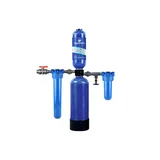
Aquasana Rhino Whole House Water Filter
Aquasana Rhino Whole House Water Filter
Compare for chlorine taste and odor on city water. This carbon system is not a softener or disinfectant; check chloramine requirements separately.
Compare sizing, treatment options and ongoing costs in our best whole house water filters guide.
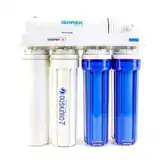
iSpring RCC7AK 6-Stage RO System
iSpring RCC7AK 6-Stage RO System
A kitchen RO option for compatible drinking-water needs. Check exact contaminant claims, inlet pressure and cartridge costs.
Compare sizing, treatment options and ongoing costs in our best reverse osmosis systems guide.
Multi-Stage Filtration Systems
The most effective water filtration combines multiple technologies in sequence, with each stage targeting specific contaminant categories. Think of it as layers of defense—each stage handles what the previous one cannot. This approach provides comprehensive protection that no single technology can achieve alone.
Well Water System (5-Stage)
- 1. Sediment Filter (5-20 micron): Removes dirt, sand, rust
- 2. Iron/Manganese Filter: Oxidizes and removes dissolved metals
- 3. Carbon Filter: Removes sulfur smell, chlorine (if chlorinated)
- 4. UV Sterilizer: Kills bacteria, viruses, parasites
- 5. RO (optional): Removes nitrates, arsenic, other dissolved contaminants
Under Sink RO System (4-6 Stage)
- 1. Sediment Pre-filter: Protects RO membrane from particles
- 2. Carbon Pre-filter: Removes chlorine (which damages membrane)
- 3. RO Membrane: Removes specific dissolved contaminants within verified model limits
- 4. Carbon Post-filter: Polishes taste, removes residual odors
- 5. Remineralization (optional): Adds back calcium/magnesium
- 6. UV (optional): Final bacteria/virus protection
Whole House System (3-Stage)
- 1. Sediment Filter: Removes particles throughout home
- 2. Carbon Filter: Chlorine removal for drinking, bathing, appliances
- 3. Water Softener (optional): Hardness removal, scale prevention
Filtration Method Cost Comparison
Understanding total cost of ownership (TCO) helps you make smart investments. The cheapest upfront option isn't always the most economical long-term. Here's a comprehensive cost breakdown for a family of four over 5 years:
| Method | Upfront Cost | Annual Maintenance | 5-Year TCO | Cost Per Gallon |
|---|---|---|---|---|
| Pitcher Filter | $25-40 | $36-96 | $205-520 | $0.08-0.15 |
| Faucet Mount | $25-40 | $60-100 | $325-540 | $0.10-0.20 |
| Under-Sink Carbon | $100-300 | $40-80 | $300-700 | $0.04-0.08 |
| Under-Sink RO | $200-600 | $60-150 | $500-1,350 | $0.06-0.12 |
| Whole House Carbon | $800-2,000 | $100-300 | $1,300-3,500 | $0.01-0.03 |
| Water Softener | $400-2,500 | $50-150 (salt) | $650-3,250 | $0.005-0.02 |
Comparison to bottled water: A family of 4 drinking 3 gallons/day of bottled water spends $1,642/year ($8,210 over 5 years). Even the most expensive home filtration system saves thousands while producing less plastic waste.
Filter Certifications Matter
NSF International provides third-party testing and certification for water filters. These certifications verify that filters actually remove what manufacturers claim. Without independent certification, you're relying solely on marketing claims that may be exaggerated or outright false.
- • NSF 42: Aesthetic effects (chlorine, taste, odor) — the most basic certification
- • NSF 53: Health effects (lead, arsenic, VOCs, cysts) — critical for safety
- • NSF 58: Reverse osmosis systems — verifies membrane performance
- • NSF 401: Emerging contaminants (pharmaceuticals, herbicides)
- • NSF P473: PFAS reduction (forever chemicals) — increasingly important
- • NSF 55: UV sterilization systems — verifies microbial kill rate
⚠️ Warning: "NSF Certified Components" is NOT the same as "NSF Certified System." Only full system certification guarantees performance. Manufacturers sometimes use misleading language—always verify at NSF's online database.
Explore Our Top Picks by Category
Best RO Systems
Top-rated reverse osmosis systems reviewed
Best Whole House Filters
Carbon and multi-stage whole house systems
Best Under-Sink Filters
Point-of-use filtration for drinking water
Best Water Softeners
Salt-based and salt-free softener reviews
Best Water Pitchers
Budget-friendly carbon pitcher filters
Best Countertop Filters
No-installation countertop systems
Key Questions, Answered
What's the best water filtration method for home use?
Test first. Carbon often suits chlorine taste and odor; RO can reduce specific dissolved contaminants, and validated UV can provide disinfection when appropriate. No single method solves every water problem.
Does activated carbon remove lead and heavy metals?
Ordinary taste-and-odor carbon is not a lead guarantee. Some specialized carbon-block systems are certified for lead reduction; verify the exact model and claim. Other metals need their own verified treatment.
Can I combine multiple filtration methods?
Yes. Choose each stage for a measured need and follow the manufacturer’s treatment order. Sediment can protect later equipment, carbon can address taste, RO can reduce dissolved contaminants and suitable UV can provide disinfection. Remineralization is optional for taste.
Frequently Asked Questions
Related Articles
Top-rated Reverse Osmosis Systems
Top-rated RO water filters
Our picks for Water Softeners
Top water softening systems
Buying guide: Whole House Water Filters
Complete whole-house filtration
Top-rated Well Water Filters
Specialized well water treatment
More on Water Filter Buying Guide
Avoid common buying mistakes
Deep dive — State Water Quality Guide
Water quality by state