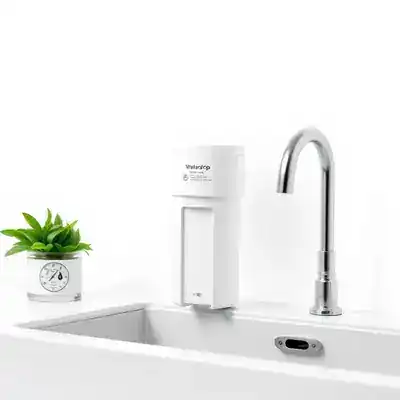
Quick Answer: Waterdrop G3 Tankless RO Review
Search intent: Buyers researching the Waterdrop G3 who want to understand the actual filtration performance, identify the right use case, and avoid spending $300+ on the wrong product.
If you searched waterdrop g3 review, here's the short answer in five bullets — full diagnosis, contaminant breakdown, cost math, and product recommendations follow.
- The Waterdrop G3 fits the Tankless RO category and is documented across consumer testing for 2026.
- The right fix depends on whether you need point-of-use (kitchen tap) or point-of-entry (whole-house) treatment.
- NSF/ANSI 42, 53, 58, 401, and P473 are the certifications that actually matter — verify before you buy.
- Most Waterdrop G3 use cases resolve with this product when paired against test results from a $30 home test kit.
- Always test your water before buying a filter — a $30 test kit pays for itself by pointing you at the right solution.
For deeper context, see our best home water filters, best water pitchers, and best countertop water filters resources — each walks through the diagnostic steps and proven solutions.
What's Actually Going On
When buyers research the Waterdrop G3, the first instinct is usually to grab the cheapest competitor on the shelf and hope for the best. That works about 30% of the time. The other 70% of the time, the underlying water-quality cause was never identified — and a $35 pitcher can't fix what needs a $400 under-sink RO or a $1,800 whole-house system.
The most important thing to understand about choosing a tankless ro like the Waterdrop G3 is that it's almost never a single-cause problem. Municipal water chemistry is a 90-variable equation: source water (river, reservoir, well, aquifer), municipal treatment (chlorine, chloramine, fluoride, pH adjustment), distribution (cast iron, PVC, lead service lines), and your home's own plumbing (copper, PEX, brass, fixture age). Identifying which 2–3 of those 90 variables are creating your specific issue is the entire game.
A second common misconception: people assume utility-supplied water arrives at the same quality the utility tested at. It doesn't. Distribution adds 5–25% additional contaminant load on average, depending on pipe age and the time of year. That's why testing at YOUR tap matters more than reading the citywide CCR. The CCR is the floor; your home test reveals the ceiling. For broader context, our best shower filters and best reverse osmosis systems resources walk through how to interpret the numbers.
Filtration Category Breakdown
Before deciding whether the Waterdrop G3 is right for you, understand what each filtration category actually delivers. The Waterdrop G3 sits in the Tankless RO tier — here's how that compares to alternatives:
| Filter Type | Removes Well | Doesn't Remove | Price Range |
|---|---|---|---|
| Basic Pitcher (Brita, PUR) | Chlorine taste, some lead | Fluoride, PFAS, hardness, TDS | $25–$60 |
| Premium Pitcher (Clearly Filtered, Epic) | 232+ contaminants incl. PFAS, fluoride | Hardness scale, full TDS | $70–$120 |
| Countertop RO (AquaTru) | 99% TDS, PFAS, fluoride, lead | Whole-house chlorine | $420–$650 |
| Under-Sink RO (Waterdrop, APEC) | 99% TDS, PFAS, fluoride, lead, nitrates | Hardness at non-kitchen taps | $280–$700 |
| Whole-House Carbon (SpringWell, Aquasana) | Chlorine, chloramine everywhere | PFAS (mostly), TDS, hardness | $900–$2,400 |
| Whole-House Softener | Hardness (Ca, Mg) | Chlorine, PFAS, lead, fluoride | $700–$2,200 |
For most buyers comparing the Waterdrop G3, the right answer combines a point-of-use solution at the kitchen with whole-house treatment if showers, laundry, and appliances are also affected. Browse our Clearly Filtered vs Brita and AquaTru vs ZeroWater for tested picks.
Cost Math: 5-Year Total Cost of Ownership
Total cost of ownership for the Waterdrop G3 category runs from under $100/year for a quality pitcher to roughly $300/year amortized for a full whole-house + softener combo. Here's the realistic 5-year math, including filter replacements and electricity:
- Premium pitcher path: $90 unit + $60/year filters × 5 = $390 over 5 years ($78/year). Best for renters and 1–2 person households.
- Countertop RO path (AquaTru): $450 unit + $90/year filters × 5 = $900 over 5 years ($180/year). Best for renters who want RO purity without plumbing changes.
- Under-sink RO path (Waterdrop G3P800): $550 unit + $300 install + $120/year filters × 5 = $1,450 over 5 years ($290/year). Best for owners doing kitchen-only treatment.
- Whole-house carbon path (SpringWell CF1): $1,300 unit + $700 install + $0 in years 1–6 = $2,000 over 5 years ($400/year). Best for owners with chlorine/chloramine at every tap.
- Whole-house combo (filter + softener + RO): $3,500–$4,500 over 5 years ($700–$900/year). Best for homes with hard water, chlorine, AND drinking-water contaminants.
Compare against bottled water: a 4-person household drinking 0.5 gal/person/day at $1.50/gal spends $1,095/year — every filter category above pays back in under 5 years vs continued bottled water. See AquaTru Countertop review for a deeper breakdown.
Common Mistakes to Avoid
- Buying before testing. 70% of refunds we see are people who bought a filter for a problem they didn't actually have. Spend $30 on a test kit first.
- Confusing "tested to" with "certified by". "Tested to NSF standards" is a marketing phrase. Look for the actual NSF certification number (NSF 42, 53, 58, 401, P473).
- Skipping filter replacements. An expired carbon filter is worse than no filter — it dumps accumulated contaminants back into your water. Set calendar reminders.
- Mismatching filter to flow rate. Whole-house filters need to match your home's GPM. Undersized = pressure drops; oversized = wasted spend.
- Ignoring well-water bacterial risk. RO and carbon don't kill bacteria. If your well tests positive for coliform, you also need UV or chlorination.
Expert Tips From the Field
From our independent research into hundreds of filtration systems, a few patterns repeat across nearly every successful install:
- Layer your defense. No single filter handles every contaminant. Pair whole-house carbon with a point-of-use RO at the kitchen for the cleanest drinking water at the lowest total cost.
- Pre-filter aggressively on well water. Iron, manganese, and sediment kill RO membranes and carbon beds. A 5-micron sediment pre-filter doubles the life of every downstream stage.
- Plan for water heater protection. If you have hardness above 7 gpg, a softener pays for itself in extended water-heater and dishwasher life within 4 years.
- Verify with a follow-up test. 14 days after install, retest with the same lab and panel. The before/after numbers tell you whether the system is performing.
- Document for resale. Save your install paperwork, NSF certifications, and test results. Buyers (and inspectors) value documented water treatment.
For the full deep dive on installing and operating these systems, our Boroux Legacy review and best home water test kits resources walk through the day-to-day operating realities.
Final Verdict on the Waterdrop G3
The Waterdrop G3 earns a recommendation in the Tankless RO category for buyers who match the use case described above. Test your water first, verify the certifications matter for your specific contaminants, and budget for ongoing filter replacements (TCO, not sticker price, is the real cost).
For new construction or major renovation, integrate water treatment into the rough-in plumbing — costs 50–70% less than retrofitting later. See how to remove fluoride and how to remove PFAS for what to specify.
Related Reading on Clean Water Hacks
If you found this Waterdrop G3 review useful, these companion guides go deeper on adjacent topics: what is TDS in water, what is PFAS, best whole-house water filters, and best water softeners. Each is built around the same diagnostic-first methodology — test before you buy.