Well Water Rust Removal: Complete Guide
Eliminate rusty water, orange stains, and metallic taste with proven iron removal methods
Rust in well water is caused by iron, a naturally occurring mineral in groundwater. Iron exists in three forms in well water, each requiring different treatment approaches:
Ferrous Iron
Fe²⁺ (Dissolved, Clear Water Iron)
- • Water appears clear from tap
- • Turns orange/brown after exposure to air
- • Removed by water softeners or oxidation
Ferric Iron
Fe³⁺ (Rust, Red Water Iron)
- • Water is orange/reddish from tap
- • Visible rust particles
- • Removed by sediment filtration
Iron Bacteria
Biological Iron (Slime)
- • Slimy orange/brown biofilm
- • Musty or rotten egg smell
- • Requires chlorination + filtration
EPA & WHO Standards
- • EPA Secondary MCL: 0.3 ppm (aesthetic guideline, not health-based)
- • WHO Guideline: No health-based limit; recommends below 0.3 ppm for taste
- • Typical well water: 0.5-10 ppm (varies by region)
- • Staining threshold: Above 0.3 ppm causes orange stains on fixtures
Iron is not toxic at typical well water concentrations, but it ruins water quality. Levels above 0.3 ppm cause metallic taste, stained laundry, and orange buildup in pipes, toilets, and appliances. For complete well water treatment solutions, addressing iron is critical.
Orange or Brown Staining
Toilets, sinks, bathtubs develop rust-colored stains. Laundry turns orange/yellow, especially whites.
Metallic or Bitter Taste
Water tastes like rust or metal. Coffee and tea have off-flavors.
Cloudy or Discolored Water
Water runs clear initially, then turns orange/brown in glass after 10-30 minutes (ferrous iron oxidizing).
Reddish-Brown Sediment
Rust particles settle at bottom of toilet tanks or glasses. Water appears murky or turbid.
Slimy Orange Deposits (Iron Bacteria)
Thick, slimy biofilm in toilet tanks or on faucet aerators. May have musty or fuel-like odor.
Clogged Pipes and Fixtures
Reduced water pressure from iron buildup in pipes. Faucet aerators clog frequently with rust particles.
If you notice 2+ of these signs, test your well water for iron using a comprehensive water test kit. Knowing the exact iron concentration and type guides treatment selection.
Step 1: Collect a Water Sample
- Run cold water for 5 minutes to flush standing water from pipes
- Fill a clean glass or plastic bottle (avoid metal containers)
- Cap immediately to minimize air exposure
- For lab testing, follow kit instructions for sample preservation
Step 2: Choose a Testing Method
| Test Type | Cost | Accuracy | What It Tests |
|---|---|---|---|
| DIY Test Strips | $10-20 | ±20% error | Total iron (rough estimate) |
| Home Test Kit (TapScore) | $250-350 | Lab-grade | Total iron, pH, hardness, 100+ contaminants |
| Local Lab Test | $75-200 | Certified | Total iron, ferrous/ferric breakdown, bacteria |
| State/County Health Dept | $30-100 | Certified | Basic well water panel (iron, bacteria, nitrates) |
Step 3: Interpret Test Results
- Below 0.3 ppm: No treatment needed (ideal)
- 0.3-1 ppm: Mild iron. May cause minor staining. Consider whole house filter.
- 1-3 ppm: Moderate iron. Noticeable taste and staining. Water softener effective.
- 3-10 ppm: High iron. Requires air injection or oxidation system.
- Above 10 ppm: Very high iron. Chlorine injection + backwashing filter required.
- Iron bacteria detected: Chlorination (shock or continuous) mandatory.
Recommended Tests for Well Water
Beyond iron, test for these common well water issues:
- • pH: Low pH (acidic water) accelerates iron leaching from pipes
- • Hardness: High calcium/magnesium often coexists with iron
- • Manganese: Causes black staining, often paired with iron
- • Sulfur (H₂S): Rotten egg smell, common in wells with iron bacteria
- • Bacteria: Coliform, E. coli, iron bacteria
For comprehensive well water testing, see our guide on well water testing schedules and requirements.
| System Type | Iron Capacity | Cost | Best For |
|---|---|---|---|
| Water Softener | Up to 3-5 ppm (ferrous only) | $500-$2,500 | Low iron + hard water |
| Air Injection System | 3-10 ppm (ferrous + ferric) | $800-$2,500 | Moderate to high iron, no bacteria |
| Sediment Filter | Unlimited (ferric only) | $150-$800 | Rust particles (after oxidation) |
| Chlorine Injection | 10+ ppm + bacteria | $1,200-$3,500 | High iron, iron bacteria, sulfur |
| Greensand Filter | 5-15 ppm (with regeneration) | $1,000-$2,800 | Iron + manganese removal |
| Birm Filter | 3-10 ppm (pH 6.8+) | $900-$2,200 | Iron removal without chemicals |
System Selection Guide
Scenario 1: Low Iron (0.3-3 ppm) + Hard Water
Best solution: Water softener with iron removal capability
- Removes calcium/magnesium (hardness) AND ferrous iron via ion exchange
- Single system handles two problems
- Cost-effective for moderate iron levels
Recommended: Salt-based water softener rated for iron removal
Scenario 2: Moderate Iron (3-10 ppm), No Bacteria
Best solution: Air injection oxidation system + sediment filter
- Air injection oxidizes ferrous iron to ferric (rust)
- Sediment filter captures rust particles
- No chemicals needed
- Effective for iron + manganese + mild sulfur
Popular brands: Terminox, AIO (Air Injection Oxidation) systems
Scenario 3: High Iron (10+ ppm) or Iron Bacteria
Best solution: Chlorine injection + retention tank + backwashing carbon filter
- Chlorine pump injects bleach to oxidize iron and kill bacteria
- Retention tank provides 20-minute contact time
- Backwashing carbon filter removes chlorine, iron, and bacteria
- Most powerful solution for severe contamination
Note: Requires professional installation and ongoing chlorine maintenance
Scenario 4: Ferric Iron (Visible Rust Only)
Best solution: Whole house sediment filter (5-20 micron)
- If water is already rusty from tap, iron is already oxidized
- Simple sediment filtration captures particles
- No oxidation system needed
- Replace cartridge every 3-6 months
Recommended: Whole house sediment filter with backwashing capability
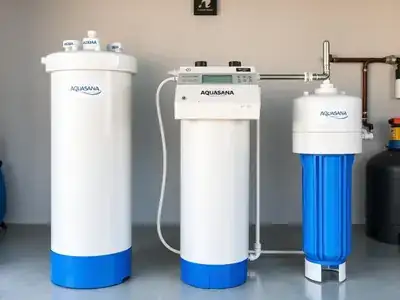
Air injection oxidation (AIO) is the gold standard for iron removal in well water. Here's the step-by-step process:
Air Pocket Creation
Well water enters the top of the filter tank. A venturi valve or air compressor injects compressed air into the water, creating an air pocket at the top of the tank.
Oxidation
Water passes through the air pocket. Dissolved iron (ferrous, Fe²⁺) reacts with oxygen and oxidizes into rust particles (ferric, Fe³⁺). This happens in 15-30 seconds of contact time.
Filtration
Oxidized iron (rust particles) drops to the bottom of the tank and gets trapped in the filter media bed (typically catalytic carbon or birm media). Clean water exits the bottom of the tank.
Backwashing (Automatic)
Every 3-7 days, the system backwashes itself. Water flows backward through the filter media, flushing accumulated iron particles down the drain. This regenerates the filter media for continued use.
Advantages of Air Injection Systems
- No chemicals required (uses only air)
- Removes iron, manganese, and sulfur simultaneously
- Automatic backwashing (minimal maintenance)
- Handles 3-10 ppm iron effectively
- Long lifespan (filter media lasts 5-10 years)
Disadvantages
- Requires electricity for air compressor and control valve
- Needs adequate water pressure (40+ PSI)
- Won't kill iron bacteria (use chlorine for bacteria)
- Initial cost higher than sediment filters ($800-2,500)
Pro Tip: Size the System Correctly
Air injection systems are rated by flow rate (GPM) and iron capacity (ppm). A 3-bathroom home needs 10-12 GPM capacity. For 5-7 ppm iron, choose a system rated for at least 10 ppm to ensure long-term effectiveness.
Water softeners can remove dissolved iron (ferrous) up to 3-5 ppm through ion exchange. However, they have limitations:
How Water Softeners Remove Iron
Ion exchange resin beads trade sodium ions for calcium, magnesium, and ferrous iron. Iron sticks to the resin during the softening cycle. During regeneration (brine flush), iron is flushed to the drain along with hardness minerals.
Limitations
- Ferrous iron only: Cannot remove ferric iron (rust particles). If water is already rusty, pre-filtration is needed.
- Iron fouling: Iron above 3 ppm can coat resin beads, reducing softener effectiveness over time. More frequent regeneration required.
- Iron bacteria: Water softeners cannot kill bacteria. Iron bacteria will colonize the resin tank.
- Combined hardness + iron limit: Total hardness + iron should not exceed 10-12 grains per gallon (gpg) for reliable operation.
Best Scenario for Water Softener Iron Removal
- • Iron: 0.5-3 ppm (ferrous only, clear water)
- • Hardness: 7-20 gpg (moderate to hard water)
- • No iron bacteria present
- • pH: 6.5-8.0 (neutral to slightly alkaline)
If your well water meets these criteria, a high-efficiency water softener can handle both hardness and iron removal with a single system.
Pre-Treatment for Softeners
For iron above 3 ppm or when iron bacteria is present, install a pre-oxidation system before the softener:
- Air injector or chlorine injector oxidizes ferrous iron to ferric
- Sediment filter captures rust particles
- Water softener polishes remaining dissolved iron and hardness
This two-stage approach protects the softener resin from iron fouling and ensures complete iron removal.
Chlorine injection is the most aggressive treatment for severe iron problems (10+ ppm) and iron bacteria. It combines oxidation, disinfection, and filtration in one system.
System Components
1. Chlorine Injection Pump
Metering pump injects liquid bleach (sodium hypochlorite) into the water line. Dosage adjusted based on iron concentration (typically 1-3 ppm chlorine).
2. Retention Tank
40-120 gallon tank provides 15-30 minutes of contact time for chlorine to oxidize iron and kill bacteria. Size based on household water usage.
3. Backwashing Carbon Filter
Removes chlorine residual, oxidized iron, and dead bacteria. Automatically backwashes every 3-7 days to flush accumulated contaminants.
4. Sediment Filter (Optional)
Additional 5-10 micron filter after carbon removes any remaining rust particles for crystal-clear water.
When to Use Chlorine Injection
- Iron levels above 10 ppm
- Iron bacteria confirmed in well (slimy biofilm, musty smell)
- Combination of iron + manganese + sulfur (rotten egg smell)
- Air injection systems failed to solve the problem
Maintenance Requirements
- Refill chlorine solution tank every 1-3 months
- Test chlorine residual monthly (should be 0-0.5 ppm after carbon filter)
- Replace carbon media every 3-5 years
- Check injection pump settings annually
- Backwash filter runs automatically (no manual action needed)
Safety Note
Chlorine injection systems require professional installation. Incorrect dosing can leave chlorine residual in drinking water or fail to kill bacteria. Annual water testing recommended to verify system performance.
For detailed guidance on well water bacteria, see our well water bacteria treatment guide.
Difficulty Level: Moderate to Advanced
DIY installation is possible with plumbing experience. Professional installation recommended for well pump integration and electrical connections. Budget 4-8 hours for DIY install.
Tools & Materials Needed
- Air injection filter system (sized for household GPM and iron level)
- Pipe cutter or hacksaw
- CPVC or PEX piping and fittings
- Pipe thread sealant (Teflon tape or pipe dope)
- Adjustable wrenches
- Drain hose (for backwash line to floor drain or outside)
- Electrical outlet (115V, GFCI-protected)
Test water for iron type and concentration
Use a comprehensive well water test kit to measure total iron (ppm), ferrous iron (dissolved), ferric iron (rust), pH, hardness, and iron bacteria. This determines the right treatment method.
Choose filtration system based on iron levels
0.3-3 ppm: Water softener. 3-10 ppm: Air injection system. 10+ ppm or iron bacteria: Chlorine injection + backwashing filter. Match system capacity to household flow rate (GPM).
Install oxidation system (if needed)
Air injection or chlorine injection oxidizes dissolved iron to rust particles before filtration. Install oxidation system before the pressure tank for whole-house treatment.
Install sediment or backwashing filter
Sediment filter (5-20 micron) captures rust particles. Backwashing filter automatically flushes accumulated iron. Install after oxidation system and before water softener (if using both).
Flush system and retest water
Run water for 30-60 minutes to flush rust from pipes. Retest iron levels after 1 week. Should drop below 0.3 ppm for clear water and no staining. Adjust system settings if iron remains.
Post-Installation Checklist
- ✓ All connections are leak-free and sealed
- ✓ Drain line flows freely to waste point
- ✓ System backwashes automatically on timer
- ✓ Water runs clear with no rust color or metallic taste
- ✓ Iron test shows reduction to below 0.3 ppm
| System Type | Equipment | Installation | Annual Maintenance | Total (5-Year) |
|---|---|---|---|---|
| Water Softener (Iron Removal) | $500-1,500 | $300-1,000 | $80-150 (salt) | $1,200-3,250 |
| Air Injection System | $800-2,000 | $400-1,200 | $50-100 (backwash) | $1,450-3,700 |
| Chlorine Injection | $1,200-2,800 | $500-1,500 | $120-250 (chlorine + filters) | $2,300-5,550 |
| Sediment Filter Only | $150-500 | $100-300 | $60-120 (cartridges) | $550-1,400 |
Hidden Costs to Consider
- Electricity: Air compressors and control valves add $30-60/year to electric bill
- Water waste: Backwashing uses 50-100 gallons per cycle (2-4 times/week)
- Filter media replacement: Every 5-10 years ($150-400)
- Well shock chlorination: $200-500 if iron bacteria is severe (one-time)
- Plumbing upgrades: May need larger pipes or pressure tank ($300-800)
DIY vs Professional Installation
DIY installation saves $300-1,200 but requires plumbing skills and 4-8 hours. Professional installation includes:
- • Proper system sizing and placement
- • Electrical wiring and drain line routing
- • Warranty protection (voids with DIY in some cases)
- • Post-installation testing and adjustment
Even with a filtration system installed, existing rust in pipes and fixtures can persist. Here's how to clean and prevent future buildup:
Flushing Existing Rust from Pipes
- After installing iron removal system, turn off water heater
- Open all faucets (hot and cold) and let water run for 30-60 minutes
- Start with furthest faucet from well, work toward closest
- Water will run rusty initially, then gradually clear
- Flush toilets 5-10 times to clear tank rust
- Drain water heater completely and refill with treated water
- Clean faucet aerators (remove rust particles trapped in screens)
Removing Rust Stains from Fixtures
Toilets and Bathtubs
- Use pumice stone or Bar Keeper's Friend cleaner
- Apply white vinegar and let sit 30 minutes, then scrub
- For heavy stains, use oxalic acid-based cleaner (Zud, Iron Out)
Faucets and Sinks
- Soak in vinegar solution (50/50 vinegar/water) for 15 minutes
- Scrub with soft brush or old toothbrush
- Rinse thoroughly and dry
Clothing (Iron-Stained Laundry)
- Pre-soak in Iron Out powder solution before washing
- Add 1 cup white vinegar to rinse cycle
- Avoid chlorine bleach (makes iron stains worse)
Long-Term Prevention
- Maintain iron filtration system (replace filters on schedule)
- Test water quarterly to verify iron stays below 0.3 ppm
- Clean faucet aerators monthly to prevent rust particle buildup
- Install water heater flush valve and drain tank annually
- For severe corrosion, consider re-piping with PEX (corrosion-resistant)
Well water iron levels vary dramatically by geology. These states have the highest iron concentrations in groundwater:
High Iron States
- • Michigan (iron-rich bedrock, 3-15 ppm common)
- • Minnesota (Iron Range region, 5-20 ppm)
- • Wisconsin (northern counties, 2-10 ppm)
- • Ohio (glacial deposits, 1-8 ppm)
- • Pennsylvania (Appalachian wells, 2-12 ppm)
Moderate Iron States
- • Florida (limestone aquifer, 0.5-3 ppm)
- • Texas (Gulf Coast, 1-5 ppm)
- • North Carolina (Piedmont region, 1-4 ppm)
- • Indiana (central/northern, 1-6 ppm)
- • Illinois (rural wells, 0.5-4 ppm)
If you live in a high-iron state, budget for iron removal when drilling a new well or upgrading filtration. For location-specific guidance, see our state-by-state well water filtration guides.
Frequently Asked Questions
Why is my well water rusty?
Rust in well water is caused by dissolved iron (Fe²⁺) oxidizing when exposed to oxygen or chlorine. Iron levels above 0.3 ppm cause orange/brown stains. Sources include iron-rich bedrock, corroded well casing, rusty pipes, or iron bacteria.
Is rusty well water safe to drink?
Iron itself is not toxic at typical well water levels (0.5-10 ppm), but it tastes metallic, stains fixtures, and indicates potential bacterial contamination. EPA recommends iron below 0.3 ppm for aesthetic reasons. Test for iron bacteria and other contaminants.
What's the best way to remove iron from well water?
Air injection oxidation + sediment filtration removes 95%+ of iron. Water softeners remove dissolved iron up to 3-5 ppm. For iron bacteria or heavy rust (10+ ppm), use chlorine injection + retention tank + backwashing filter.
Do water softeners remove rust from well water?
Water softeners remove dissolved iron (ferrous, Fe²⁺) up to 3-5 ppm via ion exchange. They do NOT remove rust (ferric, Fe³⁺) or iron bacteria. Pre-oxidation is required to convert dissolved iron to rust particles for filtration.
How much does a well water iron removal system cost?
Air injection systems: $800-$2,500 installed. Chemical injection (chlorine): $1,200-$3,500. Water softeners: $500-$2,500. Sediment filters: $150-$800. Total cost depends on iron levels, flow rate, and whether professional installation is needed.
What is an air injection iron filter and how does it work?
Air injection (oxidation) filters use a pocket of compressed air inside the filter tank to oxidize dissolved iron (Fe²⁺) into rust particles (Fe³⁺), which are then trapped by the filter media. The system backwashes automatically to flush trapped iron. Effective for iron levels up to 10 ppm. Requires no chemicals—just air and backwash water.
Can a whole house filter remove rust stains?
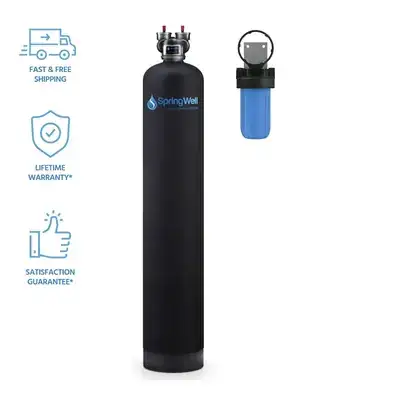
Yes, properly sized iron filters eliminate the source of rust stains by removing dissolved iron before it reaches fixtures. Existing stains require cleaning with iron-specific products (Iron OUT, CLR). Prevention with filtration is far easier than ongoing stain removal. The SpringWell WS1 removes up to 7 ppm iron effectively.
How do I test my well water for iron levels?
Use a well water test kit that measures total iron, dissolved iron, and pH. Send samples to a certified lab for accurate results ($30-75). Iron levels above 0.3 ppm cause staining, above 1 ppm affects taste, and above 3 ppm requires aggressive treatment. Also test for manganese, which often accompanies iron.
What maintenance does an iron filter require?
Air injection filters backwash automatically (2-3 times/week, 20-30 minutes each). Replace filter media every 5-8 years ($150-300). Chemical injection systems need solution refills (chlorine or hydrogen peroxide) every 1-3 months ($50-100/year). Sediment pre-filters need replacement every 3-6 months ($10-20).
Does chlorine shock treatment fix rusty well water permanently?
Chlorine shock treats iron bacteria (slimy, rusty biofilm) but doesn't fix dissolved iron. Shock treatment kills iron bacteria temporarily—they often return within months. For permanent rust removal, install an iron filter (air injection for <10 ppm, chemical injection for >10 ppm). Shock treatment is a temporary fix, not a solution.
What's the difference between ferrous and ferric iron?
Ferrous iron (Fe²⁺) is dissolved and invisible—water looks clear but turns orange when exposed to air or chlorine. Ferric iron (Fe³⁺) is oxidized rust particles visible as orange/brown sediment. Ferrous iron requires oxidation before filtration; ferric iron can be caught with sediment filters. Test both types to choose the right treatment.
Can I use a water softener to remove iron?
Water softeners can remove low levels of ferrous iron (up to 2-3 ppm) through ion exchange. However, iron damages softener resin over time and reduces efficiency. For iron above 3 ppm, install a dedicated iron filter upstream of the softener. The SpringWell SS1 softener handles light iron; pair with WS1 filter for higher levels.