Best Portable Water Filters: 2026 Expert Reviews
Whether you are thru-hiking the Appalachian Trail, car camping at a national park, or traveling through Southeast Asia, the right portable water filter transforms questionable water sources into safe drinking water in seconds. After testing 15 portable filters across three years of backcountry trips and international travel, we have identified the best options for every use case and budget. The key distinction is between filters (remove bacteria and protozoa) and purifiers (also remove viruses)—and which one you need depends entirely on where you travel.
Filter vs. Purifier: The Critical Distinction
Understanding this difference could save your life on an international trip:
Water Filters (0.1-0.2 micron)
Physical barrier that removes particles larger than the pore size.
Removes:
- Bacteria: E. coli, Salmonella, Cholera (99.99999%)
- Protozoa: Giardia, Cryptosporidium (99.9999%)
- Sediment, dirt, microplastics
Does NOT Remove:
- Viruses: Hepatitis A, Norovirus, Rotavirus
- Dissolved chemicals, pesticides, heavy metals
Use in: US/Canada backcountry, established campgrounds
Water Purifiers (0.02 micron or chemical/UV)
Eliminates ALL waterborne pathogens including viruses.
Removes:
- Everything filters remove PLUS
- Viruses: Hepatitis A, Norovirus, Rotavirus (99.99%)
- Some models also remove chemicals and heavy metals
Methods:
- GRAYL press purifiers
- SteriPEN UV light
- Chlorine dioxide tablets
Use in: International travel, developing countries, disaster scenarios
Detailed Reviews
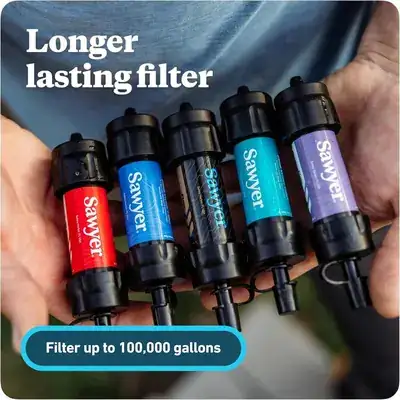
1. Sawyer MINI — Best Overall Value
The Sawyer MINI is the most cost-effective portable water filter ever made. At just 2 ounces, it filters an astonishing 100,000 gallons through its 0.1-micron hollow fiber membrane—enough for a lifetime of hiking. It removes 99.99999% of bacteria and 99.9999% of protozoa, meeting EPA standards for water purifiers in the bacteria/protozoa category. The MINI attaches to included squeeze pouches, standard water bottle threads, or inline with hydration bladder tubing.
Pros
- 100,000 gallon lifetime
- Only 2 ounces
- Multiple attachment options
- $0.00025/gallon cost
- Made in USA
Cons
- No virus removal
- Requires backflushing after each trip
- Flow rate slows with use
- Cannot freeze with water inside
2. GRAYL GeoPress — Best for International Travel
The GRAYL GeoPress is the ultimate travel water purifier. Its electroadsorptive media removes viruses, bacteria, protozoa, heavy metals, chemicals, and microplastics in just 8 seconds with a single press. The 24oz capacity is generous for a purifier bottle, and no batteries, pumping, or waiting is required. For international travelers, this is the single most important piece of gear you can pack—it makes any water source safe to drink instantly.
Pros
- Removes viruses (99.99%)
- 8-second press purification
- Removes heavy metals and chemicals
- 24oz capacity
- Built like a tank
Cons
- Most expensive option ($100)
- Cartridge replacement every 65 gallons ($24)
- Bulkier and heavier (16 oz)
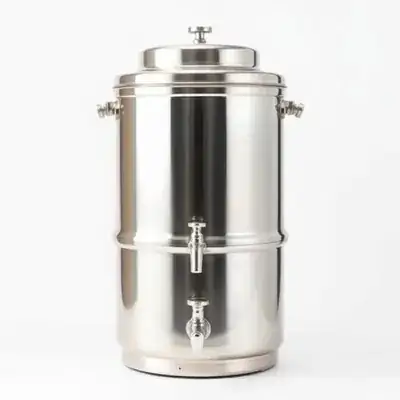
3. Big Berkey — Best for Group/Car Camping
The Big Berkey is the gold standard for gravity-fed water purification. Its Black Berkey elements remove 99.999% of bacteria, 99.999% of viruses, heavy metals, pesticides, pharmaceuticals, and VOCs without electricity or water pressure. Each element filters 3,000 gallons before replacement. Perfect for car camping, base camps, and RVs where weight is not a concern but water quality is paramount.
Pros
- Laboratory-grade purification
- 3,000 gallon element life
- No electricity needed
- 2.25 gallon capacity
Cons
- Too heavy for backpacking (7 lbs)
- Higher upfront cost
- Slow: 7 gal/hour with 2 elements
4. GRAYL UltraPress — Best Ultralight Purifier
The UltraPress is GRAYL's lighter, more compact purifier. At 10.9 oz, it is nearly half the weight of the GeoPress while offering the same virus, bacteria, and protozoa removal. The 16oz capacity is smaller but sufficient for solo travelers. The 10-second press purification requires no batteries, pumps, or chemicals. Ideal for ultralight backpackers who need virus protection for international treks.
Check Price on Amazon5. LifeStraw Water Filter Bottle — Best for Casual Hiking
The LifeStraw bottle combines the trusted LifeStraw hollow fiber membrane with a convenient 23oz BPA-free bottle. Two-stage filtration (hollow fiber + activated carbon) removes bacteria, protozoa, and improves taste. No backflushing required—just sip and go. The simplest option for day hikers and weekend campers who want hassle-free filtered water without learning backflushing techniques.
Check Price on AmazonCost Per Gallon Analysis
| Filter | Price | Capacity | Cost/Gallon | Removes Viruses |
|---|---|---|---|---|
| Sawyer MINI | $25 | 100,000 gal | $0.00025 | No |
| SteriPEN UV | $70 | 8,000 uses | $0.009 | Yes |
| LifeStraw Bottle | $40 | 264 gal | $0.15 | No |
| GRAYL GeoPress | $100 + $24/cartridge | 65 gal/cartridge | $0.37 | Yes |
| Bottled water | — | — | $1.00-3.00 | N/A |
How to Choose: Decision Framework
US/Canada Day Hiking →
Sawyer MINI ($25) or LifeStraw Bottle ($40). Bacteria and protozoa are the primary threats. Lightweight, affordable, effective.
Ultralight Backpacking →
Sawyer MINI (2 oz, no contest). Pair with a Cnoc Vecto dirty water bag for the ultimate lightweight gravity setup.
International Travel →
GRAYL GeoPress ($100) for virus protection. No question—viruses are the #1 threat in developing countries and only purifiers handle them.
Car/Group Camping →
Big Berkey ($300) for base camp. Gravity-fed, high capacity, laboratory-grade purification. Too heavy for backpacking but unbeatable for camp water.
Emergency Preparedness →
Sawyer MINI + chlorine dioxide tablets. The MINI handles bacteria/protozoa; tablets handle viruses. Together they cover every scenario for under $35.
Portable Filter Selection by Activity Type
Different outdoor activities demand different portable filtration approaches. Day hikers carrying 1-2 liters benefit most from inline squeeze filters (Sawyer Squeeze, 3 oz) that attach directly to soft bottles—filtering on demand with zero setup time. Backpackers on multi-day trips covering 10-20 miles daily need higher throughput: gravity filters like the Platypus GravityWorks (11 oz) process 4 liters hands-free while you set up camp, providing enough water for cooking, drinking, and cleaning without manual effort.
International travelers face different threats than North American hikers. Viruses (hepatitis A, rotavirus, norovirus) are common in developing countries but rare in US and Canadian backcountry water. Standard hollow fiber filters like the Sawyer and LifeStraw do NOT remove viruses—their 0.1-0.2 micron pores are too large. Travelers to Asia, Africa, Central/South America, and Eastern Europe need purification, not just filtration. Options include UV purifiers (SteriPEN Ultra, 5 oz), chemical treatment (Aquamira drops, 3 oz), or the MSR Guardian purifier (17 oz) which handles all pathogen types through mechanical purification.
Emergency preparedness requires the most robust portable filtration. Natural disasters, infrastructure failures, and contamination events can compromise municipal water treatment for days or weeks. A gravity purifier (Berkey Sport or LifeStraw Community) provides high-volume purification for families. Complement with chemical treatment tablets (Katadyn Micropur, 4-year shelf life) as backup. Store at least one gallon per person per day of pre-filtered water alongside portable purification equipment. The most resilient emergency water strategy uses multiple methods: physical filtration removes particles and pathogens, chemical treatment provides residual disinfection, and UV eliminates chemical-resistant organisms like Cryptosporidium.
Explore Our Top Picks
Related Resources
Understanding Water Quality Science
Water quality is determined by a complex interplay of dissolved minerals, organic compounds, and potential contaminants that vary significantly by geographic region and water source. Municipal water treatment facilities use multi-stage processes including coagulation, sedimentation, sand filtration, and chemical disinfection to meet EPA Safe Drinking Water Act standards. However, these treatment processes can introduce disinfection byproducts such as trihalomethanes and haloacetic acids, which form when chlorine reacts with naturally occurring organic matter in the source water.
Private well water faces different challenges, as it bypasses municipal treatment entirely and may contain naturally occurring contaminants like arsenic, radon, and heavy metals that leach from surrounding geological formations. The Environmental Protection Agency recommends annual testing for coliform bacteria, nitrates, total dissolved solids, and pH levels for all private wells. Additional testing for volatile organic compounds, pesticides, and heavy metals should be conducted if you live near agricultural areas, industrial sites, or old mining operations. Understanding your specific water chemistry is the critical first step in selecting the most effective filtration system for your household needs.
Total dissolved solids (TDS) measurements provide a general indicator of water purity but should not be the sole basis for filtration decisions. Water with high TDS from beneficial minerals like calcium and magnesium may actually be healthier than ultra-purified water. The World Health Organization has noted that demineralized water may have adverse health effects due to the absence of essential minerals. This is why many advanced filtration systems, particularly reverse osmosis units, now include remineralization stages that add back beneficial minerals after removing contaminants. The ideal approach balances contaminant removal with mineral retention, targeting specific harmful substances identified through comprehensive water testing while preserving the natural mineral content that contributes to both taste and health benefits.
Filtration Technology Comparison
Modern water filtration leverages several distinct technologies, each with unique strengths for addressing specific water quality challenges. Activated carbon filtration, the most common residential method, uses adsorption to capture chlorine, volatile organic compounds, and taste-affecting chemicals. Granular activated carbon (GAC) filters provide good flow rates but may allow channeling, while carbon block filters compress carbon particles for more consistent contact time and finer filtration down to 0.5 microns. Catalytic carbon represents the latest advancement, specifically engineered to break down chloramines through a catalytic reaction rather than simple adsorption.
Reverse osmosis systems force water through a semipermeable membrane with pore sizes as small as 0.0001 microns, effectively removing dissolved solids, heavy metals, and most microorganisms. Modern RO systems achieve 95-99 percent rejection rates for contaminants like lead, arsenic, fluoride, and PFAS compounds. The primary considerations for RO systems include water waste ratios (typically 3:1 to 4:1 for standard systems, improved to 1:1 in premium tankless models), storage tank requirements, and the need for pre-filtration to protect the delicate membrane from sediment and chlorine damage.
Ion exchange technology, used in both water softeners and specialized contaminant removal systems, swaps problematic ions in the water with benign alternatives. Water softeners exchange calcium and magnesium ions for sodium ions, preventing scale buildup in plumbing and appliances. Specialized ion exchange resins can target specific contaminants like lead, nitrates, or perchlorate. Ultraviolet purification provides chemical-free disinfection by disrupting the DNA of bacteria, viruses, and protozoa at wavelengths around 254 nanometers. UV systems are particularly valuable for well water and as a final treatment stage in multi-barrier systems, though they do not remove chemical contaminants or improve taste.
Long-Term Cost Analysis
When evaluating water filtration costs, the total cost of ownership over five years provides a much more accurate picture than initial purchase price alone. A budget pitcher filter at thirty dollars may seem economical, but replacement filters at forty dollars every two months add up to over twelve hundred dollars in five years. Meanwhile, an under-sink system costing two hundred dollars upfront with sixty-dollar annual filter changes totals just five hundred dollars over the same period, delivering superior filtration at less than half the long-term cost.
Whole house filtration systems represent a larger initial investment of eight hundred to two thousand dollars including professional installation, but they protect all water fixtures and appliances simultaneously. When you factor in the extended lifespan of water heaters, dishwashers, and washing machines that no longer process unfiltered water, the return on investment often exceeds the system cost within three to four years. Water softener savings are particularly dramatic: the Water Quality Association estimates that soft water can reduce water heating costs by up to twenty-nine percent and extend appliance lifespans by thirty to fifty percent.
For households currently purchasing bottled water, any home filtration system provides massive savings. The average family spending twenty dollars per week on bottled water spends over five thousand dollars in five years. Even the most premium whole house filtration system with annual maintenance costs less than two thousand dollars over the same period, saving over three thousand dollars while eliminating hundreds of plastic bottles from landfills annually. The environmental and financial case for home filtration is compelling at every price point.
Frequently Asked Questions
Related Articles
More on Backpacking Water Treatment
Complete backcountry water purification guide
Deep dive — Emergency Water Preparedness
Portable filters for disaster readiness
Read: International Travel Water Safety
Stay safe drinking water abroad
Deep dive — Emergency Water Filters
Best filters for emergency situations
Best Water Bottles with Filters
Filtered water bottles for on-the-go
Buying guide: Water Pitchers
Home pitcher alternatives after outdoor trips