Best Emergency Water Filters: No-Power Solutions for Any Crisis (2026)
Plan emergency water before buying
A filter extends your supply; it does not replace stored water or official boil-water instructions.
- Store at least one gallon per person per day.
- Pick one home filter and one portable backup.
- Never drink floodwater or water near a chemical spill.
When disaster strikes—hurricanes, earthquakes, flooding, power outages, or infrastructure failures—clean drinking water becomes your most critical need. The average person needs 1 gallon per day for drinking and basic hygiene. Municipal water systems can fail for days or weeks, and stored water eventually runs out. Emergency water filters that operate without electricity or water pressure are essential preparedness tools. This guide covers every proven emergency filtration method with honest performance assessments and a complete preparedness checklist.
Quick Answer
Best home setup: stored water plus a gravity filter that works without power. Best portable: Sawyer MINI ($25) — weighs 2 oz, lasts 100,000 gallons, fits in any emergency kit. Always maintain a backup chemical method (bleach or purification tablets).
Why Emergency Water Filtration Matters
Natural disasters compromise water safety in multiple ways simultaneously. Flooding overwhelms treatment plants and introduces sewage, agricultural chemicals, and industrial contaminants into water supplies. Earthquakes rupture water mains, allowing soil bacteria and groundwater contaminants into the distribution system. Power outages disable pumping stations and treatment equipment. Even "boil water" advisories assume you have fuel—which may not be available during extended emergencies.
FEMA data shows that in major disasters, municipal water service can be disrupted for 3-14 days or longer. During Hurricane Maria in Puerto Rico, some communities lacked clean water for months. The 2021 Texas freeze left millions without water for over a week. Having a reliable, power-independent water filtration system isn't paranoia—it's practical preparedness.
- Stored water runs out: Even the recommended 7-day supply (7 gallons per person) eventually depletes. Filters work only within their documented source-water and service limits.
- Boiling requires fuel: Propane, firewood, and camp stove fuel are finite. Filtration needs zero energy input.
- Chemical treatment has limits: Bleach and tablets don't remove chemicals, heavy metals, or sediment. They also affect taste and require precise dosing.
- Bottled water disappears fast: Stores sell out within hours of emergency warnings. Having a filter means independence from supply chains.
Emergency Filter Comparison
| Filter | Type | Removes | Capacity | Power | Price |
|---|---|---|---|---|---|
| Big Berkey | Gravity | Check exact element documentation | 6,000 gal/element | None | $350-400 |
| Sawyer MINI | Squeeze/inline | Bacteria, protozoa | 100,000 gal | None | $25 |
| LifeStraw Mission | Gravity bag | Bacteria, viruses, parasites | 18,000 liters | None | $75-90 |
| Grayl GeoPress | Press bottle | Check current purifier claims | 250L/cartridge | None | $90-100 |
| SteriPEN Ultra | UV purifier | Bacteria, viruses, protozoa | 8,000 treatments | USB rechargeable | $70-90 |
| Katadyn Pocket | Pump | Bacteria, protozoa, sediment | 50,000 liters | None (manual) | $350-400 |
Top Emergency Filter Recommendations
Best Home Emergency: Big Berkey Gravity Filter
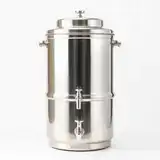
Berkey Big Berkey Gravity Filter
Berkey Big Berkey Gravity Filter
Works without power or water pressure. Use only sources supported by the current element documentation; it does not replace boil-water instructions or make chemical-contaminated water safe.
Best Portable: Sawyer MINI
The Sawyer MINI is a lightweight hollow-fiber filter for its documented freshwater uses. It targets bacteria and protozoa, not viruses or dissolved chemicals. Follow the current manual for cleaning, storage, capacity and freeze protection.
Compare portable emergency filters
Best for International/Viral Threats: Grayl GeoPress
When you need purification—not just filtration—the Grayl GeoPress removes viruses in addition to bacteria and protozoa. Fill the outer container with water, press down the inner container (like a French press), and drink purified water in 8 seconds. Each cartridge handles 250 liters ($25 replacement). The 24-ounce capacity is larger than most portable purifiers. Ideal for scenarios involving sewage-contaminated water or international emergencies.
Emergency Water Purification Methods Without Filters
Filters are the best option, but redundancy saves lives. Every emergency kit should include at least one backup purification method that doesn't depend on a filter's physical integrity.
Boiling
The oldest and most reliable purification method. A rolling boil for 1 minute (3 minutes above 6,500 feet elevation) kills all bacteria, viruses, and protozoa. Limitations: requires fuel, doesn't remove chemicals or heavy metals, doesn't remove sediment or turbidity. Let water cool before drinking. Pre-filter through cloth if water is cloudy.
Chemical Treatment (Bleach)
Use only the plain unscented bleach and concentration specified by official emergency drinking-water guidance. Dose and contact time depend on concentration and water conditions; do not use a universal drops-per-gallon rule. Bleach does not remove fuels, toxic chemicals or all parasites. Read CDC emergency water guidance.
Water Purification Tablets
Chlorine dioxide tablets (Potable Aqua, Aquamira, Katadyn Micropur) kill bacteria, viruses, and protozoa including Cryptosporidium (which is resistant to bleach). Follow package directions for dosage and wait time (typically 30 minutes to 4 hours). Tablets have a 5-year shelf life when sealed and are compact enough for any emergency kit. They leave a slight taste but are extremely reliable.
Building Your Emergency Water Kit
A complete emergency water preparedness plan includes stored water, filtration capability, and chemical backup. Here's a comprehensive checklist for a family of four:
| Item | Purpose | Quantity | Cost |
|---|---|---|---|
| Stored water (commercial) | Immediate use, first 3-7 days | 28 gallons (7 days × 4 people) | $15-25 |
| Gravity filter (Berkey) | Long-term home filtration | 1 system | $250-400 |
| Portable filter (Sawyer MINI) | Evacuation/grab-and-go | 1 per person | $25 each |
| Purification tablets | Chemical backup | 50-100 tablets | $10-15 |
| Collapsible containers | Water collection and transport | 2-3 (5-7 gallon each) | $10-20 |
| Unscented bleach | Disinfection backup | 1 bottle (replace annually) | $3-5 |
Total emergency water kit cost: $350-500 for a family of four with 7+ days of independence from municipal water.
Emergency Water Sources: What's Safe to Filter
In an emergency, you may need to collect water from unconventional sources. Not all sources are equally safe—even with a filter. Here's a ranking from safest to riskiest:
- Stored or officially supplied water: preferred drinking-water source.
- Rainwater: collection surfaces can introduce microbes and chemicals. Do not assume carbon filtration makes it safe.
- Streams, lakes and ponds: use public-health treatment guidance for microbial risks; avoid algal blooms and suspected chemical contamination.
- Floodwater: do not drink or try to make it safe with a household filter, boiling or bleach.
- Swimming pools: reserve for non-drinking uses; off-gassing does not establish safety.
- Water-heater tanks: follow official emergency and manufacturer instructions; do not improvise work on hot, pressurized or powered equipment.
Maintaining Your Emergency Filters
Emergency filters must be maintained even when not in active use. A filter that fails during a crisis defeats its entire purpose.
- Berkey: Scrub and re-prime elements every 6-12 months. Store dry. Test annually with red dye test (food coloring should not pass through).
- Sawyer MINI: Backflush with included syringe after each use. Store with caps off to prevent mold. Never allow to freeze with water inside—ice crystals destroy hollow fibers.
- Purification tablets: Check expiration dates annually. Replace expired tablets. Store in cool, dry location.
- Stored water: Rotate every 6-12 months. Follow the date on commercially bottled water. Mark containers with storage date.
- Bleach: Replace annually—sodium hypochlorite degrades over time. After 12 months, concentration drops below effective levels.
Emergency Filtration for Specific Scenarios
Hurricane / Flooding
Primary risks: sewage contamination, chemical runoff, bacteria. Use comprehensive filtration (Berkey with carbon) plus chemical treatment. Municipal "boil water" advisories may last days to weeks. Do not use floodwater for drinking unless absolutely necessary and treated with multiple methods. Fill bathtubs and containers before the storm hits while water is still treated.
Earthquake
Primary risks: broken water mains, loss of pressure, pipe contamination. Your hot water heater tank contains 30-80 gallons of pre-treated water—drain it first. Gas lines may rupture, so use portable filters instead of boiling if gas smell is present. Filter any tap water through carbon to remove sediment from damaged pipes.
Extended Power Outage
Primary risks: treatment plant shutdown, loss of water pressure, bacterial regrowth in stagnant pipes. Gravity filters are ideal—they need no electricity. If water still flows but isn't treated, filter with Berkey or equivalent. Monitor local emergency communications for boil-water advisories.
Contamination Event (Chemical Spill)
Primary risks: industrial chemicals, PFAS, heavy metals. Most portable filters do NOT remove chemicals—you need carbon-based filtration (Berkey) or reverse osmosis. If chemical contamination is suspected, use bottled water or a comprehensive filter. Follow local health department guidance on specific contaminants.
Related Resources
Understanding Water Quality Science
Water quality is determined by a complex interplay of dissolved minerals, organic compounds, and potential contaminants that vary significantly by geographic region and water source. Municipal water treatment facilities use multi-stage processes including coagulation, sedimentation, sand filtration, and chemical disinfection to meet EPA Safe Drinking Water Act standards. However, these treatment processes can introduce disinfection byproducts such as trihalomethanes and haloacetic acids, which form when chlorine reacts with naturally occurring organic matter in the source water.
Private well water faces different challenges, as it bypasses municipal treatment entirely and may contain naturally occurring contaminants like arsenic, radon, and heavy metals that leach from surrounding geological formations. The Environmental Protection Agency recommends annual testing for coliform bacteria, nitrates, total dissolved solids, and pH levels for all private wells. Additional testing for volatile organic compounds, pesticides, and heavy metals should be conducted if you live near agricultural areas, industrial sites, or old mining operations. Understanding your specific water chemistry is the critical first step in selecting the most effective filtration system for your household needs.
TDS measures dissolved substances, not specific contaminants or microbial safety. Mineral content and taste are separate from health and safety; choose treatment for laboratory findings and regard remineralization as optional.
Filtration Technology Comparison
Modern water filtration leverages several distinct technologies, each with unique strengths for addressing specific water quality challenges. Activated carbon filtration, the most common residential method, uses adsorption to capture chlorine, volatile organic compounds, and taste-affecting chemicals. Granular activated carbon (GAC) filters provide good flow rates but may allow channeling, while carbon block filters compress carbon particles for more consistent contact time and finer filtration down to 0.5 microns. Catalytic carbon represents the latest advancement, specifically engineered to break down chloramines through a catalytic reaction rather than simple adsorption.
Reverse osmosis can reduce specific dissolved contaminants, with performance depending on the exact model and inlet water. Verify certification for the contaminants in your test, check drain-water and installation requirements, and maintain prefilters and membranes. Household RO is not automatically a microbiological purifier.
Ion exchange technology, used in both water softeners and specialized contaminant removal systems, swaps problematic ions in the water with benign alternatives. Water softeners exchange calcium and magnesium ions for sodium ions, preventing scale buildup in plumbing and appliances. Specialized ion exchange resins can target specific contaminants like lead, nitrates, or perchlorate. Ultraviolet purification provides chemical-free disinfection by disrupting the DNA of bacteria, viruses, and protozoa at wavelengths around 254 nanometers. UV systems are particularly valuable for well water and as a final treatment stage in multi-barrier systems, though they do not remove chemical contaminants or improve taste.
Long-Term Cost Analysis
When evaluating water filtration costs, the total cost of ownership over five years provides a much more accurate picture than initial purchase price alone. A budget pitcher filter at thirty dollars may seem economical, but replacement filters at forty dollars every two months add up to over twelve hundred dollars in five years. Meanwhile, an under-sink system costing two hundred dollars upfront with sixty-dollar annual filter changes totals just five hundred dollars over the same period, delivering superior filtration at less than half the long-term cost.
Whole house filtration systems represent a larger initial investment of eight hundred to two thousand dollars including professional installation, but they protect all water fixtures and appliances simultaneously. When you factor in the extended lifespan of water heaters, dishwashers, and washing machines that no longer process unfiltered water, the return on investment often exceeds the system cost within three to four years. Water softener savings are particularly dramatic: the Water Quality Association estimates that soft water can reduce water heating costs by up to twenty-nine percent and extend appliance lifespans by thirty to fifty percent.
For households currently purchasing bottled water, any home filtration system provides massive savings. The average family spending twenty dollars per week on bottled water spends over five thousand dollars in five years. Even the most premium whole house filtration system with annual maintenance costs less than two thousand dollars over the same period, saving over three thousand dollars while eliminating hundreds of plastic bottles from landfills annually. The environmental and financial case for home filtration is compelling at every price point.
Key Questions, Answered
What's the best emergency water filter?
Keep stored safe water first, then choose a no-power home filter and portable backup matched to the source. Many portable filters target bacteria and protozoa, not viruses or chemicals. Verify current exact-model documentation.
How long do emergency water filters last?
Follow each model’s storage, time and capacity instructions. Slowing flow can require cleaning or replacement but is not a safety indicator. Protect wet hollow-fiber filters from freezing.
What should be in an emergency water kit?
Store at least one gallon per person per day for several days, with more if possible. Include suitable containers, a source-matched filter and an appropriate disinfection backup. TDS meters do not establish safety.
Frequently Asked Questions
Related Articles
Our picks for Portable Water Filters
Top hiking, camping, and travel filters
More on Backpacking Water Treatment
Complete backcountry water purification guide
Deep dive — Emergency Water Preparedness
Portable filters for disaster readiness
Read: International Travel Water Safety
Stay safe drinking water abroad
Deep dive — Portable Filter Comparison
Side-by-side portable filter analysis
Deep dive — Emergency Water Filters
Best filters for emergency situations