Arsenic III vs arsenic V: why the form decides the result
Arsenic in water comes in two main forms. RO membranes push back charged particles far better than uncharged ones, so the same system can do very well on one form and poorly on the other.
| Form | Charge in drinking water | Where it shows up | How RO handles it |
|---|---|---|---|
| Arsenic V (arsenate) | Negatively charged | Oxygenated groundwater and chlorinated city water | Rejected well by RO. This is the form NSF/ANSI 58 arsenic claims cover. |
| Arsenic III (arsenite) | Uncharged | Deep, low-oxygen wells, often with iron, manganese or sulfur smell | Passes through RO much more easily. Oxidize to arsenic V first. |
City water that is disinfected with chlorine has usually had its arsenic oxidized to arsenic V at the plant. Private wells are the problem case: deep, low-oxygen water often carries mostly arsenic III. Learn more in our guide to arsenic in well water.
On a well: oxidize arsenic III before the RO stage
If your test shows arsenic III, add a step that turns it into arsenic V before the water reaches the membrane. The usual order looks like this:
- Test with speciation. Ask a certified lab for total arsenic and the split between arsenic III and V. Add iron, manganese, pH and hardness, which all affect the treatment design.
- Oxidize. Common options are chlorine injection with enough contact time, or a manganese-dioxide filter bed. Water-treatment pros may also use permanganate or ozone. Air alone works slowly and isn't a dependable fix.
- Remove leftover chlorine. Chlorine damages RO membranes, so a carbon stage must sit between the chlorine and the membrane. Ask whether your RO's built-in carbon can handle the chlorine dose.
- Treat drinking water with RO. Put the RO system at the kitchen tap you use for drinking and cooking.
- Retest the RO tap. A lab result from the RO faucet is the only real proof the setup works.
Skipping oxidation on a well with arsenic III can leave arsenic above the EPA limit even with a new RO system. If iron or manganese is high, treat those first; see our iron removal guide and the best well water filters.
What an NSF/ANSI 58 arsenic claim means
NSF/ANSI 58 is the standard for home reverse osmosis systems. Its arsenic claim is named "Arsenic (pentavalent) reduction". To earn it, a system is fed water spiked with arsenic V at 0.050 or 0.30 mg/L and must bring it down to 0.010 mg/L or less.
- It covers arsenic V only. The test doesn't prove a system can handle arsenic III, which is why wells need oxidation first.
- Check the certifier's listing, not just the box. NSF, WQA and IAPMO each publish searchable listings. Look for your exact model number and the arsenic claim on that listing.
- Read the performance data sheet. It lists the pressure, temperature and filter-change conditions the claim depends on.
- "Tested to" is not the same as "certified". Some brands report their own test results. That can be useful, but a certifier's listing is the stronger proof.
You can search the NSF drinking water treatment listings by brand or model.
RO systems to compare for arsenic
These are drinking-water RO systems with published arsenic V data. On a well with arsenic III, any of them still needs the oxidation step above.
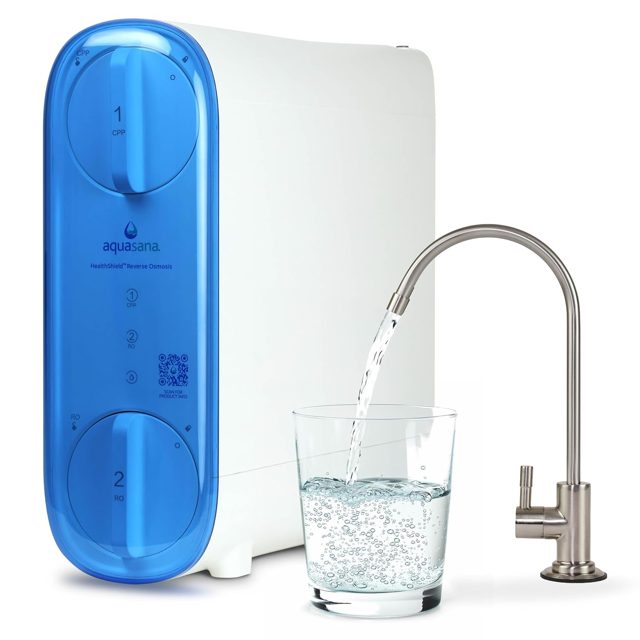
Aquasana Tankless Reverse Osmosis System (800 GPD)
Aquasana Tankless Reverse Osmosis System (800 GPD)
Best for: City water, or well water after arsenic III has been oxidized
Aquasana's performance data sheet for this tankless model (AQ-HSRO800) lists 96.42% pentavalent arsenic reduction from a 0.050 mg/L test under NSF/ANSI 58, and the system is IAPMO certified for the claims on that sheet. It has no storage tank, but it needs a power outlet and at least 60 psi of water pressure.

iSpring RCC7AK 6-Stage RO System
iSpring RCC7AK 6-Stage RO System
iSpring's manual reports 97.9% pentavalent arsenic reduction (50 ppb in, under 10 ppb out) in testing to NSF/ANSI 58. NSF's own listing for this model names TDS reduction, so confirm the arsenic claim on the listing for the exact version you buy, and lab-test the RO tap after installing.
Compare sizing, treatment options and ongoing costs in our best reverse osmosis systems guide.
Want a system with no plumbing? Our best countertop filters guide covers countertop RO units. For more options, see the best arsenic filters.
RO vs other arsenic treatment methods
RO is the most common choice for drinking water, but it isn't the only one. Whole-house arsenic problems usually call for media designed for arsenic.
| Method | Works on | Watch out for |
|---|---|---|
| Under-sink or countertop RO | Arsenic V; arsenic III after oxidation | Treats one tap only; needs filter and membrane changes and sends some water to drain |
| Iron-based adsorptive media | Mostly arsenic V; can be sized for the whole house | Media wears out; phosphate, silica and pH reduce capacity |
| Activated alumina | Arsenic V | Works best in slightly acidic water; capacity drops over time |
| Anion exchange | Arsenic V | Sulfate competes, and an exhausted bed can release arsenic in a burst |
| Distillation | Both forms | Slow and uses electricity; small batches |
| Carbon-only filters and pitchers | Not designed for arsenic | Only trust a listing that names arsenic for the exact model |
| Boiling | Does not remove arsenic | Concentrates it slightly as water evaporates |
For a step-by-step plan covering every option, read how to remove arsenic from water. If you'd rather distill, compare water distillers.
Arsenic limits and who's most at risk
- EPA limit: 0.010 mg/L (10 parts per billion) for public water systems. The health goal is zero. See the EPA chemical contaminant rules.
- Stricter state limit: New Jersey enforces 5 parts per billion.
- Private wells: not covered by the EPA limit. A USGS and CDC study estimated about 2.1 million people in the lower 48 states may use domestic wells with arsenic above 10 parts per billion, mostly from natural rock sources.
- Health effects: long-term exposure is linked to skin, bladder and lung cancer and to heart disease. Arsenic has no taste, smell or color.
Read about warning signs in arsenic in drinking water symptoms, and see the full arsenic contaminant profile. The EPA private wells page explains testing for well owners.
How to confirm your RO is removing arsenic
- Test raw water for total arsenic, with speciation on a well.
- Install the system and flush it as the manual says.
- Send a sample from the RO faucet to a certified lab for total arsenic.
- Compare the two results. You want the RO tap well below 10 parts per billion.
- Retest at least yearly and after each membrane change. Well arsenic can change over time.
A TDS meter is a handy quick check that the membrane still works, but it can't measure arsenic. Compare lab and home options in our water test kits guide.
Bottom line
Reverse osmosis is the most practical home fix for arsenic in drinking water, as long as the arsenic reaching the membrane is arsenic V. City water usually already is. Well water often isn't, so test with speciation, add oxidation where needed, choose a system with an arsenic claim on its listing, and prove the result with a lab test. Compare full system rankings in our best reverse osmosis systems guide.