Step 1: Find your arsenic level and form
Arsenic has no taste, smell or color, so a lab test is the only starting point. Public water must meet EPA's limit of 10 parts per billion; private wells are up to you to test.
- Use a state-certified lab. The EPA private wells page explains how to find one.
- Ask for speciation on a well. Knowing how much is arsenic III versus arsenic V tells you whether you need an oxidizing step.
- Add the tests that size a system: iron, manganese, pH, phosphate, silica and sulfate all change how arsenic media and RO perform.
- On city water, read your utility's annual water quality report for its arsenic result.
Health effects, sources and state limits are covered in arsenic in drinking water. Well owners should also read arsenic in well water.
Step 2: Match treatment to your result
| Your situation | Usual treatment | Watch out for |
|---|---|---|
| Arsenic V, drinking water only | Under-sink RO with an arsenic claim | Treats one tap; change filters and membrane on schedule |
| Arsenic III in the result | Oxidize first, then RO or arsenic media | Chlorine must be removed before an RO membrane |
| Whole house, or very high arsenic | Iron-based adsorption media sized by a pro | Phosphate, silica and pH shorten media life |
| Arsenic and fluoride together | RO or activated alumina | Alumina works best in slightly acidic water |
| Arsenic with high iron or manganese | Treat iron and manganese first | They foul RO membranes and arsenic media |
Chlorine damages RO membranes. If you oxidize arsenic III with chlorine, a carbon stage must remove the leftover chlorine before the membrane. See the full setup in does reverse osmosis remove arsenic.
Most homes treat only the kitchen tap. Very little arsenic passes through skin, so drinking and cooking water matter most.
RO systems to compare for arsenic
These under-sink RO systems treat drinking and cooking water. Confirm the arsenic claim for the exact model, and plan to test the RO tap after installing.
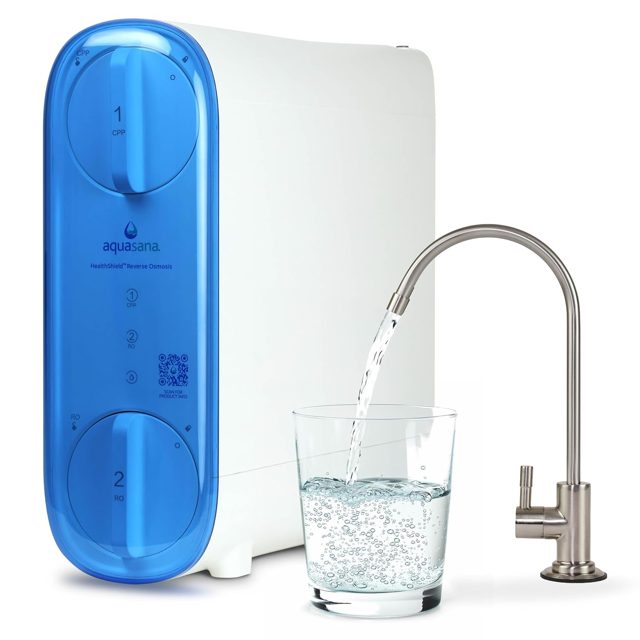
Aquasana Tankless Reverse Osmosis System (800 GPD)
Aquasana Tankless Reverse Osmosis System (800 GPD)
Aquasana's performance data sheet for this tankless model (AQ-HSRO800) lists 96.42% pentavalent arsenic reduction from a 0.050 mg/L test under NSF/ANSI 58, plus lead and fluoride reduction. The sheet says it's for water with a free chlorine residual or arsenic already in the pentavalent form.
Compare sizing, treatment options and ongoing costs in our best reverse osmosis systems guide.
iSpring RCC7AK 6-Stage RO System
iSpring RCC7AK 6-Stage RO System
iSpring's manual reports 97.9% pentavalent arsenic reduction (50 ppb in, under 10 ppb out) in testing to NSF/ANSI 58. NSF's own listing for this model names TDS reduction, so confirm the arsenic claim for the exact version you buy, and lab-test the RO tap after installing.
Compare sizing, treatment options and ongoing costs in our best reverse osmosis systems guide.
Step 3: Install and maintain it
- Put RO at the tap you drink from, and connect the fridge or ice maker line to it if you can.
- Pretreat first on wells. Sediment, iron and manganese clog membranes and arsenic media.
- Change parts on the manual's schedule. Pre-filters and carbon stages wear out faster than the membrane.
- Don't run media past its capacity. An exhausted anion exchange bed can release arsenic back into the water.
- Keep a simple log of install date, filter changes and test results.
Step 4: Retest the treated water
Test the treated tap once the system has been flushed as its manual describes, then at least once a year. Use the same lab and method each time so the numbers compare. Keep using bottled water for drinking and baby formula until the first treated result is under the limit.
What doesn't remove arsenic
- Boiling leaves arsenic behind and slightly concentrates it.
- Standard carbon pitchers and fridge filters are not designed for arsenic unless the listing names it.
- Water softeners target hardness, not arsenic.
- General whole-house carbon filters do not reliably remove arsenic.
Bottom line
Test for arsenic and its form, then treat drinking water with RO that lists arsenic reduction, adding an oxidizing step for arsenic III. Prove it works with a retest. Read the full background in arsenic in drinking water, and compare full rankings in our best reverse osmosis systems guide.