Best Water Filter for Well Water: Match Treatment to Your Test
There is no single best filter for every well. Learn what to test for, which treatment fixes bacteria, iron, sulfur, hardness, nitrate or arsenic, the order the equipment should go in, and how to check it keeps working.
Test first, then build treatment around the result
Each well problem needs its own fix, in the right order.
- Test for bacteria, nitrate, iron, manganese, hardness and pH.
- Treat sediment, iron and hardness before UV or RO.
- Retest after installing and at least once a year.
Quick answer
Start with a lab test. Most wells benefit from a sediment pre-filter. Add iron or sulfur treatment if your test or stains call for it, a softener for hard water, and UV if bacteria are found or you want protection for an untreated supply. Put UV last on the whole-house line, and use reverse osmosis at the kitchen sink for nitrate or arsenic.
What to test your well for
Private wells are not covered by the federal rules that apply to city water, so testing is up to you. The CDC recommends testing at least once a year for total coliform bacteria, nitrates, total dissolved solids and pH. For choosing treatment, also test for iron, manganese and hardness, and add sulfur if the water smells of rotten eggs.
Your local health department can tell you which other contaminants, such as arsenic, uranium or radon, are common nearby. A certified lab gives the most reliable results; see our water test kits and read is well water safe to drink.
Treatment by test result
| What you find | Common signs | Usual treatment |
|---|---|---|
| Sediment | Grit, cloudiness, clogged aerators | Sediment pre-filter |
| Iron or manganese | Orange, brown or black stains; metallic taste | Oxidizing iron filter; some softeners handle low iron |
| Hydrogen sulfide | Rotten-egg smell | Carbon for low levels; oxidation or aeration for higher |
| Hardness | Scale, spots, soap that will not lather | Water softener |
| Coliform bacteria | Usually none; found by testing | Find the cause, disinfect the well, then UV for ongoing protection |
| Nitrate | None; found by testing | Reverse osmosis at the kitchen sink, or ion exchange |
| Arsenic | None; found by testing | RO or adsorption media, depending on its form |
| Low pH | Blue-green stains, pinhole leaks | Acid neutralizer |
For more on each system type, see types of well water filtration systems.
The right order for well treatment
- Sediment filter first, to protect everything after it.
- Iron, manganese or sulfur treatment, so stains and smell are removed before they foul other media.
- Water softener, if your water is hard.
- Carbon filter, if you want taste, odor or certain chemicals reduced for the whole house.
- UV last on the whole-house line, so it works on clear water just before it reaches your taps.
- Reverse osmosis under the kitchen sink for drinking water, when nitrate, arsenic or dissolved solids need reducing.
You will not need every step. Your test tells you which ones apply.
Well water picks
Match each pick to your test results, and open each deal for today's price. For full rankings, see our best well water filters.
Whole-house filtration with UV
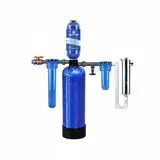
Aquasana Rhino Well Water with UV
Aquasana Rhino Well Water with UV
Whole-house well-water filtration with a UV stage for microbial protection. Check its limits for iron, manganese and hardness against your test before ordering; heavy iron or sulfur may need dedicated treatment first.
Compare sizing, treatment options and ongoing costs in our best well water filters guide.
Hard well water
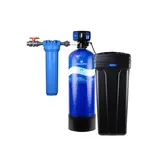
Aquasana SimplySoft 60,000 Grain Softener with LM Pre-Filter
Aquasana SimplySoft 60,000 Grain Softener with LM Pre-Filter
Salt-based hardness removal for scale, spots and poor lather. Size the softener for your household and hardness, and plan for salt, a brine tank and a drain; treat high iron before it.
Compare sizing, treatment options and ongoing costs in our best water softeners and conditioners guide.
Drinking water for nitrate or arsenic
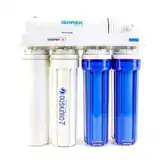
iSpring RCC7AK 6-Stage RO System
iSpring RCC7AK 6-Stage RO System
Under-sink reverse osmosis for the kitchen tap, a common choice when a test shows nitrate or arsenic. Pretreat sediment, iron and hardness to protect the membrane, and check the system's certified claims against your results; RO does not disinfect a well.
Compare sizing, treatment options and ongoing costs in our best reverse osmosis systems guide.
Sizing and flow
Whole-house equipment has to keep up with the flow your home uses at busy times, and with what your well pump can deliver. Undersized equipment lowers pressure and may not treat water properly at high flow, especially UV. Find your numbers in our well water flow rate guide, and compare complete setups in our whole house filter for well water guide.
Upkeep and retesting
- Retest after installing to confirm the system is doing its job.
- Test at least yearly for bacteria and nitrate, and after flooding, well repairs or any change in taste, smell or color.
- Follow each part's schedule: sediment cartridges, softener salt, UV lamps and RO stages all wear out on their own timelines.
- Disinfect when needed. A positive bacteria test calls for finding the cause and disinfecting; see how to shock chlorinate a well.
Bottom line
The best water filter for your well is the combination your test calls for, installed in the right order and sized for your flow. Test first, treat sediment, iron and hardness before UV or RO, and retest to confirm. Then compare complete systems in our best well water filters guide.