
Why Daycare Water Quality Matters
Children under 6 absorb lead 4–5x more efficiently than adults, and even tiny doses cause permanent neurological harm. Daycares pour water for drinking, formula, juice mixing, hand washing, and cooking — multiplying every contaminant exposure. The CDC, AAP, and EPA all recommend filtration at every tap children touch.
State Lead Testing and Filtration Rules
11 states now require lead testing in licensed childcare with action levels between 1–15 ppb: California (5 ppb), Illinois (5 ppb), New York (15 ppb), Washington (5 ppb), New Jersey (15 ppb), and others. Failed taps must be remediated with NSF/ANSI 53 certified filtration or shut off entirely. Document compliance for state licensing inspections.
Best Bottle Filler Stations
Elkay LZS8WSLP EZH2O ($1,500) is the daycare industry standard — NSF/ANSI 42 + 53 certified, touchless sensor activation, ADA-compliant child-height mounting, bottle counter, and LED filter status. Halsey Taylor HTHB-HACDBL ($1,400) offers a dual-height (kid + adult) configuration ideal for mixed-age centers.
Formula and Infant Room Filtration
Licensed infant rooms need a dedicated formula-prep tap. Best options: APEC ROES-50 reverse osmosis ($240) or Waterdrop G3P800 tankless RO ($500) — both NSF/ANSI 58 certified to remove lead, fluoride, nitrates, arsenic, and PFAS. Mount the RO faucet at the formula prep counter and label clearly to prevent accidental hand-washing use.
In-Home Daycare Solutions
Family childcare homes (under 12 children) can use under-sink filters like the Aquasana AQ-5300+ ($230) or ZeroWater pitchers ($45). Replace cartridges monthly and document each change in your daily attendance log. State licensing inspectors increasingly check filter logs alongside meal records and incident reports.
Sink and Hand-Washing Considerations
Hand-washing taps don't need NSF/ANSI 53 certification (skin doesn't absorb lead efficiently), but cooking and food-prep taps absolutely do. Install whole-facility carbon filtration at the main water entry to remove chlorine and disinfection byproducts that can irritate young skin during frequent hand washing.
Maintenance, Logs, and Licensing
Replace cartridges per manufacturer schedule (every 6 months for commercial fillers, monthly for residential pitchers). Maintain a written log with date, cartridge model, and signature — state inspectors review these during annual relicensing visits. Post a parent-facing notice about your water filtration program; it's a strong marketing differentiator.
Bottom Line
Licensed daycare centers (20+ kids): Elkay LZS8WSLP bottle fillers at every drinking station + APEC ROES-50 RO at the formula prep sink. In-home daycares: Aquasana AQ-5300+ under-sink + ZeroWater pitcher backup. Always specify NSF/ANSI 53 lead certification and maintain monthly cartridge change logs for state licensing.
Unique Water Challenges in This Environment
Water systems serving childcare facility water face challenges that differ meaningfully from a typical single-family home. The dominant pressures are infant formula prep and lead testing rules, intermittent use cycles that promote stagnation and biofilm growth, exposure to multiple unfamiliar source waters, and physical constraints (space, weight, power, plumbing access) that limit which filters can be installed. A standard whole-house cartridge system designed for a 4-bedroom suburban home is rarely the right answer for childcare facility water; the right answer is a configuration matched to the actual usage profile.
Stagnation is the single most underestimated risk in childcare facility water. When water sits in tanks, hoses, or pipes for days or weeks, it loses residual disinfectant, warms up, and becomes a growth environment for biofilm, Legionella, Pseudomonas, and nitrifying bacteria. The CDC and ASHRAE Standard 188 both highlight intermittent-use buildings as primary Legionella risk environments. Any filtration plan for childcare facility water must address stagnation through routine flushing, antimicrobial cartridges, or UV disinfection — not just particle and chemical removal.
Space, Power, and Plumbing Constraints to Plan Around
In childcare facility water, the available footprint is often the deciding factor in filter selection. Under-sink RO systems require 12–15 inches of cabinet depth, drain access, and 40–80 PSI of feed pressure. Countertop RO systems eliminate plumbing modification but consume 12–18 inches of counter space and require a nearby outlet. Pitcher and gravity systems work without any installation but require manual refills and have lower contaminant-reduction certifications.
Power availability is another constraint frequently overlooked in childcare facility water planning. UV disinfection requires 30–50 watts continuous, RO booster pumps draw 60–100 watts intermittently, and water softeners draw minimal power but require a drain. Off-grid or limited-power applications should prioritize gravity-fed (Berkey, Alexapure), hand-pumped (Sawyer, Katadyn), or solar-augmented (low-pressure RO with DC pump) configurations. Match the filter to the realistic worst-case power, water-pressure, and space scenario — not the best-case.
Filter Type Comparison: Pitcher, Countertop, Under-Sink, Portable RO
For childcare facility water, the four practical categories are gravity pitchers (Brita Elite, ZeroWater, Clearly Filtered, Berkey), countertop RO units (AquaTru, Bluevua, RKIN U1), under-sink systems (APEC ROES-50, Waterdrop G3, SpringWell SWRO), and portable cartridge or hollow-fiber systems (Sawyer, LifeStraw, Katadyn). Each category trades capacity, contaminant range, and convenience differently. Pitchers handle 1–2 gallons at a time with mid-tier contaminant range. Countertop RO produces 1–4 gallons per hour with broad NSF 58 contaminant coverage and no plumbing.
Under-sink systems deliver the highest sustained capacity (50–600 gallons per day) and the broadest contaminant reduction but require permanent installation. Portable systems are designed for emergency, travel, or off-grid use and typically address bacteria, protozoa, and sediment rather than dissolved chemicals. For childcare facility water, the most defensible default is a countertop RO when space allows, falling back to a high-tier pitcher (Clearly Filtered, ZeroWater) when counter space is unavailable.
Top Recommended Models with Capacity, Footprint, and Cost
For childcare facility water, three models cover most realistic budgets and use cases. AquaTru Classic ($449) is a 4-stage countertop RO certified to NSF 42, 53, 58, 401, and P473, producing 1 gallon in 12–15 minutes with no plumbing. Clearly Filtered Pitcher ($90 + $60 cartridges) is NSF 42, 53, 244, 401, and 473 certified for 200+ contaminants in a 10-cup pitcher footprint. Sawyer Squeeze ($45) is a 0.1-micron hollow-fiber system rated for 100,000 gallons that addresses bacteria and protozoa with no power required.
For higher-capacity needs in childcare facility water, consider the Waterdrop G3P800 ($899) tankless RO at 800 GPD with a 2:1 pure-to-drain ratio, or the SpringWell SWRO ($1,099) for households requiring 50+ gallons of treated water daily. For budget-constrained scenarios, the ZeroWater 10-cup pitcher ($35 + $60/year cartridges) reduces TDS to 0 PPM and is third-party tested for lead, chromium, and PFAS reduction. Match capacity to actual daily use plus 50% safety margin.
Installation Walkthrough and Common Mistakes
Installing a countertop RO in childcare facility water takes 10–15 minutes: unbox, install cartridges per the manual, fill the source tank with cold tap water, run two or three discard cycles to flush manufacturing residue, and the unit is ready. Under-sink installation takes 60–120 minutes and requires shutting off the cold-water supply, tapping into the cold-water line with a saddle valve or T-fitting, drilling a 1.25-inch hole in the countertop or sink for the dedicated faucet, and tying the drain line to the kitchen drain above the trap.
The most common installation mistakes in childcare facility water are skipping the recommended initial flush (which leaves manufacturing carbon dust in the first gallons), overtightening fittings (which cracks plastic threads), installing the system on the hot-water line (which destroys cartridges), and routing the drain line below the trap (which causes back-siphoning). Read the manual completely before starting, take photos of the supply-line configuration before disassembly, and keep the receipt and serial number in a labeled folder for warranty claims.
Maintenance Schedule and Cartridge Sourcing on the Move
For childcare facility water, cartridge maintenance is the highest-failure point. Sediment pre-filters last 6–12 months, carbon blocks last 6–12 months, RO membranes last 2–3 years, and post-filter polishers last 12 months. Real-world life is shorter when influent water carries elevated sediment, hardness, chlorine, or contamination. Stock at least one spare set of cartridges on hand at all times and order replacements when the current set hits 75% of rated life — not after they expire.
Cartridge sourcing is a logistics challenge specific to childcare facility water. Verify that replacement cartridges are widely available through Amazon, the manufacturer direct site, and at least one third-party retailer before committing to a system. Avoid proprietary cartridge formats from small or new brands without a 5-year availability track record. Keep the system's model number, serial number, and original purchase date in your phone contacts so you can re-order quickly from anywhere.
Health and Safety Considerations for the Specific User Group
The user population in childcare facility water often includes people with elevated health sensitivities — children, pregnant women, immunocompromised adults, athletes, the elderly, or transient users with no medical history available. EPA and CDC guidance for these groups generally recommends one tier stricter than the federal MCL for lead, PFAS, nitrate, disinfection byproducts, and microbial pathogens. Filter selection should reflect this stricter standard rather than minimum legal compliance.
For childcare facility water, additional safety considerations include preventing cross-contamination between treated and untreated taps (label every faucet), preventing freeze damage to RO membranes (drain systems before extended cold storage), and providing clear written guidance for any user, guest, or staff member about which fixtures deliver treated water. Post a one-page water-use SOP near the filter and in any kitchen or hydration area to reduce confusion and accidental exposure.
Cost of Ownership Over 1, 3, and 5 Years
For childcare facility water, the realistic 5-year cost of ownership on a countertop RO is $449 hardware + $300 cartridges + $0 installation = $749 total, or roughly $0.04 per gallon over 18,000 gallons. An under-sink RO over 5 years runs $400–$700 hardware + $400–$600 cartridges + $0–$300 installation = $800–$1,600. A high-tier pitcher over 5 years runs $90 hardware + $300 cartridges = $390 but produces only 6,000–8,000 gallons of usable water.
Compared to bottled water at $1.00–$2.00 per gallon, every category of certified filter pays for itself within 6–18 months in childcare facility water. Compared to the medical and developmental costs of unfiltered exposure to lead, PFAS, or disinfection byproducts in a vulnerable population, the entire 5-year filter spend is less than a single specialist consultation. Document the cost analysis when proposing a filter to a landlord, school administrator, or facility manager — the financial case is usually stronger than the health case.
Decision Matrix: Matching Filter Choice to Water Source and Usage
For childcare facility water, the simplest defensible decision matrix has three inputs: water source (municipal vs. well vs. cistern vs. unknown), daily volume (under 2 gallons, 2–10 gallons, over 10 gallons), and installation feasibility (no install vs. countertop vs. under-sink vs. whole-house). Municipal + low volume + no install = high-tier pitcher. Municipal + medium volume + countertop available = AquaTru. Well or unknown + medium volume + under-sink available = under-sink RO with sediment pre-filter and UV.
Whole-house volume needs in childcare facility water (over 10 gallons daily of treated water) point toward a tankless RO like the Waterdrop G3P800 or a dedicated whole-house carbon plus point-of-use RO combination. When the source water is unknown or variable, default to the broadest-spectrum certified system available — RO with a downstream remineralization stage — and re-test treated water after 30 days, 90 days, and annually thereafter. The decision matrix should never end at purchase; it ends at verified post-installation performance.
Real-World Scenarios and User Profiles
Households and operators in the daycare category cover a wide spectrum. A weekend-only daycare sees stagnant water in pipes for 5–6 days at a time, requiring flush protocols and antimicrobial cartridges that a daily-use daycare would not need. A heavy-use daycare sees 10x the daily volume and needs higher-capacity equipment with redundant cartridges to avoid mid-week service interruptions. Identify which usage profile matches your situation before selecting equipment — the wrong filter for the right environment fails just as surely as the right filter for the wrong environment.
User profiles in daycare also influence filter choice. A household with young children or pregnant residents in daycare should default to NSF/ANSI 53 or NSF 58 certified equipment regardless of source water. A daycare hosting transient guests (rentals, vacation properties) should prioritize maintenance-free or low-maintenance configurations because guests will not change cartridges or run flush cycles. A commercial or institutional daycare requires equipment with documented inspection schedules, replacement-parts inventory, and operator training — typically beyond consumer-grade equipment.
Source Water Variability: City Hookup, Well, Cistern, Surface
In daycare, source water can change weekly. A daycare on a municipal hookup gets utility-treated water with a chlorine residual but inherits any distribution-system contamination — particularly lead from older service lines. A daycare on a private well faces the highest variability: bacteria, nitrate, arsenic, iron, and hardness can all shift seasonally with rainfall and water-table elevation. A daycare on a cistern or rainwater catchment carries continuous contamination from the catchment surface, gutter screens, and storage tank biofilm. A daycare drawing surface water (lake, river, creek) carries the highest microbial risk and the most variable turbidity.
Match the filter configuration to the worst-case source water you actually encounter in daycare. A pre-filter rated for 5-micron sediment protects downstream cartridges from premature clogging. A UV disinfection stage handles bacterial uncertainty when source water is unknown or variable. A reverse-osmosis stage covers dissolved chemical contamination from any source. Document the source water type for every fill or hookup and update the filter maintenance schedule accordingly — a single sediment-heavy fill can cut cartridge life by 50%.
Step-by-Step Setup Guide for First-Time Users
For a typical daycare installation, the first-week setup looks like this. Day 1: order the filter, verify NSF/ANSI certifications match the source-water risk profile, and confirm replacement cartridges are widely available. Day 2: receive the filter, inspect for shipping damage, and read the manual completely before opening cartridge packaging. Day 3: install per the manual using only manufacturer-supplied fittings and tubing. Day 4: run the recommended initial flush — typically 5–10 gallons for new RO systems and 1–2 gallons for new carbon systems.
Day 5: verify performance with either a TDS meter (for RO) or a chlorine test strip (for carbon) to confirm the filter is reducing the parameter you bought it to address. Day 6: label every faucet served by the filter so users know which water is treated. Day 7: schedule the first cartridge change date in your phone calendar based on either the manufacturer's time interval or the system's gallons-used meter, whichever is shorter. Send a follow-up SimpleLab Tap Score sample at the 30-day mark to lab-verify the filter is performing in your daycare's actual conditions.
Backup and Emergency Water Strategies
Every daycare should have a backup water plan independent of the primary filter. Keep at least 1 gallon of bottled water per person per day for a minimum of 3 days, stored in a cool dark location and rotated annually. Keep a hollow-fiber emergency filter (Sawyer Squeeze, LifeStraw Family) on hand for any scenario where the primary filter fails or the source water becomes unsafe. Stock at least one full set of replacement cartridges for the primary filter, plus the tools to install them.
For daycare scenarios with extended off-grid or off-utility periods, add a manual or solar-powered redundancy. Berkey-style gravity filters require no power and process 2–4 gallons per hour through certified ceramic and carbon elements. Steripen UV pens disinfect 1 liter at a time using AA batteries. Solar-augmented low-pressure RO systems exist but are specialized and expensive. The right backup configuration depends on the realistic worst-case scenario for your specific daycare — plan for the longest plausible disruption, not the typical one.
User Reviews and Field-Tested Performance Notes
Field reports from real daycare users consistently flag a few patterns. Cartridge life is shorter than manufacturer ratings when source water carries elevated sediment or chlorine — plan to replace at 70–80% of rated life rather than 100%. Flow rate degrades noticeably in the final 20% of cartridge life, which is a useful early warning. Taste-and-odor performance is the first thing to fail when a carbon cartridge is approaching exhaustion, even before measurable contaminant breakthrough. Trust the taste — if treated water starts tasting like the source water, the filter is done.
Reviews of major brands (Aquasana, SpringWell, AquaTru, Waterdrop, APEC, Berkey, Clearly Filtered) for daycare use cases generally rank AquaTru and Waterdrop highest for ease of setup and certifications, SpringWell and Aquasana highest for whole-house and high-volume use, Clearly Filtered and Berkey highest for portability and emergency use, and APEC highest for value-per-dollar in standard under-sink configurations. Read reviews from the past 12 months only — older reviews may reflect discontinued models, expired certifications, or pre-improvement design issues.
FAQ Section: Practical Use-Case Questions
How often do I change cartridges in a daycare? Sediment pre-filters every 6–12 months, carbon blocks every 6–12 months, RO membranes every 2–3 years, post-filter polishers every 12 months — adjusted shorter if source water is sediment-heavy or chlorine-heavy. Can I leave the filter installed during winter shutdown of a daycare? RO membranes will freeze and rupture below 32°F. Drain the system completely, remove cartridges, store in a sealed bag at room temperature, and reinstall in spring with a fresh flush cycle.
Does the filter affect water pressure in a daycare? Carbon and sediment filters drop pressure by 1–5 PSI when new and 5–15 PSI as they approach replacement. RO systems require a minimum 40 PSI feed and produce treated water at 5–15 PSI through the dedicated faucet — not through main fixtures. If feed pressure is below 40 PSI, add a booster pump (Aquatec or Amazon-brand pumps run $80–$150). Where do I buy replacement cartridges in a daycare? Stock from Amazon, the manufacturer direct site, and at least one local backup before relying on any single source for a daycare that may be far from major retailers.
Top Picks for Daycares & Childcare Centers
High-capacity, certified systems built for facilities serving children.
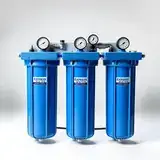
Everpure H300-RO
Everpure H300-RO
Commercial RO
High-capacity RO for restaurants/offices
Authority Resources
lead in water · test water for lead · lead poisoning symptoms · pregnancy water safety · nitrates in water · nitrate blue baby syndrome · PFAS contamination · PFAS health effects · test water for PFAS · best filter for restaurants · best filter for schools · best filter for gyms · test water TDS · test water pH · best home water test kits · best home water filters · best RO systems · best whole house filters · best water softeners · best well water filters · best water test kits · local water quality · how to choose a water filter