Prepare safely before cleaning
Identify the tank type, volume, source water, contamination event and connected equipment. Obtain the tank maker’s and local health department’s instructions. A post-flood cistern, RV tank and routine storage barrel may need different procedures.
Never enter a tank yourself. Enclosed tanks are confined spaces. Arrange qualified help if walls cannot be cleaned safely from outside. Do not mix bleach with acids, vinegar, ammonia or other cleaners.
Tank Disinfection Questions, Answered
Can I disinfect a water tank without scrubbing it first?
Disinfection is less reliable when sediment or biofilm remains. Drain the tank, remove debris, and clean accessible surfaces before applying the disinfectant according to the tank manufacturer's and public-health instructions. Never enter a tank yourself: enclosed tanks are confined spaces and can contain dangerous gases or too little oxygen.
Should I bypass my water filter when sanitizing a tank?
Follow the equipment manufacturer's instructions. Strong sanitizing solutions can damage filter media, softener resin, or an RO membrane, while carbon may remove disinfectant before it reaches the tank and pipes. Identify which equipment needs bypassing and how it should be cleaned separately before beginning; do not guess from the system's brand alone.
Do chlorine test strips prove a tank is safe to drink from?
No. Free chlorine strips measure disinfectant residual, not the absence of harmful bacteria or chemicals. After contamination, follow local public-health guidance for flushing, sampling, and laboratory testing before returning a drinking-water tank to service. For well-fed tanks, include appropriate source-water tests and investigate how contamination entered the system.
Does adding UV mean I can stop cleaning my water tank?
No. UV treats suitable water as it passes through the unit; it does not scrub tank walls or leave disinfectant protection in stored water. Placement, pretreatment, flow, and maintenance determine whether it works effectively. Keep tank inspections and cleaning, and choose appropriate disinfection when testing shows a microbial problem.
Drain, inspect and clean accessible surfaces
Isolate the system as instructed and drain it safely. Inspect the inlet, vent, overflow and covers for damage or intrusion. Remove sediment and biofilm with approved tools from outside the tank, then rinse according to the applicable procedure. Dispose of wastewater as directed; do not discharge strong chlorine solutions into a septic system, stream or garden.
The 7-step sanitizing cycle
Use the tank-specific procedure for disinfectant strength, dose, contact time and flushing. Never enter an enclosed tank.
- 1Drain
- 2Scrub
- 3Dose
- 4Fill
- 5Run taps
- 6Soak
- 7Flush & test
Cistern and RV procedures differ. Chlorine strips do not prove drinking-water safety.
Choose the correct disinfection procedure
CDC’s post-flood cistern fact sheet specifies its own cleaning, bleach concentration, dose, contact time and refill steps. Follow that entire procedure only for its stated cistern context; do not extract a dose and apply it to every tank.
For an RV, use the CDC RV water guidance alongside the RV manufacturer’s exact sanitizing instructions. Do not substitute pool chemicals or concentrated peroxide.
Confirm which filters, softeners, heaters or RO units require bypassing and separate sanitation. Strong solutions may damage equipment, and carbon may remove disinfectant before it reaches the intended surfaces.
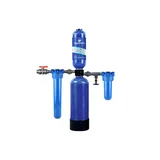
Aquasana Rhino Whole House Water Filter
Aquasana Rhino Whole House Water Filter
For ongoing city-water filtration only. Carbon can remove chlorine residual, so it is not a storage preservative or tank sanitizer. Follow the equipment maker’s bypass and separate cleaning instructions.
Compare sizing, treatment options and ongoing costs in our best whole house water filters guide.
Flush, refill and confirm readiness
Keep the tank out of drinking-water service during the prescribed contact period. Drain and refill with known safe water and flush connected lines as directed. There is no universal number of rinses or chlorine threshold that proves every system safe.
After contamination, follow local health and laboratory instructions for sampling total coliform and E. coli, including timing and disinfectant neutralization. Chlorine test strips and a lack of bleach odor do not establish bacterial or chemical safety. Use known safe water until the system is cleared for use.
How Often Should You Sanitize?
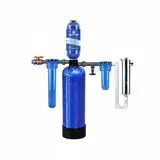
Aquasana Rhino Well Water with UV
Aquasana Rhino Well Water with UV
After flushing and a clear follow-up bacteria test, a correctly installed Rhino Well Water with UV can provide ongoing treatment in a permanent well-fed system. It does not sanitize tank walls or protect stored water after treatment. Compare well-water systems and confirm suitable pretreatment with an installer.
Compare sizing, treatment options and ongoing costs in our best well water filters guide.
Follow the tank or RV manufacturer’s maintenance schedule and local public-health guidance. Reassess after flooding, intrusion, visible biofilm, damage or extended non-use. Pool and spa tanks have separate procedures — don't substitute this guide for pool/spa-specific instructions. Tank sanitizing and replacing stored water are separate tasks: use our water storage duration and rotation guide to plan when to refresh your emergency supply.
Related Resources
For deeper exploration of related topics: how to choose a water filter · best water filters roundup · best RO systems · best whole-house filters · best water test kits.