RO vs Distilled Water: Cost, Purity & Best Uses
A definitive side-by-side comparison covering purity, cost per gallon, energy use, taste, and which technology to choose for drinking, CPAP, aquariums, and appliances.
"RO vs distilled" is one of the most common water purification questions—and the answer matters because choosing wrong can cost you hundreds of dollars per year and produce water that does not match your actual needs. Both technologies remove 95-100% of dissolved solids, but they do it through completely different mechanisms with very different cost profiles, output rates, and edge-case advantages.
Reverse osmosis uses pressure to push water through a 0.0001 micron membrane—a filtration process happening at room temperature. Distillation boils water and condenses the steam, leaving impurities behind in the boiler. Both produce ultra-pure water, but RO costs $0.02-0.05 per gallon vs $0.25-0.50 for distillation. For most homes, this cost difference makes RO the obvious choice.
That said, distillation has legitimate advantages for specific use cases: CPAP machines, humidifiers, off-grid living, and lab work. This guide gives you the complete comparison so you can choose the right technology for each application—or use both for different purposes.
Side-by-Side Comparison Table
| Feature | Reverse Osmosis | Distilled Water |
|---|---|---|
| Mechanism | Pressure through 0.0001µ membrane | Boiling + condensation |
| Output TDS | 5-15 ppm | 0-5 ppm |
| Contaminant removal | 95-98% | 99%+ |
| Production speed | 35-560 gpd | 12-24 gpd max |
| Cost per gallon | $0.02-0.05 | $0.25-0.50 |
| Annual cost (10 gpd) | $75-180 | $900-1,800 |
| Electricity use | 0-100 watts | 700-1,000 watts |
| Setup cost | $150-1,200 | $80-300 |
| Installation | Under-sink plumbing | Counter, no plumbing |
| Maintenance | Filter changes 6-12 mo | Boiler descaling monthly |
| VOC removal | 95-99% (with carbon) | 90-99% (depends on BP) |
| Bacteria/virus | 99%+ (with UV stage) | 100% |
| Heavy metals (lead) | 99%+ | 99%+ |
| Best for | Daily home use | CPAP, lab, off-grid |
How Each Technology Works
Reverse Osmosis: Pressure-Based Filtration
RO systems force tap water at 40-80 PSI through a semipermeable membrane with pores so small (0.0001 microns) that only water molecules and very small dissolved gases pass through. Dissolved solids—including lead, arsenic, fluoride, PFAS, nitrates, and 95%+ of all contaminants—are blocked and flushed to the drain as wastewater. Modern RO systems include 4-7 stages: sediment pre-filter, carbon pre-filter (removes chlorine), the RO membrane itself, post-carbon polishing filter, and optional remineralization or UV stages.
The process happens at room temperature in real-time as you use water. A tank stores 3-4 gallons of pre-filtered water for instant use, or a tankless system filters on-demand at 0.5-1 gallon per minute. Energy consumption is minimal (0-100 watts) since household water pressure does the work in tank systems.
Distillation: Phase-Change Purification
Distillers heat water to its boiling point (212°F at sea level), capture the rising steam, and condense it back to liquid water in a separate chamber. Dissolved solids do not vaporize and remain in the boiler, achieving near-zero TDS output. Volatile organic compounds with boiling points below water's (like benzene, methanol, chloroform) DO carry over with the steam unless a vent or carbon stage captures them—a limitation often misunderstood.
Residential distillers produce 0.5-1 gallon per hour, requiring 3-4 hours per gallon of operation and 700-1,000 watts of continuous electrical power. Output collects in a glass or stainless steel reservoir. The boiler must be descaled monthly (more often with hard water) by removing the accumulated mineral residue with vinegar or descaling acid.
True Cost Comparison Over 5 Years
For a family of 4 using 10 gallons per day of purified water (drinking, cooking, ice, coffee), here is the 5-year cost reality:
| Cost Category | RO System | Countertop Distiller |
|---|---|---|
| Initial equipment | $300 (mid-range) | $150 |
| Installation | $50-150 (DIY) or $200 (pro) | $0 (plug in) |
| Annual filter/maintenance | $80/year × 5 = $400 | $30 descaling/year × 5 = $150 |
| Electricity (5 years) | $50 | $2,400 (10 gpd × 3.5 kWh × $0.13) |
| Membrane replacement | $60 × 2 = $120 | $0 (no membrane) |
| 5-year total | $920-1,020 | $2,700 |
| Per gallon (5 years) | $0.05 | $0.15 |
Even with optimistic distillation cost assumptions, RO is roughly 3x cheaper over 5 years for daily household use. This gap widens for larger families—a household using 20 gpd would pay $5,400+ for distillation vs $1,500 for RO.
When to Choose RO vs Distilled
Choose RO When
- • Daily drinking water for family of 2+
- • Cooking and beverage preparation
- • Aquarium maintenance (scalable)
- • Ice maker connection
- • Have under-sink space and plumbing access
- • Cost-conscious long-term ownership
- • Need 10+ gallons daily output
- • Want minimal energy consumption
Choose Distilled When
- • CPAP machines (manufacturer-required)
- • Steam irons and humidifiers
- • Off-grid or no plumbing access
- • Lab/medical applications needing 0 TDS
- • Renting and cannot install plumbing
- • Very low volume needs (under 2 gpd)
- • Distrust filter-based purification
- • Need portable purification (countertop)
Use Case Deep Dives
CPAP Machines and Humidifiers
CPAP manufacturers specifically require distilled water in the heated humidifier chamber. Reasons: (1) Zero TDS prevents mineral scaling on heating elements, (2) No mineral aerosol released into the airway, (3) Reduced bacterial concerns. RO water (5-15 ppm) will work but causes minor scaling over months and may void warranties. For 1-2 gallons per week consumption, distillation makes economic sense—a $100 distiller produces a year's supply for under $50 in electricity.
Aquariums and Reef Tanks
Reef hobbyists overwhelmingly choose RO/DI (RO + Deionization polishing) for serious aquarium use. Reasons: (1) RO scales to 50-100+ gpd output for water changes, (2) Total cost is much lower, (3) Modular DI stage achieves near-distilled purity (0-1 ppm), (4) Can be plumbed to dedicated aquarium fill stations. Distillation is too slow for tanks over 30 gallons—a single 50-gallon water change would take 50+ hours of distillation. See our RO for aquariums guide.
Coffee, Tea, and Cooking
Both RO and distilled make functionally identical drinking water. Coffee enthusiasts often prefer RO with remineralization to hit SCA brewing water specs (150 ppm TDS). Distilled is too pure for ideal coffee extraction—use mineral packs (Third Wave Water) to bring it to brewing standards. For tea, both work well; high-end Japanese green tea benefits from low-TDS water that does not interfere with delicate flavors.
Baby Formula Preparation
Both are recommended for baby formula. Distilled is sometimes preferred by pediatricians because: (1) zero fluoride risk for fluoride-sensitive infants, (2) no mineral interaction with formula's pre-balanced nutrient profile, (3) minimum bacterial risk. RO with NSF/ANSI 58 certification provides equivalent safety—the practical difference is negligible. See our best filters for babies guide.
Top RO Systems for Replacing Distilled Water
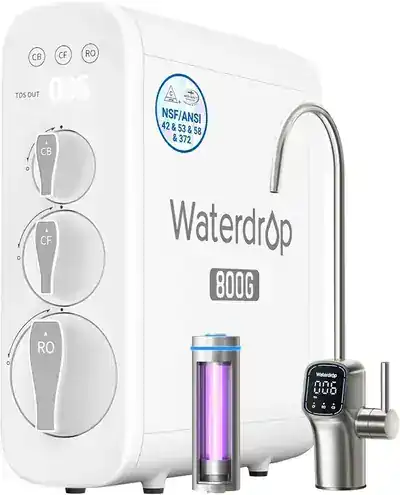
Waterdrop G3P800
- • 800 GPD output
- • Real-time TDS display
- • UV sterilization stage
- • 1:1 efficient waste ratio
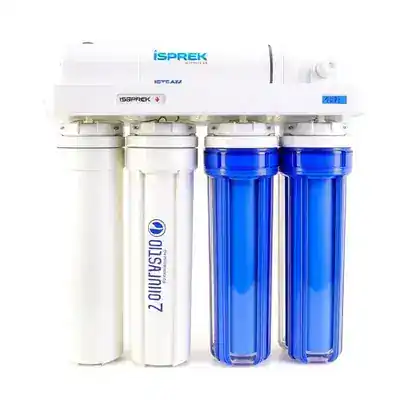
iSpring RCC7AK
- • 75 GPD with alkaline post-filter
- • NSF/ANSI 58 certified
- • Affordable replacement filters
- • 6-stage filtration
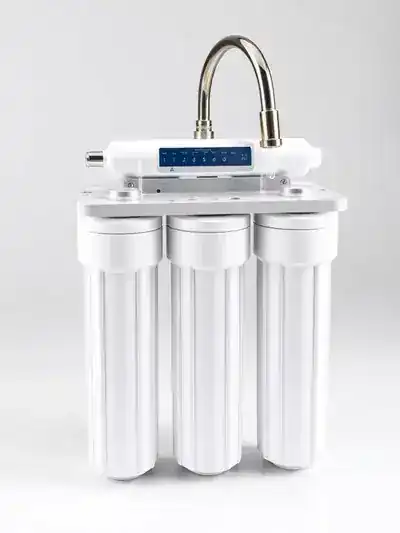
Aquasana OptimH2O
- • Claryum + RO dual technology
- • NSF certified for 88 contaminants
- • Mineral retention
- • Easy twist-off filter changes
Common Myths About RO and Distilled Water
Myth: "Distilled water leaches minerals from your body."
No mainstream medical research supports this claim. Both distilled and RO water are safe to drink for adults eating a balanced diet. The body's mineral balance is regulated by complex hormonal mechanisms, not the mineral content of drinking water.
Myth: "RO does not remove fluoride."
False. Modern TFC RO membranes remove 94-96% of fluoride—nearly identical to distillation's 95-98%. Look for NSF/ANSI 58 certification to verify.
Myth: "Distilled water is 100% pure."
False. Distillation can carry over volatile organic compounds (VOCs) like benzene and methanol via steam fractionation. Pure distilled requires a carbon vent stage, which most home distillers lack. RO with carbon pre-filtration matches or exceeds this purity.
Myth: "RO wastes too much water to be eco-friendly."
Old systems wasted 4 gallons per 1 gallon produced. Modern tankless systems achieve 1:1 ratios. Even 4:1 RO uses less total water than distillation considering the energy production water footprint of electricity.
Related Resources
RO Water Taste Guide
Why RO and distilled taste flat and how to fix it
RO Remineralization
Add minerals back to RO or distilled water
RO for Aquariums
Why hobbyists prefer RO/DI over distilled
RO Sizing Guide
Choose the right capacity for your home
Best Reverse Osmosis Systems
2026 rankings across all categories
How Reverse Osmosis Works
The science behind multi-stage RO filtration
Frequently Asked Questions
Related Articles
Our picks for Reverse Osmosis Systems
Top-rated RO water filters
Buying guide: Water Softeners
Top water softening systems
Top-rated Whole House Water Filters
Complete whole-house filtration
See the best Well Water Filters
Specialized well water treatment
Water Filter Buying Guide
Avoid common buying mistakes
Read: State Water Quality Guide
Water quality by state