Best Water Softener Alternatives: Salt-Free Options Compared (2026)
Traditional salt-based water softeners are effective but require salt refills, drain discharge, and regular maintenance. In some states, they're restricted or banned entirely due to environmental concerns. Water softener alternatives provide scale prevention without the drawbacks of ion exchange systems—no salt, no electricity, no wastewater, and virtually no maintenance. This guide covers every alternative technology with honest performance assessments, product recommendations, and a clear framework for choosing between salt-free and salt-based solutions based on your specific water hardness level.
Why Consider Water Softener Alternatives?
Traditional water softeners use ion exchange to swap calcium and magnesium ions for sodium ions, genuinely softening the water. They work extremely well, but they come with significant practical and environmental drawbacks that make alternatives attractive for many homeowners.
- Salt and maintenance: Requires adding 40-80 lbs of salt monthly plus periodic resin cleaning and brine tank sanitization
- Sodium in water: Adds 20-80 mg/L sodium to all household water (concern for low-sodium diets, hypertension, and infant formula preparation)
- Wastewater discharge: Each regeneration cycle wastes 50-100 gallons of brine water down the drain, impacting municipal wastewater treatment
- Slippery water feel: Many people dislike the characteristic slick, "slimy" texture of softened water during bathing
- Cost: $500-3,000 upfront plus $150-400/year in ongoing salt, water, and maintenance costs
- Environmental regulations: Salt discharge is restricted in California, parts of Michigan, Connecticut, Texas, and other regions due to impact on wastewater treatment and groundwater
- Removes beneficial minerals: Ion exchange strips calcium and magnesium, which are beneficial dietary minerals. WHO research suggests demineralized water may have negative health effects
Types of Water Softener Alternatives
1. Salt-Free Water Conditioners (TAC Systems)
Template-Assisted Crystallization (TAC) is the most scientifically validated salt-free alternative. TAC media contains nucleation sites that convert dissolved calcium and magnesium into stable microscopic crystals. These micro-crystals remain suspended in water and pass through your plumbing without adhering to surfaces. The minerals stay in your water (it's not technically "softened"), but they can't form scale deposits.
Independent testing by Arizona State University confirmed TAC systems prevent over 90% of scale formation in controlled studies. The German DVGW certification standard (W512) validates scale prevention performance. This is the technology behind premium systems from Aquasana, Pelican, and SpringWell.
✅ TAC Pros
- • No salt, electricity, or backwash required
- • Zero maintenance (media lasts 3-5 years)
- • No sodium added to water
- • Eco-friendly—no wastewater discharge
- • Retains healthy calcium and magnesium
- • Legal everywhere (no discharge restrictions)
❌ TAC Cons
- • Doesn't actually soften water (minerals remain)
- • No soap lather improvement
- • Minimal skin/hair benefits
- • Less effective above 25 grains hardness
- • Scale prevention only—not removal
- • Requires pre-filtration for sediment
2. Electronic/Magnetic Descalers
These devices use electromagnetic fields or permanent magnets to theoretically alter the crystal structure of hardness minerals, preventing them from forming scale. They wrap around your pipe exterior—no plumbing modifications needed. However, the scientific evidence for their effectiveness is limited and inconsistent across independent studies.
Some users report reduced scale, particularly in areas with moderate hardness. But controlled laboratory testing has produced mixed results, and no major independent certification body (NSF, WQA) has validated electromagnetic descaling technology. At $50-300, they're inexpensive to try, but we recommend proven TAC systems for reliable scale prevention.
3. Reverse Osmosis (Point-of-Use Only)
RO systems remove 95-99% of hardness minerals along with virtually all other dissolved contaminants. However, they only treat water at a single tap (typically the kitchen sink). They're excellent for eliminating hard water spots on glasses and improving coffee/tea quality, but they don't protect your shower, laundry, or appliances.
For comprehensive hard water treatment, combine a whole-house TAC conditioner (scale prevention) with an under-sink RO system (mineral removal for drinking water). This gives you the benefits of both technologies.
4. Citric Acid Conditioners
Citric acid systems like NuvoH2O inject food-grade citric acid into your water supply. The citric acid lowers pH slightly and chelates (binds to) hardness minerals, preventing them from depositing as scale. The approach is effective for scale prevention in moderately hard water, though ongoing cartridge costs ($40-60 every 4-6 months) add up over time.
Top Salt-Free Water Conditioner Recommendations
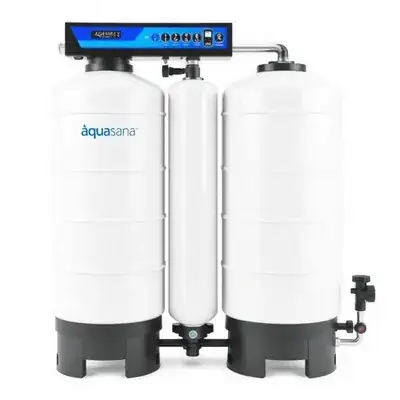
Best Overall: Aquasana Rhino + Salt-Free Conditioner
Combines catalytic carbon filtration (removes chlorine, chloramine, VOCs) with TAC scale prevention in a single system. The Aquasana Rhino is our top recommendation because it addresses two problems at once—water quality and hard water—at a competitive price point.
- Capacity: 1,000,000 gallons or 10 years
- Price: $1,200-1,500 (installation not included)
- Includes: Pre-filter + carbon + TAC conditioner
- Best for: 3-15 GPG hardness with chlorine/taste concerns
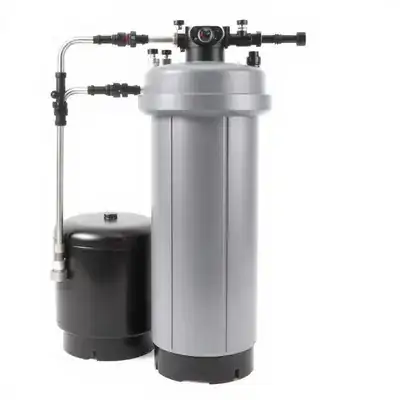
Best Budget: NuvoH2O Manor
Citric acid-based system at an accessible price point. Effective for moderate hardness (7-15 GPG). Compact design, easy DIY installation, and no electricity or drain needed. The tradeoff is ongoing cartridge costs ($40-60 every 4-6 months).
- Capacity: 50,000 gallons (6 months for family of 4)
- Price: $600-800
- Ongoing: Citric acid cartridge $40-60 / 4-6 months
- Best for: Budget-conscious, moderate hardness
Salt-Free vs Salt-Based: Complete Comparison
| Feature | Salt-Free (TAC) | Salt-Based |
|---|---|---|
| Removes minerals | ❌ No (prevents scale only) | ✅ Yes (true softening) |
| Soap lather | ❌ No improvement | ✅ Better lather |
| Skin/hair benefits | ❌ Minimal | ✅ Softer skin/hair |
| Scale prevention | ✅ Yes (90%+ effective) | ✅ Yes (100% effective) |
| Maintenance | ✅ None for 3-5 years | ❌ Monthly salt refills |
| Water waste | ✅ Zero | ❌ 50-100 gal/regen |
| Sodium added | ✅ None | ❌ 20-80 mg/L |
| Upfront cost | $600-2,500 | $500-3,000 |
| 5-year ongoing costs | $0-500 | $750-2,000 |
| Legal restrictions | ✅ None anywhere | ❌ Banned/restricted in some areas |
Decision Framework: Which to Choose
Choose salt-free TAC systems if you:
- Live in an area with salt discharge restrictions (California, parts of MI, CT)
- Want to retain minerals for health benefits
- Prefer a zero-maintenance solution
- Have moderate hard water (5-15 grains per gallon)
- Want an eco-friendly option with no wastewater
- Need to avoid adding sodium to your water
- Primarily want to protect pipes and appliances from scale
Choose traditional salt-based softeners if you:
- Have very hard water (15+ grains per gallon)
- Want better soap lather, softer skin, and brighter laundry
- Don't mind monthly salt refills and periodic maintenance
- Need complete mineral removal for specific applications
- Can accommodate drain discharge requirements
- Have existing plumbing infrastructure for a traditional softener
Hardness Level Guide: What Works Where
| Hardness (GPG) | Classification | Recommended Solution | TAC Effectiveness |
|---|---|---|---|
| 0-3 | Soft | No treatment needed | N/A |
| 3-7 | Slightly hard | Salt-free TAC system | Excellent (95%+) |
| 7-15 | Hard | Salt-free TAC or citric acid | Good (85-95%) |
| 15-25 | Very hard | Salt-based recommended | Fair (70-85%) |
| 25+ | Extremely hard | Salt-based required | Insufficient |
Installation and Space Requirements
Most salt-free conditioners install at the main water line where it enters your home. Compared to traditional softeners, they're significantly more compact and have simpler installation requirements.
- Space requirements: TAC systems are compact (10-20 inches tall, 8-10 inches diameter) versus salt softeners (48-60 inches tall with a separate brine tank)
- No drain needed: Unlike salt softeners, no backwash drain connection required
- No electricity: Passive system—no power outlet needed anywhere near the installation
- DIY-friendly: Most systems use compression or push-fit fittings for easy installation without soldering
- Pre-filter recommended: Install a 5-micron sediment pre-filter upstream to protect TAC media from particulate fouling
- Installation time: 1-3 hours for most DIY installations, versus 4-8 hours for salt-based softeners
5-Year Total Cost of Ownership
| System Type | Upfront | 5-Year Ongoing | 5-Year Total |
|---|---|---|---|
| TAC Conditioner | $600-2,500 | $0-400 | $600-2,900 |
| Citric Acid (NuvoH2O) | $600-800 | $480-720 | $1,080-1,520 |
| Electronic Descaler | $50-300 | $5-20 (electricity) | $75-400 |
| Salt-Based Softener | $500-3,000 | $750-2,000 | $1,250-5,000 |
Salt-free TAC systems typically save $400-2,250 over 5 years compared to salt-based softeners, primarily through eliminated salt purchases, reduced water bills (no backwash waste), and zero maintenance labor.
Choosing the Right Alternative for Your Situation
The best salt-free alternative depends entirely on your water hardness level and primary concerns. For moderate hardness (7-15 GPG), Template Assisted Crystallization (TAC) systems like the SpringWell FutureSoft provide excellent scale prevention at comparable cost to salt-based softeners, without the slippery water feel, sodium addition, or wastewater discharge. TAC systems require zero electricity, no drain connection, and minimal maintenance—making them ideal for environmentally conscious homeowners and those on sodium-restricted diets.
For very hard water (above 15 GPG), TAC systems become less effective at preventing all scale formation. In these cases, electronic descalers offer a budget-friendly complement—wrapping wire coils around the main water line creates electromagnetic fields that temporarily alter mineral crystallization. While scientific evidence for electronic descalers is mixed, many users report reduced scale buildup on fixtures and appliances. At $150-300 with zero ongoing costs, they represent a low-risk experiment for hard water households that can't install salt-based systems.
One critical distinction: no salt-free alternative actually removes hardness minerals from water the way salt-based softeners do. They prevent scale but don't eliminate spotting on dishes, reduce soap scum, or create the "soft water" feel. If those benefits are your priority, a traditional water softener remains the only proven solution. However, if your main concern is protecting plumbing and appliances from scale damage while avoiding salt, alternatives provide meaningful protection at lower environmental cost.
Related Resources
Understanding Water Quality Science
Water quality is determined by a complex interplay of dissolved minerals, organic compounds, and potential contaminants that vary significantly by geographic region and water source. Municipal water treatment facilities use multi-stage processes including coagulation, sedimentation, sand filtration, and chemical disinfection to meet EPA Safe Drinking Water Act standards. However, these treatment processes can introduce disinfection byproducts such as trihalomethanes and haloacetic acids, which form when chlorine reacts with naturally occurring organic matter in the source water.
Private well water faces different challenges, as it bypasses municipal treatment entirely and may contain naturally occurring contaminants like arsenic, radon, and heavy metals that leach from surrounding geological formations. The Environmental Protection Agency recommends annual testing for coliform bacteria, nitrates, total dissolved solids, and pH levels for all private wells. Additional testing for volatile organic compounds, pesticides, and heavy metals should be conducted if you live near agricultural areas, industrial sites, or old mining operations. Understanding your specific water chemistry is the critical first step in selecting the most effective filtration system for your household needs.
Total dissolved solids (TDS) measurements provide a general indicator of water purity but should not be the sole basis for filtration decisions. Water with high TDS from beneficial minerals like calcium and magnesium may actually be healthier than ultra-purified water. The World Health Organization has noted that demineralized water may have adverse health effects due to the absence of essential minerals. This is why many advanced filtration systems, particularly reverse osmosis units, now include remineralization stages that add back beneficial minerals after removing contaminants. The ideal approach balances contaminant removal with mineral retention, targeting specific harmful substances identified through comprehensive water testing while preserving the natural mineral content that contributes to both taste and health benefits.
Filtration Technology Comparison
Modern water filtration leverages several distinct technologies, each with unique strengths for addressing specific water quality challenges. Activated carbon filtration, the most common residential method, uses adsorption to capture chlorine, volatile organic compounds, and taste-affecting chemicals. Granular activated carbon (GAC) filters provide good flow rates but may allow channeling, while carbon block filters compress carbon particles for more consistent contact time and finer filtration down to 0.5 microns. Catalytic carbon represents the latest advancement, specifically engineered to break down chloramines through a catalytic reaction rather than simple adsorption.
Reverse osmosis systems force water through a semipermeable membrane with pore sizes as small as 0.0001 microns, effectively removing dissolved solids, heavy metals, and most microorganisms. Modern RO systems achieve 95-99 percent rejection rates for contaminants like lead, arsenic, fluoride, and PFAS compounds. The primary considerations for RO systems include water waste ratios (typically 3:1 to 4:1 for standard systems, improved to 1:1 in premium tankless models), storage tank requirements, and the need for pre-filtration to protect the delicate membrane from sediment and chlorine damage.
Ion exchange technology, used in both water softeners and specialized contaminant removal systems, swaps problematic ions in the water with benign alternatives. Water softeners exchange calcium and magnesium ions for sodium ions, preventing scale buildup in plumbing and appliances. Specialized ion exchange resins can target specific contaminants like lead, nitrates, or perchlorate. Ultraviolet purification provides chemical-free disinfection by disrupting the DNA of bacteria, viruses, and protozoa at wavelengths around 254 nanometers. UV systems are particularly valuable for well water and as a final treatment stage in multi-barrier systems, though they do not remove chemical contaminants or improve taste.
Long-Term Cost Analysis
When evaluating water filtration costs, the total cost of ownership over five years provides a much more accurate picture than initial purchase price alone. A budget pitcher filter at thirty dollars may seem economical, but replacement filters at forty dollars every two months add up to over twelve hundred dollars in five years. Meanwhile, an under-sink system costing two hundred dollars upfront with sixty-dollar annual filter changes totals just five hundred dollars over the same period, delivering superior filtration at less than half the long-term cost.
Whole house filtration systems represent a larger initial investment of eight hundred to two thousand dollars including professional installation, but they protect all water fixtures and appliances simultaneously. When you factor in the extended lifespan of water heaters, dishwashers, and washing machines that no longer process unfiltered water, the return on investment often exceeds the system cost within three to four years. Water softener savings are particularly dramatic: the Water Quality Association estimates that soft water can reduce water heating costs by up to twenty-nine percent and extend appliance lifespans by thirty to fifty percent.
For households currently purchasing bottled water, any home filtration system provides massive savings. The average family spending twenty dollars per week on bottled water spends over five thousand dollars in five years. Even the most premium whole house filtration system with annual maintenance costs less than two thousand dollars over the same period, saving over three thousand dollars while eliminating hundreds of plastic bottles from landfills annually. The environmental and financial case for home filtration is compelling at every price point.
Health and Safety Considerations
The health implications of water contaminants vary significantly based on exposure levels and duration. Lead exposure, even at low levels, can cause developmental delays in children, cardiovascular problems in adults, and reproductive issues. The EPA has set the maximum contaminant level goal for lead at zero, acknowledging that no level of lead exposure is considered safe. Homes built before 1986 are at particular risk due to lead solder in copper pipes and lead service lines connecting to municipal water mains.
PFAS compounds, known as forever chemicals due to their environmental persistence, have been detected in drinking water supplies serving over one hundred million Americans. These synthetic chemicals, used in nonstick cookware, food packaging, and firefighting foam, have been linked to cancer, thyroid disease, immune system effects, and reproductive problems. The EPA established enforceable maximum contaminant levels for six PFAS compounds in 2024, driving increased demand for filtration systems capable of removing these persistent pollutants.
Microbiological contaminants including bacteria, viruses, and parasitic cysts present acute health risks, particularly for immunocompromised individuals, elderly people, infants, and pregnant women. Cryptosporidium and Giardia cysts are resistant to chlorine disinfection and require physical removal through filtration at one micron or smaller. UV purification provides an additional barrier against biological threats without adding chemicals to the water. For comprehensive protection, the Centers for Disease Control recommends a multi-barrier approach combining physical filtration, chemical or UV disinfection, and regular testing to verify system performance and identify emerging contaminant threats in your water supply.
Frequently Asked Questions
Related Articles
Our picks for Water Softeners
Top-rated salt-based and salt-free systems
Top-rated Salt-Free Water Conditioners
Scale prevention without salt or drain
Salt-Based or Salt-Free Softeners? Full breakdown
Which technology is right for your home?
Walkthrough — Water Softener Sizing Guide
Calculate grain capacity for your household
Water Softener Installation
DIY installation step-by-step
Water Softener Maintenance (upkeep tips)
Salt refills, resin cleaning, and care schedule