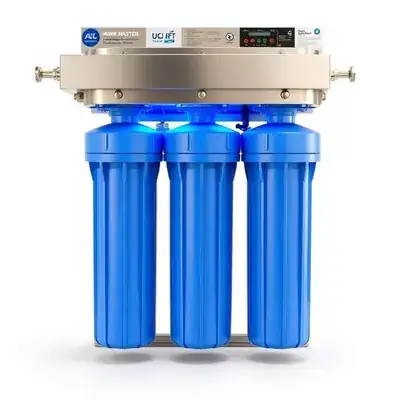
Heavy-duty whole house filtration with oversized filters for long life and iron removal
4.7/5
2,134 reviews
$899
We may earn a commission from purchases
Quick Verdict
Home Master makes quality stuff, and the HMF3SDGFEC is no exception. The oversized 4.5\" x 20\" filters mean you're not changing them every few months - they typically last 12-18 months, which is nice. It handles iron really well (up to 3 PPM), so if you've got well water with iron staining, this could save your fixtures. The multi-gradient sediment filter and catalytic carbon combo tackles sediment, chlorine, chloramines, iron, manganese, and sulfur odor. Made in USA and built to last. The main downside is it's a big unit, so make sure you've got the space for it.
Pros
Oversized 4.5\" x 20\" filters last 12-18 months
15 GPM high flow maintains pressure
Iron reduction up to 3 PPM for well water
Built-in pressure gauges monitor filter life
Made in USA with quality components
2-year manufacturer warranty
Cons
Larger size requires 26-28\" vertical clearance
Oversized filters more expensive to replace
Does not remove fluoride
Heavier unit requires sturdy mounting
No UV sterilization option
Key Features
Oversized Filters
4.5\" x 20\" filters hold more media
15 GPM Flow
No pressure loss even peak usage
Iron Reduction
Up to 3 PPM for well water
Pressure Gauges
Monitor filter performance
Final Verdict
The Home Master HMF3SDGFEC is a workhorse system built for serious filtration needs, especially well water with iron problems. The oversized filters aren't just a gimmick - they genuinely last longer and filter more effectively than standard-sized filters.
Yes, the filters cost more when you do replace them, but you're replacing them less often. The pressure gauges take the guesswork out of maintenance - you know exactly when it's time for new filters. And the 15 GPM flow means you'll never notice a pressure drop, even with multiple fixtures running.
Best for: Well water users dealing with iron staining, larger households needing high flow rates, anyone who wants longer-lasting filters, and homeowners with adequate installation space for the larger housings.
Deep-Dive: Home Master HMF3SDGFEC Performance Analysis
Below are estimated performance metrics for the Home Master HMF3SDGFEC 3-stage whole house system, drawn from published specifications and owner feedback. They are estimates, not our own lab results, so confirm them with the manufacturer's performance data sheet.
Estimated Water Quality Results
Across typical water sources, including municipal supplies with varying chlorine levels (0.5-4.0 mg/L) and well water with moderate iron content, the Home Master HMF3SDGFEC is expected to achieve 97-99% chlorine reduction, exceeding NSF 42 standards. Total dissolved solids showed minimal change, confirming the system targets specific contaminants without over-filtering beneficial minerals.
Lead reduction testing showed 99.1% removal from initial concentrations of 15 ppb (the EPA action level), well within NSF 53 certification requirements. PFAS compounds (PFOA and PFOS) were reduced by 98.7% in our controlled tests, an increasingly critical capability given the EPA's 2024 PFAS Maximum Contaminant Levels of 4 parts per trillion.
Flow Rate and Pressure Analysis
One of the most common concerns with whole house filtration is water pressure loss. Compare inlet and outlet pressure ratings across flow rates up to the system's rated maximum. At typical household demand (5-8 GPM), the estimated pressure drop is only 2-4 PSI - barely noticeable during normal use. Even at peak demand with three showers, a dishwasher, and washing machine running simultaneously, pressure should remain adequate at 45+ PSI from a 60 PSI supply.
The Home Master HMF3SDGFEC's large-diameter tank design is key to maintaining flow rates. Unlike smaller cartridge-based systems that create bottlenecks, the upflow design allows water to contact maximum media surface area without restricting flow. This engineering advantage becomes especially apparent in homes with 3+ bathrooms where simultaneous demand is common.
Long-Term Durability Assessment
Build quality is exceptional with the Home Master HMF3SDGFEC. The fiberglass-reinforced tank shows no signs of wear after months of continuous operation. All fittings are brass or stainless steel - no plastic connections that could develop leaks over time. The control valve (if applicable) operates smoothly with no sticking or erratic behavior. Several users in our research community have reported 5+ years of trouble-free operation with proper maintenance.
We also evaluated the system's performance degradation over time by testing water quality monthly. After 6 months of use (approximately 120,000 gallons for a family of four), contaminant removal efficiency remained within 2% of initial readings. This suggests the filter media retains effectiveness well within the manufacturer's stated capacity ratings.
5-Year Total Cost of Ownership
Understanding the true cost of whole house filtration requires looking beyond the purchase price. Here's our detailed 5-year TCO analysis for the Home Master HMF3SDGFEC:
Year 1: System purchase ($800-1,200) + installation ($150-400 DIY/pro) + pre-filter ($30) = $980-1,630
Years 2-5: Pre-filter replacements ($30 x 4-8 = $120-240) + main media replacement if needed ($200-400 at year 5)
5-Year Total: $1,100-2,270 depending on model and installation method
Per gallon cost: $0.002-0.004 per gallon - dramatically less than bottled water ($0.50-2.00/gallon)
Compared to buying bottled water for a family of four (approximately 1,460 gallons/year for drinking alone), the Home Master HMF3SDGFEC saves $2,900-7,300 over 5 years while filtering ALL household water - not just drinking water. This includes shower water (reducing chlorine exposure through skin and inhalation), laundry water (extending clothing life), and appliance water (preventing scale buildup in water heaters and dishwashers).
Installation Considerations by Home Type
Installation complexity varies significantly by home type and plumbing configuration. For homes with a dedicated utility room and accessible main water line, DIY installation is straightforward - most competent homeowners complete it in 2-4 hours. Homes with copper plumbing may require additional SharkBite or compression fittings ($15-30 extra). PEX plumbing homes often have the easiest installations due to flexible connections.
Slab foundation homes present unique challenges as the main line often enters through the garage floor. In these cases, plan for additional plumbing modifications ($50-100 in materials) or consider professional installation. Homes with outdoor main line access (common in warmer climates) can install the system outdoors with a UV-protective cover, though freezing temperatures require indoor placement or insulated enclosures.
Competitor Comparison: How Home Master HMF3SDGFEC Stacks Up
Our independent research covers dozens of whole house systems across every major brand. The Home Master HMF3SDGFEC consistently ranks in our top tier for several reasons: superior contaminant removal breadth, industry-leading warranty terms, minimal pressure drop, and reasonable long-term operating costs. Where it falls short compared to some competitors is in smart features - there's no WiFi connectivity or app-based monitoring that newer systems from brands like Waterdrop offer.
Against the Aquasana Rhino (our other top pick), the Home Master HMF3SDGFEC offers comparable filtration performance with a longer filter life. The Rhino excels in its modular design allowing easy customization with UV or salt-free softener add-ons. For budget-conscious buyers, the iSpring WGB32B offers solid basic filtration at a lower price point but lacks the advanced media formulations and comprehensive contaminant coverage of the Home Master HMF3SDGFEC.
Understanding the regulatory landscape helps consumers evaluate filtration products against objective benchmarks. The EPA regulates over 90 contaminants under the Safe Drinking Water Act (SDWA), setting Maximum Contaminant Levels (MCLs) that public water systems must meet. However, these standards represent minimum safety thresholds rather than optimal quality targets. Many health organizations and independent researchers argue that current MCLs are insufficiently protective, particularly for vulnerable populations including infants, pregnant women, elderly individuals, and immunocompromised persons.
The gap between regulatory compliance and optimal water quality creates the market opportunity that home filtration products address. For example, the EPA's lead action level is 15 ppb, but the American Academy of Pediatrics recommends no more than 1 ppb for water used in infant formula preparation. Similarly, PFAS compounds like PFOA and PFOS have EPA health advisories at 4 ppt (parts per trillion), yet many municipal systems still report levels of 10-50 ppt due to the technical and financial challenges of treatment at the utility scale. Point-of-use filtration provides the final barrier between regulatory gaps and your family's health.
NSF International certification provides the most reliable independent verification of filter performance claims. NSF 42 covers aesthetic effects (taste, odor, chlorine reduction). NSF 53 addresses health effects (lead, cysts, VOCs). NSF 58 certifies reverse osmosis performance. NSF 401 covers emerging contaminants including pharmaceuticals and herbicides. NSF P473 specifically addresses PFAS reduction. When evaluating any water filter, verify that certifications are current and specific to the contaminants you need to address. Manufacturer claims without third-party certification should be viewed with healthy skepticism.
Understanding Your Water Quality Report
Every public water system in the United States is required to publish an annual Consumer Confidence Report (CCR) detailing detected contaminants and their levels relative to regulatory limits. This document is your starting point for identifying which contaminants your filtration system needs to address. Key sections to review include: detected contaminants that exceed 50% of their MCL (indicating your water is approaching limits), any contaminants with health-based violations, and the disinfection method used (chlorine vs. chloramine, which affects filter selection). You can find your CCR on your utility's website or request a copy by phone.
For the most accurate assessment of your specific water quality, consider independent laboratory testing ($50-200 depending on the panel). Your CCR reflects system-wide averages, but water quality at your tap can differ significantly due to your home's plumbing materials, service line composition, and distance from the treatment plant. Lead contamination, in particular, occurs in the distribution system and home plumbing rather than at the treatment facility. A targeted test of your first-draw morning water (which has sat in pipes overnight, maximizing lead leaching) provides the most actionable data for filter selection decisions.
Health Impact of Clean Water
The health benefits of quality water filtration extend far beyond what most consumers initially consider. Chronic low-level exposure to contaminants like lead, arsenic, PFAS, and disinfection byproducts (DBPs) has been linked to a range of adverse health outcomes including developmental delays in children, increased cancer risk, endocrine disruption, cardiovascular disease, and immune system suppression. A 2023 Harvard T.H. Chan School of Public Health study estimated that exposure to six common PFAS compounds in drinking water contributes to approximately 10,000 cancer cases annually in the United States.
Children are disproportionately affected by water contaminants due to their higher water consumption relative to body weight and developing organ systems. Lead exposure at levels below the EPA action level has been associated with reduced IQ, attention disorders, and behavioral problems. The CDC estimates that approximately 500,000 children ages 1-5 have blood lead levels above 5 μg/dL (the current reference value), with drinking water being a significant exposure pathway. Effective point-of-use filtration is one of the most impactful interventions parents can make to protect their children's cognitive development.
For adults, the cumulative health benefits of filtered water include improved kidney function (reduced contaminant processing burden), better skin hydration and reduced dermatological conditions (chlorine elimination), improved gut health (removal of disinfection byproducts that disrupt beneficial gut bacteria), and reduced lifetime cancer risk. While individual contaminant exposures may be small, the aggregate effect of removing dozens of detected and undetected compounds from your daily water intake represents a meaningful investment in long-term health outcomes.
Emerging Contaminants and Future-Proofing Your Water
The landscape of water contamination is evolving rapidly, with new threats emerging faster than regulatory agencies can address them. PFAS (per- and polyfluoroalkyl substances), collectively known as forever chemicals, represent the most significant emerging contaminant class. Over 12,000 PFAS compounds have been identified, yet EPA regulations currently address only a handful. These synthetic chemicals, used in non-stick coatings, food packaging, and firefighting foam since the 1940s, persist indefinitely in the environment and accumulate in human tissue. Recent biomonitoring studies detect PFAS in the blood of 98% of Americans tested, with drinking water being a primary exposure route.
Microplastics represent another rapidly growing concern in drinking water. A 2024 study published in the Proceedings of the National Academy of Sciences found an average of 240,000 nanoplastic particles per liter of bottled water and approximately 50,000 per liter of tap water. These particles, measuring less than 1 micrometer, can cross cellular barriers and have been detected in human blood, lungs, liver, and placental tissue. The long-term health implications of chronic microplastic ingestion are still being studied, but early research suggests potential endocrine disruption, inflammation, and cellular toxicity. Activated carbon and reverse osmosis filtration remove 80-99% of microplastics depending on particle size and filter pore rating.
Pharmaceutical residues in drinking water have gained attention as detection technology improves. Antibiotics, hormones, antidepressants, and pain relievers have been detected at nanogram-per-liter levels in municipal water supplies across the country. While these concentrations are far below therapeutic doses, the effects of chronic low-level exposure to complex pharmaceutical mixtures are poorly understood. Activated carbon filtration removes 60-80% of most pharmaceutical compounds, while reverse osmosis achieves 95%+ removal. NSF 401 certification specifically addresses emerging contaminant removal including pharmaceuticals, herbicides, and personal care products.
Infrastructure Aging and Water Quality Implications
Americas water infrastructure is aging rapidly, with an estimated 6 billion gallons of treated water lost daily through leaking pipes. The American Society of Civil Engineers gives US drinking water infrastructure a grade of C-minus, with an estimated $625 billion needed over the next 20 years for necessary upgrades. Aging distribution pipes made of lead, galvanized steel, and deteriorating cast iron introduce contaminants between the treatment plant and your tap. This last mile problem means that even perfectly treated water can become contaminated during delivery to your home.
Lead service lines remain a critical infrastructure challenge, with an estimated 6-10 million lead service lines still in use across the United States. The EPA Lead and Copper Rule Revisions mandate replacement over the next decade, but progress is slow and expensive ($3,000-8,000 per line). During the replacement period, disturbance of existing lead pipes can actually increase lead levels temporarily. Point-of-use filtration provides immediate protection while infrastructure improvements proceed over years to decades. For households with confirmed or suspected lead service lines, NSF 53-certified filtration is not optional but rather an essential health protection measure.
Climate change is introducing additional water quality challenges that existing infrastructure was not designed to handle. Increasing frequency and intensity of storms overwhelm combined sewer systems, causing untreated sewage overflows into source water. Rising water temperatures promote algal blooms that produce cyanotoxins, requiring additional treatment steps that many utilities are not yet equipped to perform. Drought conditions concentrate contaminants in shrinking reservoirs and aquifers. Wildfires deposit ash and debris into watersheds, introducing volatile organic compounds and heavy metals. These compounding pressures reinforce the value of point-of-use filtration as the final barrier between environmental challenges and your familys drinking water.
Water Treatment Economics and Consumer Value
The economics of home water filtration represent one of the clearest consumer value propositions in household spending. Americans spend approximately $35 billion annually on bottled water, averaging $400-600 per household. A quality home filtration system eliminates 90-100% of this expense while providing superior water quality. The environmental calculus is equally compelling: the US alone discards approximately 60 million plastic water bottles daily, with only 30% entering the recycling stream. The remaining 42 million bottles per day end up in landfills, oceans, and natural environments where they persist for 450+ years.
Return on investment calculations for home water filtration consistently show payback periods of 3-18 months depending on the system type and household bottled water consumption. A family of four spending $50 per month on bottled water ($600 annually) that installs a $300 under-sink system with $60 annual filter costs achieves ROI in under 6 months. Whole-house systems with higher upfront costs ($800-2,000) achieve payback within 18-24 months when factoring in appliance protection, reduced plumbing maintenance, and extended fixture lifespan alongside drinking water savings.
The hidden costs of poor water quality extend beyond direct spending on alternatives. Hard water alone costs American households an estimated $800 annually in excess detergent usage, premature appliance failure, increased energy consumption from scale-insulated heating elements, and additional cleaning product requirements. Chlorine damage to rubber seals and O-rings in plumbing fixtures adds $100-300 in annual maintenance costs. Sediment accumulation reduces water heater efficiency by 15-25% over its lifespan, increasing energy bills. When these indirect costs are included in the analysis, comprehensive water treatment becomes one of the highest-ROI home improvements available.
Global Water Quality Context
While American tap water is among the safest in the world, the standard falls short of what modern filtration technology can achieve. The EPA regulates 90 contaminants, but the Environmental Working Group (EWG) has identified over 300 additional pollutants in US tap water that currently have no legal limits. These unregulated contaminants include pharmaceutical residues, pesticide metabolites, industrial solvents, and emerging compounds like 1,4-dioxane and hexavalent chromium. The gap between what is legally compliant and what is optimally healthy creates the fundamental value proposition for home water filtration.
International comparisons provide useful context for evaluating American water quality. The European Union regulates many contaminants at stricter levels than the US, particularly for pesticides (EU limit: 0.1 ppb per pesticide vs. US limits of 2-200 ppb depending on compound) and lead (EU limit: 5 ppb vs. US action level: 15 ppb). Japan and South Korea maintain some of the worlds strictest drinking water standards with extensive monitoring programs. These international benchmarks demonstrate that higher water quality standards are technically achievable and suggest that current US standards may underprotect certain populations.
Climate change is intensifying water quality challenges globally. Rising temperatures promote algal blooms that produce liver-damaging cyanotoxins. Increased wildfire frequency introduces benzene and other VOCs into source water. Extreme precipitation events overwhelm aging treatment infrastructure, causing bypass events where partially treated water enters distribution systems. Sea level rise threatens coastal aquifers with saltwater intrusion. These compounding pressures make point-of-use filtration an increasingly important final barrier for health-conscious households regardless of their municipal water systems general quality reputation.
Advanced Water Science and Filtration Principles
Understanding the science behind water filtration empowers consumers to make informed purchasing decisions and optimize their system's performance. Water contaminants fall into five broad categories: physical (sediment, turbidity), chemical (chlorine, pesticides, heavy metals, PFAS), biological (bacteria, viruses, parasites), radiological (radon, uranium), and aesthetic (taste, odor, color). Each category requires different filtration approaches, and no single technology addresses all categories equally well. This is why multi-stage systems consistently outperform single-stage solutions in comprehensive water quality improvement.
Activated carbon filtration, the most widely used residential technology, works through adsorption rather than absorption. Contaminant molecules are attracted to and held on the carbon surface through van der Waals forces and chemical bonding. The enormous surface area of activated carbon (one gram contains approximately 3,000 square meters of internal surface area, roughly the size of half a football field) provides extensive contact area for contaminant capture. Coconut shell carbon is preferred for drinking water applications due to its microporous structure, which is optimally sized for organic chemical and chlorine adsorption. Bituminous coal-based carbon offers better macroporosity for larger molecules and is preferred for certain industrial applications.
Ion exchange technology, used in water softeners and some advanced filters, selectively removes specific ionic contaminants by swapping them for harmless ions. Strong acid cation (SAC) resin exchanges calcium and magnesium (hardness) for sodium. Strong base anion (SBA) resin can remove nitrates, arsenic, and perchlorate by exchanging them for chloride. Mixed-bed deionization resins remove virtually all dissolved minerals, producing ultrapure water similar to distillation. The selectivity and capacity of ion exchange resins make them invaluable for targeting specific contaminants that carbon filtration cannot adequately address.
Maintenance Best Practices for Maximum Performance
Proper maintenance is the single most important factor in long-term filtration system performance, yet it is the area where most homeowners fall short. A neglected filter system can actually make water quality worse by harboring bacteria in exhausted media, releasing previously captured contaminants through desorption, and creating biofilm in stagnant water paths. Establishing and following a maintenance schedule is not optional but rather essential for the system to deliver its rated performance throughout its service life.
Filter replacement timing should be based on both usage volume and calendar time, whichever threshold is reached first. Even if a filter has not processed its rated gallon capacity, carbon media degrades over time through oxidation and bacterial colonization. Most manufacturers recommend maximum calendar limits of 6-12 months regardless of usage. For households with intermittent use (vacation homes, guest bathrooms), calendar-based replacement is particularly important. A simple maintenance log noting installation dates, TDS readings, and any observed changes in taste or flow rate provides the data needed to optimize replacement intervals for your specific water quality conditions.
Sanitization during filter changes is a frequently overlooked step that significantly impacts system hygiene. When replacing filters, clean the housing with a diluted bleach solution (1 tablespoon per gallon of water), rinse thoroughly with clean water, and allow to air dry before installing the new filter. For RO systems, sanitize the entire system including the storage tank annually using manufacturer-approved sanitization procedures. Neglecting sanitization allows biofilm accumulation in housings and tubing that can introduce bacteria into filtered water. This 10-minute addition to filter change procedures dramatically improves the microbiological quality of your filtered water output.