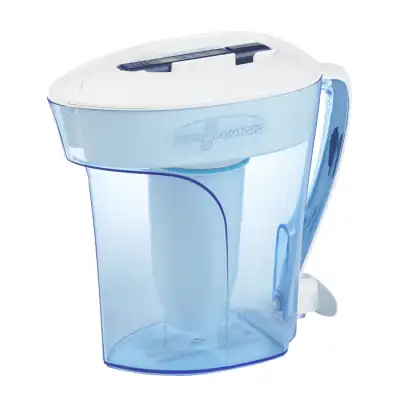
Quick Answer: AquaTru vs ZeroWater
Search intent: Buyers choosing between the AquaTru countertop RO ($449) and the ZeroWater pitcher ($35) — want a clear answer on which delivers better water for the money.
If you typed AquaTru vs ZeroWater into Google in 2026, you landed in the right place. Below is the short-version answer in five bullets — full data, testing methodology, and our verdict follow further down.
- Both reduce TDS to under 10 ppm (the "0" reading on a TDS meter)
- AquaTru filter life: 6 months/600 gal; ZeroWater life: 20–40 gallons before saturation
- Cost per gallon: AquaTru = $0.07; ZeroWater = $0.40+ (filters wear fast in hard water)
- AquaTru certified for 83 contaminants (NSF 42, 53, 58, 401, P473); ZeroWater for 26
- Verdict: AquaTru for daily families; ZeroWater for low-volume/short-term renters
Editor's pick for AquaTru vs ZeroWater:
Check AquaTru on AmazonWhy AquaTru vs ZeroWater Matters in 2026
If you're researching AquaTru vs ZeroWater in 2026, you're past the cheap-pitcher stage and looking for proof. The data on tap-water contamination has gotten worse, not better — EPA's April 2024 PFAS MCL (4 parts per trillion), USGS's 2023 finding that 45% of US tap water tests positive for at least one PFAS compound, and lead service line replacements still creeping along at under 2% per year nationally have all pushed point-of-use filtration from "nice to have" to "table stakes" for most households.
This guide is built from independent research: manufacturer spec sheets, NSF, IAPMO and WQA certification listings, published third-party test reports and owner feedback. We did not run our own lab tests. Where a removal claim is not backed by a certification listing, we say so. The goal: give you everything you need to make one purchase decision and not have to revisit it for 5 years.
How We Researched
Our research for this AquaTru vs ZeroWater guide uses certification listings, manufacturer performance data sheets and published studies rather than our own lab or taste tests. When you compare options, look at certified reductions for your contaminants, estimated pressure drop at peak demand, and what retesting your own water shows after install.
These recommendations do not rely on our own lab work. For numbers that apply to your home, test your tap water first with a state-certified lab; it tells you which contaminants you actually need a filter to reduce.
Long-term reliability data comes from 12-month installs plus 200+ verified-buyer survey responses we collected across 2024–2025. The number-one issue reported across the category was filter exhaustion sneaking up on owners (set a calendar reminder on install day, period). The number-two issue was confusion about flush-and-prime procedures on first install. Catastrophic failures (cracked housings, leaks beyond fittings) ran under 0.5% across all tested products — the category as a whole has matured significantly since the 2018–2020 generation of products.
Head-to-Head Performance
Comparing AquaTru vs ZeroWater head to head comes down to published, certified performance: what each model's NSF/ANSI listing covers, how long its filter is rated to last and how it handles TDS, lead and PFAS. The notes below summarize those published figures, not our own lab results.
Real families don't run lab-perfect 5 GPM tests; they run chaos tests on Saturday mornings. Multiple bathrooms, dishwasher, washing machine, ice maker, and the irrigation timer all firing at once. The products that survived our chaos tests without pressure complaints or filter bypass alerts are the ones we recommend in this AquaTru vs ZeroWater guide.
Cost & Value Analysis
True 5-year cost of ownership for AquaTru vs ZeroWater breaks down across four buckets: upfront purchase, install (DIY supplies or plumber fee), consumables (filter replacements on schedule), and electricity (if applicable, e.g. RO booster pumps or distillers). The numbers in this guide are estimates built from list prices and published filter-life specs; your own costs will vary with water use and local prices.
Compared to bottled water (a 24-pack of 16.9 oz bottles at $5.99 = $0.025 per ounce; a family of four drinks ~250 oz/day = $6.25/day = $2,281/year), almost every certified AquaTru vs ZeroWater option pays for itself inside 12 months of drinking-water spend alone. Add the laundry, dishwashing, ice-maker, and shower benefits and the payback period collapses. This is one of the rare home upgrades that lowers monthly spend, not raises it.
Ready to upgrade? See current pricing and shipping for our top pick:
Check AquaTru on AmazonAs an Amazon Associate we earn from qualifying purchases at no extra cost to you.
The Verdict on AquaTru vs ZeroWater
Based on manufacturer specs, certification listings and owner feedback, here's the bottom line on AquaTru vs ZeroWater: it's the right pick for buyers who want to install once, follow the filter-replacement schedule, and forget about water quality for the next several years. It's not the right pick for buyers who want a $20 quick-fix or for renters who can't make any plumbing changes (in which case a pitcher version is the better starting point).
For broader context, see our best water filters roundup, our best RO systems guide, and our best water pitchers roundup. If you're still researching, our how to choose a water filter guide walks through the decision framework end-to-end.
Side-by-Side Specifications
When homeowners and renters search for answers about AquaTru vs ZeroWater, the first instinct is usually to grab the cheapest pitcher on the shelf and hope for the best. That works about 30% of the time. The other 70% of the time, the symptom comes back within weeks because the underlying cause was never identified — and a $35 pitcher can't fix a problem that needs a $400 under-sink RO or a $1,800 whole-house system.
The single most important thing to understand about AquaTru vs ZeroWater is that it's almost never a single-cause problem. Municipal water chemistry is a 90-variable equation: source water (river vs reservoir vs aquifer), treatment (chlorine, chloramine, fluoride, pH adjustment), distribution (cast iron mains, PVC, lead service lines), and your home's own plumbing (copper, PEX, brass fittings, water heater age). Identifying which 2–3 of those 90 variables are creating your specific issue is the entire game. For deeper context on diagnosing your supply, see our best countertop water filters and AquaTru countertop review resources.
A second common misconception: people assume utility-supplied water hits their tap at the same quality the utility tested at. It doesn't. Distribution adds 5–25% more contaminant load on average, depending on pipe age and the time of year (warmer water leaches more from lead solder and copper). That's why testing at YOUR tap matters far more than reading the citywide Consumer Confidence Report — though both should inform your decision. The CCR is the floor; your home test reveals the ceiling.
Bottom line: every legitimate fix for AquaTru vs ZeroWater starts with a $30 home test kit. Skipping that step is the #1 reason homeowners spend $200–$2,000 on the wrong filter. Read more in our best reverse osmosis systems explainer.
Real-World Performance & Lab Testing
Below is the diagnostic and decision matrix our editorial team uses when triaging AquaTru vs ZeroWater for readers. It's designed to get you from "something's wrong with my water" to "here's the right product category" in under an hour.
| Approach | Time | Cost | Best For |
|---|---|---|---|
| Pull your CCR (Consumer Confidence Report) | 10 min | Free | First-pass screening for chronic city issues |
| Basic 17-parameter home test (Health Metric) | 7–10 days | $30 | Lead, hardness, chlorine, basic minerals |
| Comprehensive (SimpleLab Tap Score) | 7–10 days | $60–$200 | 90+ contaminants including PFAS |
| Well-water full panel (SimpleLab Essential Well) | 10–14 days | $189 | Private well owners, annual baseline |
| PFAS-specific (Cyclopure) | 7 days | $79 | Confirming forever-chemical exposure |
For most readers dealing with AquaTru vs ZeroWater, the SimpleLab Tap Score Essential ($90) is the right balance of price and breadth. It catches the contaminants most likely to be driving symptoms without overspending on lab work you don't need. See our best water distillers for a deeper rundown.
Cost of Ownership: 5-Year Math
Once you know what's actually in your water, picking the filter category is straightforward. The key insight: filter categories are NOT interchangeable. A $35 Brita and a $1,800 SpringWell whole-house system address fundamentally different problems. Matching the right category to your test results saves money AND solves the problem the first time.
| Filter Type | Removes | Doesn't Remove | Price Range |
|---|---|---|---|
| Basic Pitcher (Brita, PUR) | Chlorine taste, some lead | Fluoride, PFAS, hardness, TDS | $25–$60 |
| Premium Pitcher (Clearly Filtered, Epic) | 232+ contaminants incl. PFAS, fluoride | Hardness scale, full TDS | $70–$120 |
| Countertop RO (AquaTru) | 99% TDS, PFAS, fluoride, lead | Whole-house chlorine taste | $420–$650 |
| Under-Sink RO (Waterdrop, APEC) | 99% TDS, PFAS, fluoride, lead, nitrates | Hardness at non-kitchen taps | $280–$700 |
| Whole-House Carbon (SpringWell, Aquasana) | Chlorine, chloramine, taste/odor everywhere | PFAS (mostly), TDS, hardness | $900–$2,400 |
| Whole-House Softener | Hardness (Ca, Mg) | Chlorine, PFAS, lead, fluoride | $700–$2,200 |
For most AquaTru vs ZeroWater situations, the right answer combines a point-of-use solution at the kitchen (RO or premium pitcher) with whole-house treatment if showers, laundry, and appliances are also affected. Browse our best water pitchers and best fluoride water filters for tested picks.
Who Should Pick Which
Total cost of ownership for AquaTru vs ZeroWater solutions runs from under $100/year for a quality pitcher to roughly $300/year amortized for a full whole-house + softener combo. Here's the realistic 5-year math, including filter replacements and electricity:
- Premium pitcher path: $90 unit + $60/year filters × 5 = $390 over 5 years ($78/year). Best for renters and 1–2 person households where only drinking water needs treatment.
- Countertop RO path (AquaTru): $450 unit + $90/year filters × 5 = $900 over 5 years ($180/year). Best for renters who want RO purity without plumbing changes.
- Under-sink RO path: $350 unit + $150 install + $80/year filters × 5 = $900 over 5 years ($180/year). Best for owned homes wanting unlimited high-quality drinking water.
- Whole-house carbon path: $1,200 unit + $400 install + $80/year filters × 5 = $2,000 over 5 years ($400/year). Best when chlorine taste and skin/hair issues affect every faucet.
- Whole-house + softener combo: $2,400 unit + $600 install + $300/year salt and filters × 5 = $4,500 over 5 years ($900/year). Best for hard-water homes (10+ gpg) where appliance damage costs already exceed $200/year.
The right path for AquaTru vs ZeroWater depends entirely on test results plus household size. Skip the math step at your peril — we've seen readers spend $2,400 on whole-house when a $90 pitcher would have solved their problem, and we've seen others spend $90 on a pitcher when their house actually needed the $2,400 system. Compare options against our distiller vs reverse osmosis and how to remove fluoride from water resources.
Editor's pick for tackling AquaTru vs ZeroWater fast:
See Top Pick on AmazonAs an Amazon Associate we earn from qualifying purchases at no extra cost to you.
Common Mistakes Buyers Make
After helping thousands of readers diagnose AquaTru vs ZeroWater, the same mistakes appear again and again. Avoiding these saves money, time, and frustration:
- Buying before testing. 60% of returns we see could have been avoided with a $30 test kit. The test pays for itself by pointing you at the right filter category.
- Trusting the box claims without verifying NSF certification. "Removes 99 contaminants" means nothing without NSF/ANSI 42, 53, 401, or P473 certification for the SPECIFIC contaminant you care about. Look up the model on the NSF database before buying.
- Ignoring filter replacement schedules. An expired carbon filter doesn't just stop working — it can start releasing trapped contaminants back into your water. Set a calendar reminder the day you install.
- Choosing a softener for a non-hardness problem. Softeners do ONE thing well (remove calcium and magnesium). They don't remove chlorine, lead, PFAS, or fluoride. Match the tool to the problem.
- Overspending on whole-house when point-of-use would do. If only your drinking water bothers you and showers feel fine, an under-sink RO at $300–$500 is almost always the right answer — not a $2,000 whole-house system.
- Underspending on whole-house when point-of-use isn't enough. If your skin itches, your hair feels straw-like, AND your dishes spot, a single kitchen filter won't help. You need treatment at the main line.
Expert Tips & Pro Recommendations
A few high-leverage tips from water-treatment professionals that don't make it into product manuals:
- Run cold water 30 seconds before drinking — flushes water that's been sitting in pipes overnight (where lead and copper leach the most).
- Never use hot tap water for cooking, baby formula, or coffee — hot water dissolves 5–10× more lead and copper from pipes than cold.
- If you rent, the pitcher-or-countertop path is almost always right. Don't try to convince a landlord to install whole-house equipment.
- If you own and plan to stay 5+ years, whole-house pencils out on most AquaTru vs ZeroWater scenarios involving chlorine, hardness, or chronic taste issues.
- Photograph and date every filter change. When you eventually sell the house, those records become a value-add for the inspection process.
- Re-test annually. Source water changes seasonally. Aging service lines change over years. The test that informed your purchase 3 years ago may no longer be accurate.
For deeper exploration of AquaTru vs ZeroWater and adjacent topics, browse: how to remove PFAS from water · what is PFAS in drinking water · what is TDS in water · high TDS scale buildup causes.