What the particles tell you
Fill a clear glass from the affected tap and let it sit for a few minutes. Color, texture and how fast the particles sink point to the source.
| What you see | Likely source | Usual fix |
|---|---|---|
| Gritty sand that sinks within seconds | Well drawing sand through a worn screen or a pump set too low | Spin-down screen; call a well contractor if it's new |
| Fine silt that clouds the glass and settles slowly | Fine aquifer silt, or a disturbed water main | 5-micron cartridge, with a 1-micron stage if needed |
| Red, brown or orange flakes | Rusty iron or galvanized pipes, iron in well water, or main work | Flush; treat iron; plan pipe replacement if rust is constant |
| Black specks or smudges | Manganese, worn rubber washers or hoses, or carbon from a new filter | Test for manganese; replace washers; flush new carbon filters |
| White or tan chips that fizz in vinegar | Hard-water scale from pipes or the water heater | Flush the heater; consider softening |
| White plastic bits in hot water only | Broken water heater dip tube | Have a plumber replace the dip tube |
Milky water that clears from the bottom up within a minute is usually tiny air bubbles, not sediment; see why is my water cloudy. For dark particles, read black particles in water, and for rust-colored water see brown well water.
Find the source in five minutes
- Hot water only? The water heater is the likely source: scale, rust from the tank, or a broken dip tube.
- One faucet only? Check that faucet's aerator screen and supply hoses before treating the whole house.
- Every tap, hot and cold? The source is upstream: the well, the water main or the service pipe.
- Right after hydrant flushing or main work? It's usually temporary. Run cold water until it clears.
- Neighbors seeing it too? Report it to your utility; it's likely a main issue.
- On a well and it's new? Sudden sand or muddy water after storms needs a well contractor and a bacteria test.
Is sediment in tap water dangerous?
Sand, silt and most rust flakes are mainly a nuisance. They wear out faucet cartridges, appliance valves, water heaters and ice makers. But sediment can matter for health in a few cases:
- Germs: particles can shield microbes from disinfection. That's why EPA rules hold utilities that filter surface water to strict turbidity (cloudiness) limits; see the EPA surface water treatment rules.
- Lead: in older homes, disturbing lead service lines or old solder can release lead particles. After main or plumbing work, flush the cold tap and consider a lead test. See our lead in water guide.
- Manganese: black or brown particles on a well can mean manganese, which has its own health advice. See manganese in water.
- Wells after storms: muddy water after heavy rain can mean surface water is getting into the well. Test for bacteria before drinking.
A sediment filter removes particles only. It doesn't kill germs or remove dissolved metals, chemicals or hardness. If you're unsure what's in your water, start with a water test.
Choose the right micron rating
A micron rating is the size of particle a filter catches. Smaller numbers catch finer particles but clog faster, so heavy sediment is best handled in stages, coarse first.
| Rating | Best for | Note |
|---|---|---|
| 50–100 micron spin-down screen | Sand and coarse grit from wells | Flush the screen; it isn't thrown away |
| 20–30 micron cartridge | Coarse silt; first stage in two-stage setups | Slower to clog than finer cartridges |
| 5 micron cartridge | Most city and well homes | The usual starting point |
| 1 micron cartridge | Very fine silt, or ahead of equipment that needs it | Clogs fastest; use after a coarser stage |
Not sure whether you need sediment or carbon filtration? Read carbon vs sediment filters.
Where the sediment filter goes
Put sediment filtration first, where water enters the home, so it protects everything after it.
- Well or water meter
- Spin-down screen (sandy wells)
- Sediment cartridge
- Softener, iron or carbon filter
- UV or RO
- Taps and water heater
- Size for flow. Whole-house housings come in sizes; a larger housing (such as 4.5 by 20 inches) keeps pressure up and lasts longer between changes.
- Add pressure gauges before and after the housing so you can see when the cartridge is clogging.
- Add a bypass valve so you can change cartridges without shutting off the whole house.
- On a well, install after the pressure tank. Iron and manganese need their own treatment; see the iron removal guide.
Full installation and sizing details are in our whole-house sediment filter guide.
A whole-house filter to compare
If you're on city water and also want less chlorine taste and smell, a whole-house system with a built-in sediment pre-filter handles both jobs.
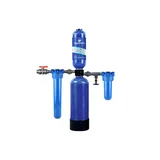
Aquasana Rhino Whole House Water Filter
Aquasana Rhino Whole House Water Filter
Comes with a sediment pre-filter ahead of its main carbon tank, for city homes that want fewer particles and less chlorine taste and odor at every tap. It isn't built for heavy well sand; on sandy wells put a spin-down screen first, and treat iron or manganese separately.
Compare sizing, treatment options and ongoing costs in our best whole house water filters guide.
On a well, compare treatment built for well water in our best well water filters guide.
Keep sediment from coming back
- Change cartridges on schedule, or when the pressure gauges show about a 10 psi drop.
- Flush spin-down screens whenever you can see sediment collecting.
- Flush the water heater on the manufacturer's schedule.
- Clean faucet aerators and appliance inlet screens a few times a year.
- If pressure stays low after a cartridge change, see water pressure issues.
When to call your utility or a well contractor
- Sediment that hasn't cleared about a day after main work.
- Brown or rusty water that keeps coming back; see brown water fixes.
- Sudden sand from a well, or muddy water after storms.
- Sediment with a new smell, taste or color change.
Bottom line
Sediment is one of the easiest water problems to fix once you know the source. Identify the particle, rule out the water heater and single-tap causes, then install a correctly sized sediment filter where water enters the home. It protects every fixture and filter after it. Compare complete systems in our best whole house water filters guide.