How Water Softeners Work: The Complete Science-Based Guide (2026)
85% of American homes have hard water, causing $800+ in annual damage to appliances, plumbing, and fixtures. Understanding exactly how water softeners work helps you choose the right system and maintain it properly for decades of protection.
What Is Hard Water and Why Does It Matter?
Hard water contains elevated concentrations of dissolved calcium and magnesium minerals, picked up as groundwater flows through limestone, chalk, and dolomite deposits. Water hardness is measured in grains per gallon (GPG) or milligrams per liter (mg/L) of calcium carbonate equivalent.
Water Hardness Scale
The Real Cost of Hard Water
Hard water costs the average household $800-1,200 per year through multiple mechanisms. Scale buildup in water heaters creates an insulating layer that forces the heating element to work harder—just 1/4 inch of scale increases energy consumption by 25-40%. The US Department of Energy estimates that hard water scale reduces water heater lifespan from 12 years to 6-8 years.
Beyond energy costs, hard water destroys appliances. Dishwashers, washing machines, ice makers, and coffee machines all suffer from mineral buildup. Hard water also wastes soap—you need 50-75% more detergent, shampoo, and cleaning products to achieve the same results in hard water. Check if your area has hard water with our water hardness calculator.
The Ion Exchange Process: How Softening Actually Works
The heart of every salt-based water softener is ion exchange—a chemical process that swaps one type of ion for another. Here's exactly what happens inside your softener, step by step:
Step 1: The Resin Bed
The softener's mineral tank contains thousands of tiny polystyrene resin beads, each about 0.3-1.2mm in diameter. These beads have a negative electrical charge and are pre-loaded with sodium ions (Na+) during the initial setup and after each regeneration cycle. Think of each bead as having thousands of "parking spots" occupied by sodium ions.
Step 2: The Exchange
When hard water flows through the resin bed, calcium (Ca²+) and magnesium (Mg²+) ions encounter the resin beads. These divalent ions (2+ charge) have a much stronger attraction to the negatively charged resin than monovalent sodium ions (1+ charge). The calcium and magnesium ions displace the sodium ions, effectively "kicking them off" the resin beads and taking their place.
For every calcium or magnesium ion captured, two sodium ions are released into the water (because Ca²+/Mg²+ have a 2+ charge while Na+ has only 1+). This is why softened water contains elevated sodium—it's a direct trade. The exchange happens instantly as water contacts the resin, requiring no energy, chemicals, or moving parts during normal operation.
Step 3: Saturation and Regeneration
Over time, all the resin's "parking spots" become occupied by calcium and magnesium—the resin is exhausted and can no longer soften water. This triggers regeneration, a multi-phase process that restores the resin:
Backwash (10-15 min)
Water flows upward through the resin bed, lifting and separating compacted beads, flushing sediment and debris to drain. This prevents channeling—where water finds shortcuts through packed resin, reducing contact time.
Brine Draw (30-60 min)
A concentrated salt solution (brine) is drawn from the brine tank through the resin. The extremely high sodium concentration overwhelms the calcium/magnesium ions' hold on the resin—mass action forces them off the beads and replaces them with sodium. The displaced hardness minerals flush to drain.
Slow Rinse (20-30 min)
Fresh water slowly rinses the resin bed in the same direction as the brine flow, pushing remaining brine and displaced minerals to drain. This ensures no residual salt taste in the treated water.
Fast Rinse (5-10 min)
A final high-flow rinse settles the resin bed and flushes any remaining brine. The softener tests output water quality—once hardness drops to near-zero, the cycle completes and the softener returns to service.
Brine Tank Refill
The brine tank refills with water to dissolve salt for the next regeneration cycle. The water level is controlled to create the right brine concentration (typically 26-28% saturation—the maximum salt solubility in water).
Types of Water Softening Technology
Salt-Based Ion Exchange (Traditional)
The most effective and widely used softening technology. Removes calcium and magnesium completely, producing truly soft water at 0-3 GPG. Requires salt refills (40-80 lbs/month) and periodic regeneration. The best water softeners use demand-initiated regeneration for maximum efficiency.
Salt-Free Conditioners (TAC)
Template Assisted Crystallization (TAC) doesn't remove hardness minerals—instead, it converts dissolved calcium into microscopic crystal structures that don't adhere to surfaces. Water still tests "hard" but doesn't form scale. No salt, no drain, no electricity, no maintenance beyond annual media replacement. See our salt-based vs salt-free comparison.
Dual-Tank Softeners
Dual-tank systems have two resin tanks: while one regenerates, the other provides soft water. This eliminates downtime—you never have to deal with hard water during regeneration. Essential for large households and commercial applications. More expensive upfront ($1,500-3,000) but more salt-efficient.
Magnetic/Electronic Descalers
These devices wrap around your water pipe and generate electromagnetic fields intended to alter mineral crystal structure. Scientific evidence for their effectiveness is limited and disputed. They don't remove minerals, don't change water chemistry measurably, and won't reduce soap usage. We generally don't recommend them as primary softening solutions, but some users report reduced scale in low-hardness situations.
Water Softener vs. Water Filter: Understanding the Difference
This is one of the most common points of confusion. A water softener and a water filter are fundamentally different devices that solve different problems:
Water Softener
- Removes calcium & magnesium
- Eliminates scale buildup
- Improves soap efficiency
- Does NOT remove chlorine
- Does NOT remove lead/PFAS
- Does NOT remove bacteria
Water Filter
- Removes chlorine & chemicals
- Removes lead & heavy metals
- Removes PFAS, VOCs, pesticides
- Does NOT soften water
- Does NOT prevent scale
- Does NOT improve soap use
For homes with both hard water AND contaminant concerns, the ideal setup is a water softener paired with a whole-house carbon filter. Install the carbon filter BEFORE the softener to remove chlorine (which degrades softener resin) and the softener after to handle hardness. Add an under-sink RO system for the ultimate drinking water.
Water Softener Maintenance & Troubleshooting
Proper maintenance ensures your softener operates efficiently for 15-20+ years. Here's what to do and when:
Monthly
Check salt level (keep above 1/3 full). Break up salt bridges (hardened salt crust above water level). Check for salt mushing (sludge at bottom). Verify soft water output with a hardness test strip.
Quarterly
Clean the brine tank if sediment is accumulating. Check the venturi valve and injector for clogs (common cause of regeneration failure). Inspect all connections for leaks.
Annually
Sanitize the resin tank with softener cleaner (Iron Out or Res-Up). Clean the brine well and float assembly. Check the control valve settings and adjust for seasonal water usage changes.
Every 5-10 Years
Test resin bead effectiveness—if hardness is consistently above 3 GPG after regeneration, resin may need replacement ($100-200 for DIY). Replace control valve seals and pistons if leaking.
Common Troubleshooting
Water feels hard again
Cause: Salt bridge, depleted resin, incorrect settings, or bypass valve open
Fix: Break salt bridges, add salt, check settings, verify bypass is closed
Salt isn't going down
Cause: Salt bridge or mushing creating a dome above water
Fix: Use a broom handle to break the bridge carefully. If mushing, clean tank and switch salt brands
Water tastes salty
Cause: Improper rinse cycle, clogged drain line, or malfunctioning control valve
Fix: Run manual regeneration. Clean drain line. Check timer/control valve settings
Low water pressure
Cause: Clogged resin bed, sediment in the injector, or undersized softener
Fix: Backwash the resin. Clean the injector/venturi. May need a larger unit for your flow rate
Brown/discolored water
Cause: Iron fouling on resin beads or bacterial iron in well water
Fix: Use iron-cleaning resin cleaner. For well water, add an iron pre-filter before the softener
Water Softener Cost Analysis
10-Year Total Cost of Ownership
The data is clear: untreated hard water is the most expensive option over 10 years, costing 3-8x more than any softening solution. Even a basic $400 softener pays for itself within 6-12 months through reduced energy bills, longer appliance life, and lower soap consumption. See our detailed water treatment cost comparison for more analysis.
Installation: DIY vs Professional
Water softener installation requires basic plumbing skills. If you're comfortable with cutting and soldering copper pipes (or using PEX/SharkBite fittings), DIY installation saves $200-500 in labor costs. See our water softener installation guide for step-by-step instructions.
Professional installation is recommended if you're on well water (may need pre-treatment), have unusual plumbing layouts, need electrical work for the control valve, or live in an area requiring permits. Professional installation typically costs $200-500 above the unit price and usually includes a warranty on the work.
For proper sizing, calculate your daily softening demand and choose a unit with 20% extra capacity. An undersized softener regenerates too frequently (wasting salt and water), while an oversized unit costs more upfront without proportional benefit.
Softeners and Conditioners to Compare
Decide first whether you need true softening or scale control. These are exact products we link to; size them for your hardness and household.
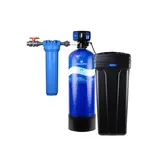
Aquasana SimplySoft 60,000 Grain Softener with LM Pre-Filter
Aquasana SimplySoft 60,000 Grain Softener with LM Pre-Filter
Salt-based ion exchange that actually removes hardness. Size the grain capacity for your hardness and household, and plan for salt, a brine tank and a drain.
Compare sizing, treatment options and ongoing costs in our best water softeners and conditioners guide.
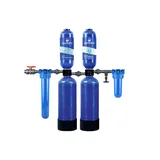
Aquasana Rhino Whole House Salt-Free Water Conditioner
Aquasana Rhino Whole House Salt-Free Water Conditioner
Salt-free scale control for homes that cannot add a drain or want no salt. It reduces scale buildup but does not remove hardness, so soap and spotting behave like hard water.
Compare sizing, treatment options and ongoing costs in our best water softeners and conditioners guide.
Not sure which you need? See our best water softeners guide and salt vs salt-free comparison.
Frequently Asked Questions
Explore Our Top Picks
Related Articles
Our picks for Water Softeners
Top-rated salt-based and salt-free systems
Salt-Free Water Conditioners
Scale prevention without salt or drain
Salt-Based vs Salt-Free Softeners
Which technology is right for your home?
Water Softener Sizing Guide
Calculate grain capacity for your household
Walkthrough — Water Softener Installation
DIY installation step-by-step
Keep it running: Water Softener Maintenance
Salt refills, resin cleaning, and care schedule