How to Test Your Water for Bacteria
Choose the right coliform and E. coli test, collect a valid sample, and respond safely to a positive result.
By the Clean Water Hacks editorial team
Start with a laboratory, not a filter
Use a state-certified drinking-water laboratory and follow its bacteria-specific collection instructions. A clear glass or a low TDS reading cannot establish microbial safety.
- Ask a state-certified lab for total coliform and E. coli testing suited to your water source.
- Use its sterile bottle, collection procedure and delivery deadline; do not substitute lead-testing instructions.
- For a positive result, contact the lab and health department before choosing corrective work or equipment.
Quick answer
Arrange a laboratory bacteria test, follow its sampling instructions exactly, and ask what a positive or negative result means. E. coli detection requires prompt safe-water action. A home TDS meter, taste-and-odor filter or clear-looking sample cannot establish that water is free of pathogens.
When and what to test
Private wells
Test for total coliform at least annually and ask about E. coli testing. Test after flooding, well work or a change in water quality. A private-well owner is responsible for arranging testing; appearance and taste cannot rule out pathogens.
Public water and other sources
Check utility notices and contact the utility or health department when contamination is suspected. Cisterns, springs and surface-water supplies need source-specific advice; do not apply a universal household schedule or assume a single negative sample makes untreated surface water safe.
Total coliform vs. E. coli
Total coliform is an indicator group found in the environment as well as intestines. E. coli indicates fecal contamination. Reports may show presence/absence or counts such as MPN per 100 mL; ask the laboratory what the method can establish.
Lab tests vs. DIY kits
Choose a state-certified laboratory for safety decisions and official requirements. Ask whether both total coliform and E. coli are included. Home kits vary in organisms detected and incubation needs; strips, TDS meters, pH meters and ORP readings cannot confirm the absence of bacteria.
Collect the sample the laboratory requests
Arrange the collection first
Obtain the laboratory’s sterile bottle and instructions before collecting. Confirm the tap, purpose of sampling, handling temperature, delivery deadline and laboratory opening hours. Do not reuse a bottle or collect ahead of the accepted holding window.
Prepare the cold-water tap
Follow the lab’s directions for removing attachments, cleaning the outlet and flushing. Do not use a flame on household fixtures. First-draw lead sampling and composite chemical sampling are not substitutes for bacteria-specific collection procedures.
Protect the bottle
Do not rinse the sterile bottle or remove its preservative or dechlorinating agent. Avoid touching the cap interior, bottle rim or inside. Fill to the specified line without overflowing, cap promptly and label the sample.
Deliver and document
Follow the exact lab instructions for cooling and delivery; bacteria samples can have short holding times. Record the time, location, recent disinfection and any unusual conditions. Ask the lab whether recent treatment could affect the result rather than assuming one generic shipping window.
What results mean and what to do next
Absent or negative
The tested organisms were not detected in that sample under that method’s conditions. This is not proof that all pathogens and chemicals are absent. Keep the report and continue recommended monitoring.
Total coliform positive
Contact the laboratory and health department for repeat sampling, E. coli follow-up and safe-use guidance. Sampling contamination, plumbing and source-water problems are all possible; a positive result alone cannot diagnose the cause.
E. coli detected
Stop using untreated water for drinking, cooking, brushing teeth and ice; use a known-safe alternative and contact the health department or utility promptly. Follow the official advisory rather than waiting for a filter or a repeat result.
Boiling is not a chemical remedy
If officials recommend boiling for microbial contamination, follow their instructions. CDC guidance uses a rolling boil for 1 minute, or 3 minutes above 6,500 feet. Boiling does not make fuel-, toxic-chemical- or nitrate-contaminated water safe.
Repair the source before relying on treatment
Inspect and correct the cause
A qualified well professional can investigate the cap, casing, drainage and possible contamination sources. Shock chlorination may be appropriate, but it is not a permanent repair. Do not use a fixed household bleach recipe without well-specific instructions.
Evaluate ongoing disinfection
For persistent confirmed microbial risks, a professional may recommend validated UV or chlorine treatment. Required flow, dose, clarity, pretreatment and maintenance depend on the exact system and water. Do not assume every UV unit treats every pathogen.
Do not rely on ordinary filters
Taste-and-odor carbon filters, pitchers and a generic household RO claim are not a microbial safety clearance. Product-specific validation and a suitable treatment design matter. A new cartridge is not a substitute for an advisory or corrective work.
Retest before resuming normal use
Follow the health department or laboratory’s post-disinfection sampling schedule. Check the untreated source and treated water where advised, retain results and follow clearance instructions. A negative result while disinfectant remains may not demonstrate that the original problem is resolved.
Compare services and keep useful records
Ask for a current quote
Confirm organisms tested, presence/absence versus counts, bottle collection, courier costs, turnaround and whether results satisfy the intended requirement. Ask about local public-health or extension support; do not assume free testing or a fixed national price.
Save context with the report
Store the report and chain-of-custody details alongside the collection location, weather, repairs, treatment and follow-up results. Ask about laboratory qualifiers and sample rejection. Trends help investigation, but a previous negative result does not cancel a new positive finding.
Ongoing treatment after testing and corrective work
Laboratory testing comes first. This is not a test kit or an immediate remedy for a positive result. After the contamination source is addressed, a qualified professional can determine whether ongoing disinfection is appropriate.
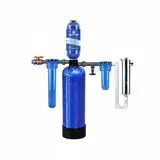
Aquasana Rhino Well Water with UV
Aquasana Rhino Well Water with UV
An option to compare for a permanent well-water system only after laboratory results and professional assessment. Confirm the exact UV operating limits, flow, water clarity and pretreatment. It does not repair the well or replace follow-up testing and official clearance.
Compare sizing, treatment options and ongoing costs in our best well water filters guide.