Whole House Water Filter Sizing Guide
How to size a whole-house filter so it keeps up with your home. Work out your peak flow in gallons per minute, check pipe size and filter capacity, and avoid the pressure drop an undersized system causes.
Selecting the correct size for a whole house water filter isn't about square footage or number of people—it's about flow rate. A properly sized system maintains consistent water pressure across all fixtures while efficiently removing contaminants. Undersized filters create bottlenecks during peak usage (morning showers, laundry), while correctly sized systems handle simultaneous demand without pressure loss.
This comprehensive sizing guide covers the three critical factors: peak flow rate calculation (GPM - gallons per minute), port size selection (3/4" vs 1"), and system capacity planning (total gallons treated before filter replacement). You'll learn to size systems for city water, well water, and special situations like high sediment or large households. Use our interactive calculator below to get specific recommendations for your home.
Interactive Sizing Calculator
Understanding GPM Requirements
Standard Fixture Flow Rates
Each plumbing fixture has a standard flow rate. Peak demand occurs when multiple fixtures run simultaneously:
Peak Flow Calculation Examples
Small Home (1-2 Bath, 2-3 People)
Typical Morning Scenario:
• 1 Shower: 2.5 GPM
• 1 Toilet flush: 2.0 GPM
• 1 Bathroom sink: 1.5 GPM
• Kitchen sink (coffee): 2.0 GPM
Peak Flow: 8.0 GPM
Recommended: 10-12 GPM system (25% margin)
Port Size: 3/4" sufficient
Medium Home (2-3 Bath, 3-5 People)
Typical Morning Scenario:
• 2 Showers: 2 × 2.5 = 5.0 GPM
• 1 Toilet flush: 2.0 GPM
• 2 Bathroom sinks: 2 × 1.5 = 3.0 GPM
• Dishwasher running: 2.0 GPM
• Kitchen sink: 2.0 GPM
Peak Flow: 14.0 GPM
Recommended: 15-18 GPM system (25% margin)
Port Size: 1" required
Large Home (3+ Bath, 5+ People)
Typical Morning Scenario:
• 3 Showers: 3 × 2.5 = 7.5 GPM
• 2 Toilets: 2 × 2.0 = 4.0 GPM
• 2 Bathroom sinks: 2 × 1.5 = 3.0 GPM
• Washing machine: 3.0 GPM
• Dishwasher: 2.0 GPM
• Kitchen sink: 2.0 GPM
Peak Flow: 21.5 GPM
Recommended: 25-27 GPM system (25% margin)
Port Size: 1" required, consider 1.5" for future-proofing
Port Size Selection: 3/4\" vs 1\" vs 1.5\"
Port Size Comparison
| Port Size | Max Flow Rate | Best For | Pressure Drop |
|---|---|---|---|
| 3/4\" | 10-12 GPM | 1-2 bath homes, <2,500 sq ft | 3-5 PSI |
| 1\" | 15-25 GPM | 2-4 bath homes, most residential | 2-4 PSI |
| 1.5\" | 30-40 GPM | 4+ bath, estates, light commercial | 1-3 PSI |
When to Choose 3/4\" Ports
- 1-2 bathroom homes
- 2-3 people maximum
- Calculated peak flow under 10 GPM
- Main water line is 3/4\"
- Budget-conscious ($100-200 less than 1\")
Warning: 3/4\" ports are easily undersized. If in doubt, go with 1\" to avoid pressure issues.
When to Choose 1\" Ports (Most Common)
- 2-4 bathroom homes
- 3-6 people
- Peak flow 12-20 GPM
- Well water systems (higher sediment load)
- Future-proofing for additions/remodels
Best Choice: 1\" ports handle 90% of residential applications without pressure loss.
Note: Port size should match or exceed your main water line size. Installing a 3/4\" filter on a 1\" main line creates a bottleneck. Use reducing fittings if needed, but always size the filter for required flow rate, not just to match existing pipes.
System Capacity & Filter Lifespan
Filter Capacity by Stage
Stage 1: Sediment Pre-Filter
Capacity
15,000-50,000 gallons
Replacement
3-6 months
Cost
$15-30
High sediment (well water, old pipes) may need monthly replacement
Stage 2: Main Carbon Tank
Capacity
500,000-1,000,000 gallons
Replacement
5-10 years
Cost
$200-500
Longest-lasting stage, media replacement every 5-10 years depending on water quality
Stage 3: Post-Carbon Filter
Capacity
25,000-50,000 gallons
Replacement
12 months
Cost
$25-50
Final polishing stage for taste and odor, annual replacement recommended
Calculating Your Filter Lifespan
Step 1: Determine Daily Water Usage
Average per person: 80-100 gallons/day
Family of 4: 320-400 gallons/day
Or check your water bill for exact usage
Step 2: Calculate Months to Replacement
Example: Sediment Pre-Filter (30,000 gallon capacity)
• Family of 4 = 350 gallons/day average
• 30,000 gallons ÷ 350 gallons/day = 85 days
= Replace every 3 months
Step 3: Account for Water Quality
Well Water: Reduce capacity by 30-50% (high sediment)
City Water (Clean): Use full rated capacity
Old Pipes (Rusty): Reduce by 20-30%
Hard Water: No effect on capacity (use softener first)
Special Sizing Scenarios
Well Water Systems
Well water requires larger capacity due to higher sediment, iron, and mineral content:
- Size filter 1.5x normal capacity (sediment load)
- Install 5-micron sediment pre-filter minimum
- Consider dual pre-filters (20μ then 5μ stages)
- Use 1\" ports even for smaller homes
- Budget for monthly pre-filter changes
Learn more: Best Well Water Filters
High Chlorine / Chloramine
Heavy chlorine/chloramine treatment exhausts carbon filters faster:
- Oversize carbon tank by 50% for chloramine
- Use catalytic carbon (better chloramine removal)
- Test chlorine levels quarterly to track capacity
- Plan for 30-40% shorter carbon lifespan
Related: Removing Chloramine from Water
Multi-System Installations
When combining softener + filter or multiple treatment stages:
- Size each system for full household flow (don't split capacity)
- Install in order: Sediment → Softener → Carbon → UV
- Add 3-5 PSI pressure drop per stage to calculations
- May need pressure booster if <60 PSI incoming
Low Incoming Pressure
If your home has <50 PSI incoming pressure:
- Oversize filter significantly (reduce pressure drop)
- Choose 1\" or 1.5\" ports even if flow rate doesn't require
- Consider pressure booster pump ($300-600)
- Replace pre-filters more frequently (clogging reduces pressure)
Pressure Test: Install gauge at hose bib, run no fixtures. Pressure should be 50-80 PSI. Below 50 PSI requires special sizing considerations.
Whole-House Systems to Compare
Once you know your peak flow, check each system's rated flow (GPM), port size and capacity against it. These two cover the most common situations: city water and well water. Open each deal for the current price and the sizes available.
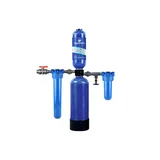
Aquasana Rhino Whole House Water Filter
Aquasana Rhino Whole House Water Filter
A whole-house carbon system for city water. Before buying, compare its listed flow rate and port size with the peak flow you calculated above, and pick the size that matches your number of bathrooms.
Compare sizing, treatment options and ongoing costs in our best whole house water filters guide.
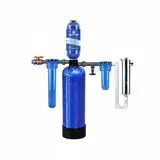
Aquasana Rhino Well Water with UV
Aquasana Rhino Well Water with UV
A well-water bundle with sediment, carbon and UV stages. Well systems need a flow rate that matches your pump and pressure tank, so check the rated GPM against your well's output as well as your household peak flow.
Compare sizing, treatment options and ongoing costs in our best well water filters guide.
5-Year Total Cost of Ownership by System Size
Understanding the true cost helps you make an informed sizing decision. Larger systems cost more upfront but often have lower per-gallon costs due to longer filter life and fewer replacements.
| System Size | Purchase | Install | 5-Yr Filters | 5-Yr Total |
|---|---|---|---|---|
| Small (7-10 GPM) | $400-800 | $300-500 | $150-300 | $850-1,600 |
| Medium (12-15 GPM) | $800-1,400 | $400-600 | $200-400 | $1,400-2,400 |
| Large (15-20 GPM) | $1,200-2,000 | $500-800 | $250-500 | $1,950-3,300 |
| Commercial (20+ GPM) | $2,000-4,000 | $800-1,500 | $400-800 | $3,200-6,300 |
Common Sizing Mistakes & How to Avoid Them
These are the sizing errors that most often lead to low pressure, short filter life and wasted money. Knowing them before you buy saves time and expense.
Mistake: Sizing by Bathroom Count Only
Many installers recommend based solely on bathroom count. A 3-bathroom home with 2 occupants has very different peak flow than a 3-bathroom home with 7 occupants. Always calculate based on simultaneous fixture use during peak periods.
Fix: Use our calculator above to determine actual GPM based on occupants, bathrooms, and usage patterns.
Mistake: Ignoring Water Source Quality
Well water with high sediment, iron, or hardness exhausts filters 2-3x faster than clean city water. A filter rated for 1,000,000 gallons on city water may only last 400,000 gallons on well water with heavy sediment.
Fix: Test your water first, then apply appropriate derating factors when sizing.
Mistake: Not Planning for Growth
Adding a bathroom, finishing a basement, or installing outdoor irrigation all increase peak flow demands. A system sized exactly for current use becomes undersized after any expansion.
Fix: Size for at least 25% above current peak flow. If planning additions within 5 years, size for the future layout now—it's much cheaper than replacing the entire system later.
Mistake: Choosing 3/4" Ports to Save Money
The $50-100 savings on a 3/4" system versus 1" is the most expensive "deal" in whole house filtration. Undersized ports create permanent bottlenecks that no filter upgrade can fix without replumbing.
Fix: Default to 1" ports for any home with 2+ bathrooms. The marginal cost is negligible compared to the performance benefit and future-proofing value.
Related Sizing Resources
Explore Our Top Picks
Best Water Softeners
Hard water treatment and scale prevention
Best RO Systems
Maximum contaminant removal for drinking water
Best Under-Sink Filters
Point-of-use protection at the kitchen tap
Water Test Kits
Test for iron, bacteria, lead, and more
Best Water Pitchers
Affordable filtered drinking water
Best Portable Filters
Emergency and travel water purification
More Guides & Reviews
Frequently Asked Questions
Related Articles
See the best Whole House Water Filters
Complete whole house filtration buyer's guide
Is the SpringWell CF4 worth it?
20 GPM whole-house carbon filter for 4-6 bath homes
Is the Aquasana Rhino Max Flow worth it?
NSF-certified pro-grade Aquasana whole-house filter
In-depth SpringWell WHF Combo 4 (filter + softener) breakdown
CF4 + FutureSoft bundle for hard city water
In-depth Aquasana Rhino Pro Grade (UV + salt-free) breakdown
Carbon + UV + SimplySoft Aquasana stack
SpringWell CF4 versus Aquasana Rhino EQ-1000 — which wins
Large-home whole house filter showdown