Sizing guide
How to Size a Reverse Osmosis System for Your Home
Balance daily demand, peak draw, storage and actual feed conditions—not just the GPD number on the box.
Before you choose a system
Balance daily demand, peak draw, storage and actual feed conditions—not just the GPD number on the box.
- Measure daily use and your largest single draw.
- Check winter feed temperature and operating pressure.
- Compare usable storage, refill time and ongoing costs.
Quick answers
What size reverse osmosis system do I need?
Size for measured drinking and cooking demand, your largest single draw, and refill time. A conventional tank system may meet modest daily use, while a higher-output tankless model can suit repeated large draws. Household size alone does not establish the required GPD.
What does GPD mean for reverse osmosis systems?
GPD means gallons per day: production measured over 24 hours under the manufacturer's stated test conditions. It is not the faucet flow rate or a guarantee of production in your home. Compare ratings only after checking pressure, temperature and feed-water conditions.
Is a tankless RO system better than a tank system?
Neither design is universally better. Tank systems store water for short bursts and often work without electricity. Tankless systems avoid a separate storage tank and commonly use an electric pump. Compare actual faucet flow, drain-water ratio, replacement costs and available space for the specific models.
GPD ratings: production is not faucet flow
What to check
GPD describes membrane production over a full day at stated conditions. Faucet flow is a different measurement. Dividing a rated GPD by 1,440 gives an average gallons-per-minute production equivalent, not a guaranteed dispensing rate. A tank can supply a short burst while the membrane replenishes it more slowly.
Practical planning
Compare manufacturer performance sheets and their test conditions. Do not apply a single real-world percentage to every membrane or assume all ratings use identical pressure, temperature and feed-water chemistry.
Household sizing: measure demand before choosing a tier
What to check
Record several days of drinking, cooking, coffee and tea use, then add approved appliance demand. Note the largest draw: filling bottles before school or a large cooking pot can empty a small tank even when daily production is adequate.
Practical planning
As an illustration only, 3 gallons for drinking plus 1 for cooking and 0.5 for beverages totals 4.5 gallons per day. A personally chosen reserve of 1.5 gallons gives a 6-gallon planning target. This is an example, not a health recommendation or a universal household allowance.
| Sizing factor | Your requirement | Product information |
|---|---|---|
| Daily volume | Measured drinking and cooking use | Verified output at your feed conditions |
| Peak draw | Largest amount needed at once | Usable tank volume or faucet flow |
| Refill / recovery | Time between large draws | Model-specific refill or production data |
Pressure and temperature: plan for your actual supply
What to check
Yes. Low feed pressure can reduce membrane production and tank refill speed. Measure pressure at the installation point and compare it with the system's operating range. Use a compatible booster pump only when approved by the manufacturer; a higher GPD label does not solve inadequate feed pressure.
Practical planning
Yes. Colder feed water generally slows membrane production. Use the manufacturer's temperature-correction information when estimating winter output. Do not connect an ordinary residential RO system to hot water or assume that a pump fully cancels the effect of cold water.
Tank vs tankless: storage or on-demand production
What to check
Neither design is universally better. Tank systems store water for short bursts and often work without electricity. Tankless systems avoid a separate storage tank and commonly use an electric pump. Compare actual faucet flow, drain-water ratio, replacement costs and available space for the specific models.
Practical planning
For a tank system, compare usable drawdown volume and refill time. For tankless, compare verified dispensing flow, startup behavior, power needs and refrigerator compatibility. Neither design has unlimited capacity.
Special connections: refrigerators, aquariums and appliances
What to check
Often, but check both manufacturers' instructions first. The refrigerator needs sufficient inlet pressure and flow, and long tubing runs can increase pressure loss. Include actual ice and dispenser demand in your calculation; a universal daily allowance is not reliable.
Practical planning
RO can provide a controlled starting point for aquarium water, but treatment and remineralization depend on the species and whether the tank is freshwater or marine. Follow aquarium-specific guidance for dechlorination, mineral balance and any deionization stage. Include water-change volume in sizing.
Compatibility and safety
Follow the appliance manual for humidifiers and CPAP devices. RO water is not automatically distilled or sterile, and a drinking-water filter does not override a requirement to use distilled water.
Recommended options to compare
These are starting points for comparison, not a claim that every model treats every water problem. Check the current product manual, verified contaminant claims, installation requirements and replacement-filter availability before ordering.

iSpring RCC7AK 6-Stage RO System
iSpring RCC7AK 6-Stage RO System
Under-sink reverse osmosis with a remineralization stage for drinking water. Check pressure, cabinet space and any well-water pretreatment before ordering.
iSpring RCC7AK
iSpring RCC7AK
An existing tank-based RO option for shoppers comparing stored-water delivery, under-sink space and replacement-filter costs.
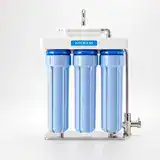
APEC ROES-50
APEC ROES-50
Compare this existing conventional RO choice against your actual daily demand, usable tank storage and feed-water conditions rather than selecting by household size alone.
Compare RO specifications and ongoing costs and match well-water treatment to a water test.
Explore our top picks
Best Reverse Osmosis Systems
Complete RO system rankings
Best Under-Sink Filters
Under-sink filtration options
Best Whole House Filters
Whole home filtration solutions
Best Well Water Filters
Filters for well water homes
Best Water Softeners
Hard water treatment systems
Best Countertop Filters
Portable countertop purification
Frequently Asked Questions
Related Articles
Top-rated Reverse Osmosis Systems
Top-rated RO systems with detailed comparisons
How APEC compares to iSpring RO Comparison
Head-to-head comparison of leading RO brands
How Waterdrop compares to iSpring RO Systems
Compare tankless vs tank RO systems
Walkthrough — RO Installation Guide
Step-by-step RO system installation
RO Maintenance & Troubleshooting (upkeep tips)
Filter replacement schedules and common fixes
See the best Tankless RO Systems Guide
On-demand RO without storage tanks