Whole House Filter for Well Water vs City Water: What You Actually Need in 2026
A whole house filter built for chlorinated city water won't handle iron-laden well water — and vice versa. Here's how each source differs and which system type fits yours.
Know your water source before you buy
The right whole house system depends entirely on where your water comes from and what's in it.
- City water: read your utility's annual Consumer Confidence Report to see chlorine vs chloramine and detected contaminants.
- Well water: get a lab test for bacteria, nitrates, iron, manganese, hardness, pH and sulfide before choosing equipment.
- Check your peak flow needs and whether you have a drain and outlet near the main line — most well systems need both.
Quick Answer
- City water: Carbon-based system for chlorine, chloramine and disinfection byproducts → no drain or power usually needed
- Well water with iron or sulfur smell: Oxidation iron filter with backwash → needs drain and power
- Well water with bacteria risk: Sediment + carbon + UV disinfection → test first, treat iron before UV
- Nitrates or arsenic: Whole house carbon won't fix these → add RO at the drinking tap
Understanding City (Municipal) Water Contamination
Municipal water undergoes treatment at a water utility plant before reaching your home through a network of underground pipes. The treatment process typically includes coagulation/flocculation (removing large particles), sedimentation, filtration, and disinfection with chlorine or chloramine. While this process makes water safe from acute bacterial threats, it introduces its own set of chemical concerns — and the distribution infrastructure itself can add contaminants along the way.
Chlorine and chloramine are the most prevalent city water contaminants. About 70% of U.S. utilities use free chlorine, while 30% use chloramine (a compound of chlorine and ammonia that persists longer in the distribution system). Both are effective disinfectants, but they create disinfection byproducts (DBPs) when they react with organic matter — including trihalomethanes (THMs) and haloacetic acids (HAAs), which are linked to increased cancer risk in epidemiological studies. The EPA regulates THMs at 80 ppb and HAAs at 60 ppb, but health-based guidelines from the EWG suggest much lower thresholds.
PFAS "forever chemicals" are increasingly detected in municipal water supplies. These synthetic compounds, used in non-stick cookware, firefighting foam, and industrial processes, don't break down in the environment and accumulate in the human body. The EPA set an enforceable limit of 4 ppt (parts per trillion) for PFOA and PFOS in 2024 — and many utilities are still working to achieve compliance. Activated carbon filtration removes 70-90% of most PFAS compounds, making whole house carbon filters an important layer of protection.
Lead from aging infrastructure remains a significant concern. An estimated 6-10 million lead service lines still deliver water to American homes, and the EPA's Lead and Copper Rule allows up to 15 ppb of lead at the tap — while health agencies agree there is no safe level of lead exposure. Homes built before 1986 may also have lead solder in their plumbing joints. A whole house filter with KDF-55 media provides some lead reduction, but for maximum protection at the drinking water tap, pair it with an under-sink filter orRO system certified for lead removal.
Common City Water Contaminants
- • Chlorine/Chloramine: 0.5-4 ppm (taste/odor threshold: 0.5 ppm)
- • Trihalomethanes (THMs): Up to 80 ppb allowed
- • Haloacetic Acids (HAAs): Up to 60 ppb allowed
- • PFAS/PFOS: Limit 4 ppt (many utilities non-compliant)
- • Lead: Action level 15 ppb (no safe level exists)
- • Microplastics: 94% of U.S. tap water contains them
- • Pharmaceuticals: Trace levels detected in most supplies
Understanding Well Water Contamination
Approximately 43 million Americans — about 15% of the population — rely on private wells for their drinking water. Unlike municipal supplies, well water receives no treatment and is not monitored by any government agency. The homeowner is solely responsible for testing, treating, and maintaining their water quality. Well water contaminants vary dramatically based on geology, depth, location, and surrounding land use, making comprehensive testing essential before selecting any filtration system.
Iron and manganese are the most common well water quality issues. Dissolved (ferrous) iron gives water a metallic taste and, when exposed to air, oxidizes into ferric iron — the familiar rust-colored particles that stain everything they touch. The EPA's secondary standard for iron is 0.3 ppm, but well water often contains 1-15+ ppm. Manganese above 0.05 ppm creates stubborn black stains and can affect cognitive development in children at high concentrations. Treatment requires oxidation (air injection, chlorine injection, or ozone) followed by filtration — a process completely different from the carbon filtration used for city water. Read our in-depth iron removal guide for detailed treatment options.
Hydrogen sulfide (H₂S) produces the distinctive rotten egg smell that many well water users experience. Created by sulfur-reducing bacteria in groundwater, it's detectable at concentrations as low as 0.05 ppm and corrosive to copper plumbing above 1 ppm. The SpringWell WS1 uses air injection oxidation to convert dissolved H₂S to elemental sulfur for filtration — handling up to 8 ppm without chemicals. This is the same technology used in municipal water treatment but scaled for residential applications.
Bacteria and microbiological contamination is a serious concern for shallow wells (under 100 feet), wells near septic systems, and wells in flood-prone areas. Total coliform bacteria presence indicates potential contamination pathways, and E. coli specifically indicates fecal contamination. While chemical disinfection (chlorination) is effective, UV purification is the preferred residential solution because it adds no chemicals and provides continuous protection. A UV system must be placed after sediment and carbon filtration to ensure water clarity — turbid water reduces UV effectiveness.
Nitrates from agricultural runoff are a growing concern, especially in farming regions. The EPA MCL for nitrates is 10 ppm, and levels above this pose acute health risks for infants (blue baby syndrome). Standard carbon and iron filters do NOT remove nitrates — you need either ion exchange, reverse osmosis, or distillation for nitrate reduction. If your well water tests above 5 ppm nitrates, install a dedicatednitrate removal system at the point of use.
Common Well Water Contaminants
- • Iron: 0.3-15+ ppm (aesthetic + staining issues)
- • Manganese: 0.05-2 ppm (black staining + health concern)
- • Hydrogen Sulfide: 0.05-10 ppm (rotten egg odor)
- • Hardness: 7-50+ GPG (scale, soap inefficiency)
- • Bacteria: Coliform, E. coli (health hazard)
- • Nitrates: 1-50+ ppm near agriculture (infant risk)
- • Sediment: Sand, silt, clay, rust particles
- • Arsenic: Naturally occurring in certain geologies
City Water vs Well Water: Complete Filtration Comparison
| Factor | City Water | Well Water |
|---|---|---|
| Primary Treatment Need | Chlorine/chemical removal | Iron/sulfur/bacteria removal |
| Key Filter Media | Activated carbon + KDF | Oxidation media + carbon + UV |
| Testing Frequency | Check annual CCR report | Test annually minimum |
| Regulatory Oversight | EPA regulated, utility tested | None — homeowner responsible |
| UV Purification Needed | Rarely | Strongly recommended |
| Typical System Cost | $800–$2,000 | $1,500–$4,000 |
| System Complexity | 1-2 stages | 3-5 stages |
| Drain Required | No (upflow carbon) | Yes (backwash iron filters) |
| Electricity Needed | No | Yes (UV + control valves) |
| Maintenance Level | Low | Moderate |
As the comparison shows, well water filtration is inherently more complex and expensive than city water treatment. City water has already been treated for bacteria and large particles, so you're primarily removing chemical residues. Well water may need multi-stage treatment addressing biological, chemical, and physical contaminants simultaneously. This is why testing is non-negotiable for well water — you need to know exactly what you're dealing with to select the right combination of treatment technologies.
Best Whole House Filter Systems by Water Source
Match the system to your water source and test results. These picks cover the most common city and well water scenarios.
Best for City Water
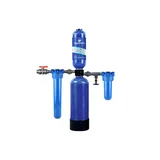
Aquasana Rhino Whole House Water Filter
Aquasana Rhino Whole House Water Filter
Municipal water's main issues are chlorine or chloramine and disinfection byproducts. The Aquasana Rhino is a carbon-based whole house system built for treated city water, with no drain or electricity required for the filter itself.
Compare sizing, treatment options and ongoing costs in our best whole house water filters guide.
Best for Well Water
Match dedicated treatment to your water test and available flow; general filtration, softening and RO are not interchangeable. Compare well-water treatment options.
Compare sizing, treatment options and ongoing costs in our best well water filters guide.
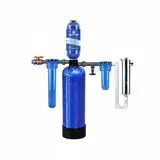
Aquasana Rhino Well Water with UV
Aquasana Rhino Well Water with UV
For wells where bacteria are a concern but iron is low, the Rhino Well Water with UV combines whole house filtration with UV disinfection at the point of entry. Test your well first — high iron should be treated before UV.
Compare sizing, treatment options and ongoing costs in our best well water filters guide.
Installation Differences: City vs Well Water Systems
City water filter installation is relatively straightforward. The system installs at the point of entry (where the main water line enters your home), typically after the water meter and pressure regulator. An upflow carbon filter like the SpringWell CF1 requires no drain connection and no electricity — just pipe cuts and fittings. Most competent DIYers can complete the installation in 2-3 hours. Professional installation adds $200-500 but ensures warranty compliance.
Well water system installation is significantly more complex. Iron filters require a drain connection for backwash (25-65 gallons per backwash cycle, typically occurring every 2-3 days). UV purifiers require a 120V electrical outlet within 6 feet and should be placed after all other filtration stages. Multi-stage systems (iron filter + carbon filter + UV) need adequate physical space — plan for at least 6-8 feet of linear wall space. Professional installation ($500-1,200) is recommended for well water systems due to the additional plumbing and electrical requirements.
For detailed step-by-step instructions, see our whole house filter installation guide. Well water homeowners should also review ourwell water specific installation tips for considerations unique to private well systems, including well pump compatibility and pressure tank placement.
5 Costly Mistakes When Choosing a Whole House Filter
Mistake #1: Using a city water filter on well water. A carbon-only filter won't remove iron, manganese, or bacteria — the primary well water concerns. You'll waste $800-1,500 on a system that doesn't address your actual problems, and the iron may even clog and damage the carbon media within months.
Mistake #2: Skipping the water test. Installing any filtration system without comprehensive testing is like taking medicine without a diagnosis. A $50-150 water test can save you thousands by ensuring you buy the right system the first time. This is especially critical for well water, where contaminant profiles vary dramatically between neighboring properties.
Mistake #3: Ignoring flow rate requirements. An undersized system creates pressure drops during peak usage (multiple showers + dishwasher + laundry running simultaneously). City water homes typically need 7-12 GPM; well water systems must match your well pump's output capacity. Use our flow rate sizing guide to calculate your needs.
Mistake #4: Not planning for maintenance. All systems require periodic maintenance — pre-filter changes every 6-9 months, UV bulb replacement annually ($30-80), salt refills for softeners (monthly), and media replacement every 5-10 years. Factor these ongoing costs into your decision. Our maintenance guide provides detailed schedules for each system type.
Mistake #5: Buying the cheapest system. Budget systems often use inferior media that depletes quickly, provide limited flow rates, lack bypass valves, and come with short warranties. A $500 system that lasts 3 years and needs $200/year in filters costs more over 10 years ($2,500) than a $1,200 SpringWell CF1 with $50/year pre-filters ($1,700). Quality pays for itself — especially when your family's water quality is at stake.
How to Test Your Water Before Buying
Before investing in any whole house filtration system, testing your water is the most important step you can take. For city water, start by reviewing your utility's annual Consumer Confidence Report (CCR) — available online or by calling your water utility. This document lists all detected contaminants and their levels relative to EPA standards. Supplement this with a home water test kit ($30-50) to check for chlorine, hardness, pH, and lead at your specific tap, which may differ from utility-wide averages.
For well water, comprehensive lab testing ($100-400) is essential. Request a panel that includes: bacteria (total coliform and E. coli), nitrates, pH, iron, manganese, hardness, TDS, sulfide, and any regionally relevant contaminants (arsenic, radon, PFAS). Test annually at minimum and after any changes — flooding, nearby construction, new septic systems, or changes in taste/odor/appearance. Keep records of all test results to track trends over time. Read our completeDIY water testing guide for recommended labs and detailed instructions.
Explore Our Top Picks
Best Whole House Filters
Top systems for city and well water
Best Well Water Filters
Iron, sulfur, and bacteria treatment
SpringWell CF1 Review
Best city water whole house filter
SpringWell WS1 Review
Best well water iron filter
Aquasana Rhino Review
10-year whole house filter
Home Water Test Kits
Test before you buy
Frequently Asked Questions
Related Reviews & Guides
Buying guide: Whole House Water Filters
Complete whole house filtration buyer's guide
Is the SpringWell CF4 worth it?
20 GPM whole-house carbon filter for 4-6 bath homes
Aquasana Rhino Max Flow: full review and verdict
NSF-certified pro-grade Aquasana whole-house filter
SpringWell WHF Combo 4 (filter + softener)
CF4 + FutureSoft bundle for hard city water
Aquasana Rhino Pro Grade (UV + salt-free)
Carbon + UV + SimplySoft Aquasana stack
SpringWell CF4 or Aquasana Rhino EQ-1000? Full breakdown
Large-home whole house filter showdown