What hardness numbers mean
Hardness is the amount of dissolved calcium and magnesium in your water. Softener makers measure it in grains per gallon, while labs and city reports usually use mg/L or ppm (the same thing). One grain per gallon equals 17.1 mg/L. Here is the scale most of the water treatment industry uses:
| Level | Grains per gallon | mg/L or ppm | What to expect |
|---|---|---|---|
| Soft | Under 1 | Under 17 | No treatment needed for hardness |
| Slightly hard | 1 to 3.5 | 17 to 60 | Usually no treatment needed |
| Moderately hard | 3.5 to 7 | 60 to 120 | Spots and some scale |
| Hard | 7 to 10.5 | 120 to 180 | Scale on fixtures and water heaters |
| Very hard | Over 10.5 | Over 180 | Heavy scale; a softener usually pays off |
The USGS uses a simpler scale in mg/L, with over 180 counted as very hard; see its hardness of water page. EPA does not set a health limit for hardness.
Ways to test water hardness
| Method | What you get | Best for | Downside |
|---|---|---|---|
| Test strips | A color range in a minute | Quick checks and testing a softener | Hard to read between colors |
| Drop (titration) kit | An exact count in grains per gallon | Sizing a softener yourself | Takes a few minutes and care |
| Lab test | Hardness plus iron, manganese and pH | Wells and before buying equipment | Takes days for results |
| Utility report | Your city's average hardness | A free first look on city water | Not a test of your own tap |
On city water, start with your utility's report; our guide on how to read a water quality report shows where hardness is listed. Compare kits in our water test kits guide, or see well water test kits if you're on a well.
How to test, step by step
Test strips
- Run the cold tap for a minute and fill a clean glass.
- Dip the strip for the time on the package, usually a second or two.
- Wait the stated time, then match the color to the chart in good light.
Drop (titration) kit
- Fill the kit's tube to the marked line with cold water.
- Add drops one at a time, swirling after each, until the color changes.
- Count the drops. On many kits each drop equals 1 grain per gallon; check your kit's instructions.
Lab test
Order a kit, fill the bottle exactly as the lab says and send it back. On a well, ask for iron, manganese and pH as well, because iron uses up softener capacity and changes what you should buy.
To find out how hard your water is, test a tap the softener doesn't treat, such as an outdoor spigot on many homes. To check a softener, test a softened tap: it should read close to zero.
Use your result to size a softener
A common way to estimate the daily load: hardness in grains per gallon × people in the home × 75 gallons. For four people at 15 grains, that is 4,500 grains a day, or about 31,500 a week, so a softener rated around 32,000 grains or more lets it regenerate roughly once a week.
Many sizing guides add extra grains for each ppm of iron, and buying a little larger than the minimum usually uses salt more efficiently. Work through the details in our softener sizing guide, and see the best water softeners to compare options.
Treatment options for hard water
A salt-based softener removes the hardness. A salt-free conditioner doesn't remove it but reduces scale buildup without salt or a drain line.
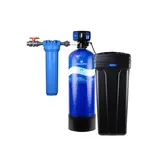
Aquasana SimplySoft 60,000 Grain Softener with LM Pre-Filter
Aquasana SimplySoft 60,000 Grain Softener with LM Pre-Filter
A salt-based softener that removes hardness at every tap. Size it for your household and hardness, and plan for salt, a brine tank and a drain.
Compare sizing, treatment options and ongoing costs in our best water softeners and conditioners guide.
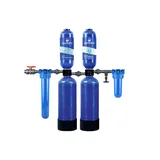
Aquasana Rhino Whole House Salt-Free Water Conditioner
Aquasana Rhino Whole House Salt-Free Water Conditioner
Salt-free scale control with no brine tank or drain line. It reduces scale buildup but does not remove hardness, so compare it with a softener if you want truly soft water.
Compare sizing, treatment options and ongoing costs in our best water softeners and conditioners guide.
Not sure which suits you? Read salt vs saltless softeners.
Bottom line
Test cold, untreated water, write the result in grains per gallon and compare it with the scale above. Under 3.5 rarely needs treatment; above 7 usually justifies a softener or conditioner. Size from your own number, not your city's average, and retest a softened tap every few months. For stains and scale cleanup, see hard water stains.