Well Water Hardness Solutions
Comprehensive guide to softening hard well water and protecting your home
Understanding Well Water Hardness
Over 85% of American homes have hard water, with well water typically harder than city water (average 10-15 GPG vs 3-5 GPG). Hard water isn't a health hazard, but it costs homeowners thousands in appliance damage, plumbing repairs, and cleaning product waste. For wells above 7 GPG, water softening is an investment that pays for itself.
Soft
0-3.5 GPG
No treatment needed
Moderate
3.5-7 GPG
Optional softening
Hard
7-10.5 GPG
Softening recommended
Very Hard
10.5+ GPG
Treatment essential
Effects of Hard Well Water
Hard water creates cascading problems throughout your home. Understanding the true cost helps justify the investment in proper treatment. Here's what hard well water is costing you:
Appliance & Plumbing Damage
- • Water heater failure: Scale reduces efficiency 25-48%, cuts lifespan from 12 years to 6-8 years. Replacement cost: $1,200-2,500.
- • Pipe scaling: ½" pipes reduced to ¼" diameter over 15 years. Reduces flow by 70%, requires $3,000-8,000 repiping.
- • Appliance breakdown: Dishwasher, washing machine lifespan cut 30-50%. Early replacement costs $1,500-3,000.
- • Faucet and fixture damage: Scale buildup clogs aerators, damages seals. Replacement: $200-600 per fixture.
Daily Quality Issues
- • Soap waste: Hard water requires 30-50% more soap/detergent to lather. Annual extra cost: $150-300 for family of four.
- • Cleaning time: Soap scum on tubs, showers, sinks requires 2-3x cleaning effort. Harsh chemicals needed to remove buildup.
- • Laundry problems: Clothes dingy, stiff, wear out faster. Whites turn gray. Towels scratchy and hard.
- • Skin and hair: Dry, itchy skin. Dull, lifeless hair. Soap residue remains after washing.
- • Dishes and glassware: White spots, film on dishes. Glassware becomes cloudy and etched over time.
True Cost of NOT Treating Hard Well Water
Based on 15 GPG well water (common in Midwest and Southwest), family of four, 15-year period:
Water Softening Solutions Compared
Salt-Based Water Softeners (Best for Most Wells)
Ion exchange technology: resin beads exchange sodium (from salt) for calcium and magnesium minerals, physically removing hardness. True softening that delivers slippery feel, perfect soap lather, and zero scale buildup. The proven solution for moderate to very hard well water (7-25+ GPG).
Advantages
- ✓ Completely removes hardness minerals (to 0 GPG)
- ✓ Eliminates scale buildup in pipes and appliances
- ✓ Soap and shampoo lather perfectly (30-50% savings)
- ✓ Soft skin and hair, spotless dishes
- ✓ Extends appliance lifespan 2-3x
- ✓ Works for any hardness level (up to 50+ GPG)
- ✓ Proven technology (60+ years track record)
Limitations
- ✗ Requires salt refills ($50-120/year)
- ✗ Adds sodium to water (not for salt-restricted diets)
- ✗ Regeneration discharges brine (septic concern)
- ✗ Slippery feel (personal preference issue)
- ✗ Uses water during regeneration (30-80 gallons)
Best For:
Any well water over 7 GPG. Essential for very hard water (10+ GPG). Homeowners wanting complete mineral removal. Those without sodium restrictions or septic concerns.
Top Systems:
- • SpringWell SS1: $900-1,400 | Best overall | Lifetime warranty | High efficiency
- • Fleck 5600SXT: $600-900 | Budget pick | Proven reliability | DIY-friendly
- • Aquasana Rhino: $2,000+ | Softening + filtration combo | Salt-free option available
Salt-Free Water Conditioners (TAC/Template Assisted Crystallization)
Template-assisted crystallization (TAC) media converts hardness minerals into microscopic crystals that won't adhere to surfaces. Minerals remain in water but don't form scale. NOT true softening—doesn't improve soap lather or remove minerals. Best for moderate hardness when scale prevention is primary goal.
Advantages
- ✓ No salt, electricity, or drain needed
- ✓ Prevents scale buildup (90-95% effective)
- ✓ Maintains healthy minerals in water
- ✓ No sodium added (safe for diets)
- ✓ Septic and environment-friendly
- ✓ Minimal maintenance (media lasts 3-6 years)
Limitations
- ✗ Does NOT remove hardness minerals
- ✗ No improvement in soap lather
- ✗ Water still tests as "hard"
- ✗ Skin/hair benefits minimal
- ✗ Higher upfront cost ($1,200-2,500)
- ✗ Limited effectiveness above 15 GPG
- ✗ Not ideal for very hard wells (10+ GPG)
Best For:
Moderate hardness (7-12 GPG). Homeowners primarily concerned with scale prevention, not soap performance. Salt-restricted diets. Septic systems. Want maintenance-free solution. Don't care about "soft water feel."
Dual-Tank Salt-Based Systems (High Demand)
Two resin tanks alternate service—one softens while other regenerates. Provides continuous soft water 24/7 with no bypass during regeneration. Essential for large families, high water usage, or commercial applications. More expensive but eliminates any interruption in soft water supply.
Advantages
- ✓ Continuous soft water (no hard water periods)
- ✓ Ideal for large homes (4+ bathrooms)
- ✓ Handles peak demand without pressure drop
- ✓ Regenerates on-demand (no scheduled downtime)
Limitations
- ✗ Higher cost ($1,500-3,000+)
- ✗ Larger footprint (two tanks)
- ✗ More complex installation
- ✗ Overkill for most residential applications
Best For:
Large families (6+ people). Homes with 4+ bathrooms. High daily water usage (400+ gallons/day). Wells with extreme hardness (20+ GPG). Commercial or rental properties requiring 24/7 soft water.
Combination Well Water Systems (Iron + Hardness)
Many wells have both iron and hardness. CRITICAL: Install dedicated iron filter BEFORE water softener. Iron above 2 ppm fouls softener resin, requiring frequent cleaning and early replacement. Combination systems handle both contaminants efficiently.
⚠️ Critical Well Water Rule:
Never send iron-containing water (>1 ppm) directly to softener. Iron fouls resin permanently. Correct sequence: Sediment filter → Iron filter → Water softener → (optional) Carbon filter for taste/odor.
Recommended System Sequence:
Sediment Pre-Filter
5-10 micron to remove sand, silt, rust particles
Iron Removal Filter
Air injection or greensand system for iron 3-15 ppm
Water Softener
Salt-based softener sized for hardness level
Carbon Filter (Optional)
For taste, odor, or chlorine removal if needed
Sizing Your Well Water Softener
Proper sizing is critical. Undersized systems regenerate too frequently, wasting salt and water. Oversized systems cost more upfront and may not regenerate enough, allowing bacterial growth. Follow this 3-step sizing process:
Step 1: Determine Daily Water Usage
Average household: 80-100 gallons per person per day. Check actual usage on water bill or well pump meter if available.
Step 2: Test Water Hardness
Professional test: $20-50. Accurate to 0.1 GPG. Home test strips: $10-15, less accurate but sufficient for sizing. Test both hardness AND iron—both affect capacity.
If iron present: Add 3 GPG to hardness for every 1 ppm iron. Example: 10 GPG hardness + 2 ppm iron = 16 "compensated hardness" for sizing.
Step 3: Calculate Required Capacity
Formula: Daily Water Usage × Hardness × 7 days = Minimum Grain Capacity
Example: 400 gallons/day × 15 GPG × 7 days = 42,000 grains minimum
Standard Softener Sizes:
Installation Guide
Pre-Installation Requirements
- • Location: Indoor (basement, utility room, garage). Near water main and drain.
- • Space: 2×3 feet for tank + brine tank. 18" clearance for service access.
- • Plumbing: Install after pressure tank but BEFORE water heater. If iron present, install after iron filter.
- • Drain: Floor drain or utility sink within 20 feet for brine discharge.
- • Electrical: 110V outlet for electronic control valve (within 6 feet).
- • Water pressure: 25-80 PSI optimal. Install pressure regulator if >80 PSI.
DIY Installation Steps
Shut Off Water and Drain System
Turn off main water. Open lowest faucet to drain pressure. Drain water heater if softener installing before it.
Cut Main Water Line
Cut pipe after pressure tank. Use appropriate method for pipe type (copper solder, PEX crimps, or SharkBite fittings). Leave 3-4 feet accessible pipe each side.
Install Bypass Valve Assembly
Connect bypass valve to softener inlet/outlet. Allows water flow during maintenance. Use union fittings for easy removal. Apply Teflon tape to threads.
Connect Drain Line and Overflow
Run ½" drain tubing from brine tank overflow and softener drain to floor drain. Must be air-gap (open end). Secure tubing to prevent siphoning.
Fill Brine Tank with Salt
Add water softener salt (pellets or crystals) to brine tank. Fill to half-full initially. Connect brine line from tank to control valve. Add water to just cover salt bottom.
Program Control Valve
Set hardness level, regeneration time (2-3 AM recommended), regeneration frequency (based on water usage). Most systems auto-calculate based on hardness and daily gallons.
Startup and Testing
Slowly open water inlet. Check for leaks. Manually initiate regeneration cycle. After 24 hours, test softened water with hardness test strips (should be 0-1 GPG). Adjust settings if needed.
Professional Installation Considerations
Cost: $500-1,000 depending on complexity. Worth it if:
- • Limited plumbing experience
- • Existing plumbing needs modification (galvanized pipe, complex routing)
- • Well system requires integration with multiple treatment stages
- • Local permits required for water treatment installation
- • Warranty requires professional installation for coverage
Best Water Softeners for Wells 2026
Top-rated salt-based and salt-free water softening systems for well water
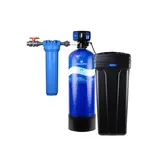
Aquasana SimplySoft 60,000 Grain Softener with LM Pre-Filter
Aquasana SimplySoft 60,000 Grain Softener with LM Pre-Filter
Salt-based hardness removal. Size the softener for your household and plan for salt, a brine tank and a drain.
Aquasana SimplySoft
Aquasana SimplySoft
Salt-Free Conditioner
Salt-free scale prevention, 6-year lifespan
Culligan WHD200
Culligan WHD200
Premium Softener
Demand-initiated, low salt usage, local support
Well Water Softener Costs
Initial Costs
Ongoing Costs
Maintenance Schedule
Monthly
Check Salt Level
Maintain salt at least half-full in brine tank. Top up when drops below 1/4 full to ensure proper regeneration.
Quarterly
Clean Brine Tank
Remove salt crust ('salt bridge') and sediment buildup. Break up any hardened salt chunks blocking brine draw.
Semi-Annual
Inspect Resin Bed
Check for resin fouling from iron or sediment. Run iron-out cleaner if iron present in well water.
Annual
System Performance Test
Test hardness of softened water (should be 0-1 GPG). Adjust regeneration settings if needed. Inspect valves and seals.
10-15 Years
Resin Replacement
Replace exhausted resin bed. Signs: hardness breakthrough, reduced capacity, discolored water after regeneration.
Explore Our Top Picks
Best Whole House Filters
Top-rated systems for complete home filtration
Best Water Softeners
Salt-based and salt-free softener reviews
Water Softener Maintenance
Keep your softener running efficiently
Sizing a Water Softener
Calculate the right size for your household
Brine Tank Maintenance
Salt bridges, mushing, and cleaning tips
Sulfur Removal Guide
Eliminate rotten egg smell from well water
Well Water Testing Schedule
What to test and how often
UV Water Purifiers
Bacteria treatment for well water
Best Under-Sink Filters
Point-of-use filtration for drinking water
Best Reverse Osmosis Systems
Multi-stage purification for well water
Water Filter Test Kits
DIY and lab testing options
Best Countertop Filters
No-install filtration for any kitchen
Best Shower Filters
Reduce hard water effects in your shower
Related Water Softening Guides
Side-by-side: SpringWell WS4 vs Aquasana Rhino Well Pro
Large home well water comparison
Our hands-on Aquasana Rhino Pro Grade review
UV + carbon + softener combo for borderline wells
Buying guide: Well Water Filters
Complete well water filtration buyer's guide
Well Water Whole House Systems
Multi stage whole house treatment for wells
Well Water Bacteria Treatment
UV, chlorination, and disinfection methods
Read: Well Water Rust Removal
Iron and manganese treatment solutions