Reverse Osmosis: Pros and Cons (2026)
What reverse osmosis does well, where it falls short, what it costs to run and who actually needs one, so you can decide before you spend money on a system.
Check whether you need RO before you buy
RO is the broadest home treatment, but it is overkill for some water. Confirm what's in yours first.
- Test for lead, arsenic, nitrates, PFAS and TDS — these are the problems RO solves best.
- If chlorine taste is your only complaint, a carbon filter is cheaper and wastes no water.
- Measure cabinet space and check for a nearby outlet if you're considering a tankless unit.
Quick Answer
- Biggest pro: Removes the widest range of dissolved contaminants, including lead, PFAS, nitrates and arsenic
- Biggest con: Sends some water to the drain and strips minerals → choose tankless or remineralization models
- Best for: Drinking and cooking water at one tap, especially with health-related contaminants
- Skip it if: You only need chlorine taste fixed or want whole house treatment
The Pros
Broadest filtration
Reduces most dissolved contaminants, including lead, arsenic, PFAS, nitrates and fluoride. Check the certification for each contaminant you care about.
Independent certification available
Many RO systems are certified to NSF/ANSI 58. Check each listing for the specific contaminants a model is certified to reduce.
Cleaner taste
A neutral flavor many people prefer for coffee, tea and ice.
Cheap long term
About $0.03 to $0.07 per gallon. Pays for itself within a year for most bottled water buyers.
Low maintenance
Filter swaps take five minutes, once or twice a year. $50 to $120 annually.
The Cons
Water waste
Older systems waste 3 to 4 gallons per gallon produced. Newer tankless models waste much less. Reject water works fine for plants or cleaning.
Mineral removal
Strips 90 to 99% of dissolved minerals. Most systems offer a remineralization stage if you want it back.
Fluoride removal
Removes 85 to 95% of fluoride. Add a fluoride post filter or rely on toothpaste if needed.
Higher upfront cost
$200 to $500 for under sink, $300 to $500 for countertop. Five year totals still beat pitchers.
Install needed (under sink)
Basic DIY plumbing, 1 to 2 hours. Countertop models skip install entirely.
Who Should Get One
RO fits you if
- Your water has lead, arsenic or PFAS
- TDS above 300 ppm
- You spend $40+ a month on bottled water
- You want the most thorough filtration
- You have well water with multiple issues
- You cook, brew or have infants at home
Skip RO if
- You only need chlorine taste fixed
- TDS already below 100 ppm
- You want whole house treatment
- Budget is under $100
- You prefer mineral rich water
- Water conservation is the priority
RO vs Other Technologies
| Tech | Lead | PFAS | TDS | Best for |
|---|---|---|---|---|
| Reverse Osmosis | 99%+ | 95 to 99% | Yes | Full purification |
| Carbon block | 99% (NSF 53) | 60 to 90% | No | Chlorine, taste, lead |
| Pitcher | Varies | Varies | No | Basic taste |
| Whole house carbon | No | Partial | No | Chlorine everywhere |
| Distillation | 99%+ | 99%+ | Yes | Lab grade water |
Environment: RO vs Bottled
RO system (per year)
- About 1,500 gallons of reject water
- 2 to 3 small filter cartridges
- Tiny carbon footprint
- $60 to $140 ongoing
Bottled water (family of 4)
- 700 to 1,400 plastic bottles
- Only 30% are recycled
- Heavy manufacturing and transport
- $600 to $1,800 a year
RO Systems to Compare
If the pros outweigh the cons for your home, start with these two under-sink systems. Both add minerals back after the membrane, which answers the flat-taste complaint. Open each deal for the current price.
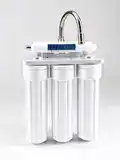
Aquasana OptimH2O Reverse Osmosis + Claryum
Aquasana OptimH2O Reverse Osmosis + Claryum
An under-sink RO system that pairs the membrane with Aquasana's Claryum carbon stage and a remineralizer. Check Aquasana's current performance data sheet for the exact contaminants it is certified to reduce before relying on a specific claim.
Compare sizing, treatment options and ongoing costs in our best reverse osmosis systems guide.

iSpring RCC7AK 6-Stage RO System
iSpring RCC7AK 6-Stage RO System
Answers the upfront-cost con: a tank-based six-stage system with an alkaline remineralization stage. It needs cabinet space for the tank and a drain connection, but no power outlet.
Compare sizing, treatment options and ongoing costs in our best reverse osmosis systems guide.
Compare more options in our best reverse osmosis systems guide. Need whole home treatment instead? See whole house filters.
5 Year Cost of Ownership
| System | Upfront | Filters / yr | 5 yr total | $ / gal |
|---|---|---|---|---|
| Tank under-sink RO | $200 to $500 | $50 to $100 | $450 to $1,000 | $0.03 to $0.06 |
| Tankless under-sink RO | $350 to $700 | $60 to $120 | $650 to $1,300 | $0.03 to $0.06 |
| Countertop RO | $300 to $500 | $80 to $120 | $700 to $1,100 | $0.05 to $0.08 |
| Bottled water | $0 | $600 to $1,200 | $3,000 to $6,000 | $0.50 to $1.00 |
Bottom Line
RO reduces the widest range of dissolved contaminants of any common home filter. Its trade-offs (drain water, mineral loss, cabinet space) are real but manageable. If your test shows lead, PFAS, arsenic or nitrates, an RO system certified for that contaminant is usually the strongest single-tap choice. If you just need chlorine taste fixed, a simple carbon filter works. Compare options in our RO system reviews or the distiller vs RO guide.
Frequently Asked Questions
Explore More
Related Reviews & Guides
How APEC compares to iSpring RO
Head-to-head comparison of leading RO brands
How Waterdrop compares to iSpring
Tankless vs tank RO system showdown
Brita versus PUR Pitchers — which wins
The two most popular pitcher brands compared
How Aquasana compares to Berkey
Premium countertop filter comparison
How SpringWell compares to Aquasana
Whole house filter brand face-off
How Salt-Based compares to Salt-Free Softeners
Which softener technology is right for you?